


Page 1279 - Hall et al (2015) Principles of Critical Care-McGraw-Hill
P. 1279
886     PART 7: Hematologic and Oncologic Disorders


                 Clostridium difficile infection presents with diarrhea and can be treated   patients at high risk of reactivation of the latter. Reactivation of myco-
                 with oral metronidazole.                              bacterial infections may be present as localized to the lung or dissemi-
                   Culture-negative, neutropenic fevers which persist despite appropri-  nation disease and atypical forms are more common. The T cells in the
                 ate antibiotic coverage, especially in patients with a history of prolonged   cord blood transplant patients are much more naïve than those in the
                 neutropenia prior to transplant, should trigger an evaluation for hepatic   volunteer donor grafts, and viral infections play a greater role in infec-
                 and sinopulmonary fungal infections. Many transplant centers will use   tious complications of cord blood transplants.
                 prophylaxis for fungal organisms most characteristic of their location
                 but persistent neutropenic fevers, especially in the setting of imaging     ■  LATER POSTTRANSPLANT
                 studies consistent with invasive fungal infection will also require adjust-  Most patients have adequate neutrophil counts. Mucosal barriers
                 ment of antifungal therapy. 40,41                     destroyed during chemotherapy and radiotherapy are now restored, but
                     ■  POSTENGRAFTMENT                                may again be disrupted by GI involvement with GVHD—again increas-

                 Patients have recovered their neutrophil counts but often continue to   ing the risk of gram-negative bacteremia. Opportunistic infections due to
                                                                       delayed recovery of immune function (T and B cells) are also observed
                 need central venous catheters for treatments. Bacterial infections thus   during this period. Bacterial infections to be considered, especially in
                 remain a risk but to a lesser degree than when the patient is neutropenic.   the setting of treatment for GVHD, are those observed with immuno-
                 T-cell function is suppressed by medications used to prevent GVHD   globulin deficiency—encapsulated organisms such as  Pneumococcus,
                 in the posttransplant period. B-cell production of immunoglobulins is   Haemophilus influenzae, and Klebsiella spp. Often patients with delayed
                 reduced and may recover more slowly after unrelated and mismatched   B-cell immunoglobulin recovery especially in the setting of GVHD will
                 transplants compared to matched, related transplants. Immunoglobulin   receive prophylaxis for encapsulated organisms. The development of
                 levels are monitored early posttransplant and according to recom-  these infections in the immunocompromised patient can be life threat-
                 mendations from the Centers for Disease Control (CDC), should be   ening and result in ICU admission. Community-acquired pneumonias
                 repleted for levels <400 to reduce the risk of infections. Opportunistic   should  be  considered  in  the  differential  diagnosis  of  fevers  and  pul-
                 and viral infections now play a greater role. With the universal practice   monary symptoms during this time. Community-acquired respiratory
                 of prophylaxis with acyclovir, infections by herpes simplex or varicella   viruses such as influenza, parainfluenza, respiratory syncytial virus,
                 are exceedingly rare in the early postengraftment period. Similarly,   adenovirus, and less commonly metapneumovirus  have been associated
                                                                                                           45
                 Pneumocystis jiroveci pneumonia (PCP) in a patient who has received   with lower respiratory infections and substantial morbidity and mortality
                 adequate prophylaxis is also very uncommon. It should be considered   in HSCT patients. The risk of reactivation of a mycobacterial infection
                 if patient compliance with prophylaxis is in question. A history of cyto-  continues until immune recovery and is greater when additional immu-
                 megalovirus (CMV) in the patient or donor and previous Epstein-Barr   nosuppressive therapy is needed to treat GVHD. Disease caused by
                 virus (EBV) infection in the patient can result in reactivation of these   resistant herpes viruses may occur in the late postengraftment period
                 viral infections posttransplant. A list of viral infections which should   especially in the setting of prolonged exposure to antivirals for prophy-
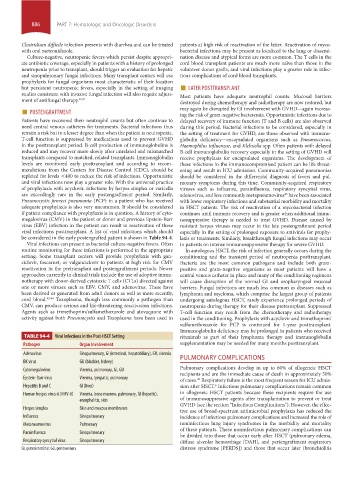
                 be considered in the early postengrafted patient is shown in Table 94-4.  laxis or treatments. Similarly, breakthrough fungal infections may occur
                   Viral infections can present as bacterial culture-negative fevers. Often   in patients on intense immunosuppressive therapy for severe GVHD.
                 routine monitoring for these infections is performed in the appropriate   In autologous HSCT, the risk of infection generally occurs during the
                 setting. Some transplant centers will provide prophylaxis with gan-  conditioning and the transient period of neutropenia posttransplant.
                 ciclovir, foscarnet, or valganciclovir to patients at high risk for CMV   Bacteria are the most common pathogens and include both gram-
                 reactivation in the pretransplant and postengraftment periods. Newer   positive and gram-negative  organisms  as most patients will have  a
                 approaches currently in clinical trials include the use of adoptive immu-  central venous catheter in place and many of the conditioning regimens
                 notherapy with donor-derived cytotoxic T cells (CTLs) directed against   will cause disruption of the normal GI and oropharyngeal mucosal
                 one or more viruses such as EBV, CMV, and adenovirus. These have   barriers. Fungal infections are much less common as diseases such as
                 been derived or generated from adult donors as well as more recently,   lymphoma and myeloma, which comprise the largest group of patients
                 cord blood. 42-44  Toxoplasma, though less commonly a pathogen than   undergoing autologous HSCT, rarely experience prolonged periods of
                 CMV, can produce serious and life-threatening reactivation infections.   neutropenia during therapy for their disease pretransplant. Suppressed
                 Agents such as trimethoprim/sulfamethoxazole and atovaquone with   T-cell function may result from the chemotherapy and radiotherapy
                 activity against both Pneumocystis and Toxoplasma have been used in   used in the conditioning. Prophylaxis with acyclovir and trimethoprim/
                                                                       sulfamethoxazole for PCP is continued for 1-year posttransplant.
                                                                       Immunoglobulin deficiency may be prolonged in patients who received
                   TABLE 94-4    Viral Infections in the Post-HSCT Setting  rituximab as part of their lymphoma therapy and immunoglobulin
                  Pathogen           Organ Involvement                 supplementation may be needed for many months posttransplant.
                  Adenovirus         Sinopulmonary, GI (intestinal, hepatobiliary), GU, viremia  PULMONARY COMPLICATIONS
                  BK virus           GU (bladder, kidney)
                  Cytomegalovirus    Viremia, pulmonary, GI, GU        Pulmonary complications develop in up to 60% of allogeneic HSCT
                                                                       recipients and are the immediate cause of death in approximately 50%
                  Epstein-Barr virus  Viremia, lympatic, pulmonary     of cases.  Respiratory failure is the most frequent reason for ICU admis-
                                                                             46
                  Hepatitis B and C  GI (liver)                        sion after HSCT.  Infectious pulmonary complications remain common
                                                                                   6
                  Human herpes virus-6 (HHV-6)  Viremia, bone marrow, pulmonary, GI (hepatic),   in allogeneic HSCT patients because these recipients require the use
                                       encephalitis, skin              of immunosuppressive agents after transplantation to prevent or treat
                                                                       GVHD (see the section “Infectious Complications”). However, the effec-
                  Herpes simplex     Skin and mucous membranes
                                                                       tive use of broad-spectrum antimicrobial prophylaxis has reduced the
                  Influenza          Sinopulmonary                     incidence of infectious pulmonary complications and increased the role of
                  Metaneumovirus     Pulmonary                         noninfectious lung injury syndromes in the morbidity and mortality
                                                                       of these patients. These noninfectious pulmonary complications can
                  Parainfluenza      Sinopulmonary
                                                                       be divided into those that occur early after HSCT (pulmonary edema,
                  Respiratory syncytial virus  Sinopulmonary           diffuse alveolar hemorrhage [DAH], and periengraftment respiratory
                 GI, gastrointestinal; GU, genitourinary.              distress syndrome [PERDS]) and those that occur later (bronchiolitis


            section07.indd   886                                                                                       1/21/2015   7:43:04 AM

