


Page 1276 - Hall et al (2015) Principles of Critical Care-McGraw-Hill
P. 1276
CHAPTER 94: Hematopoietic Stem Cell Transplantation and Graft-Versus-Host Disease  883


                                                                          its inherent risks for infection. Often narcotic analgesics are needed for
                      TABLE 94-2    Drugs Used in Conditioning a
                                                                          pain management—compounding the issues of nausea and producing
                    Busulfan—alkylating agent  Hepatotoxicity, mucositis, seizures, darkening of the   somnolence. In addition to their marrow suppressive effects, many of
                                        skin, cataracts                   the  agents  used  for  conditioning  in  the  allogeneic  transplant  setting
                    Carmustine—alkylating agent  Infusion pain and burning of the face, hepatotoxicity,   are also lymphocytotoxic—producing immunosuppression, and thus
                                          nausea, vomiting, hypotension, pulmonary fibrosis  expanding the spectrum of pathogens to which the patient is susceptible
                                                                          (see the section “Infectious Complications”).
                    Cyclophosphamide—alkylating   Electrolyte imbalances, cardiomyopathy, SIADH,
                    agent                 nausea, vomiting, diarrhea, hemorrhagic cystitis  In the case of autologous HSCT, the conditioning includes only the
                                                                          high-dose chemotherapy, radiotherapy, and/or monoclonal antibody
                    Cytosine arabinoside—   Nausea, vomiting, diarrhea, neurotoxicity, ocular irrita-  therapy, and does not require immunosuppression. As a consequence,
                    antimetabolite      tion, capillary leak syndrome, hand-foot syndrome  the complications are due to the direct toxic effect of this therapy
                    Etoposide—topoisomerase II   Infusion hypotension/hypertension, acidosis during   and the resulting cytopenias.
                    inhibitor             infusion, nausea, vomiting, diarrhea, rash, mucositis  Additional agents that may be used during the conditioning in allo-
                    Fludarabine—antimetabolite  Nausea, vomiting, fever, immunosuppression  geneic HSCT include antithymocyte globulin and immunosuppressive
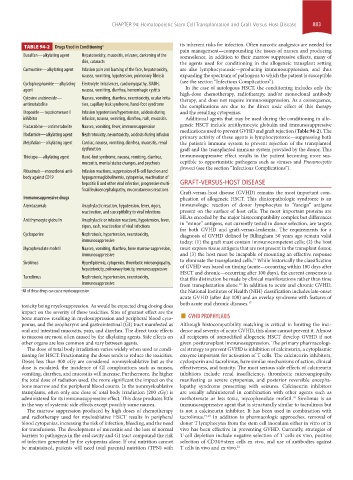
                                                                          medications used to prevent GVHD and graft rejection (Table 94-2). The
                    Ifosfamide—alkylating agent  Nephrotoxicity, neurotoxicity, acidosis during infusion
                                                                          primary activity of these agents is lymphocytotoxic— suppressing both
                    Melphalan—alkylating agent  Cardiac, nausea, vomiting, diarrhea, mucositis, renal   the patient’s immune system to prevent rejection of the   transplanted
                                        dysfunction                       graft and the transplanted immune system provided by the donor. This
                    Thiotepa—alkylating agent  Hand-foot syndrome, nausea, vomiting, diarrhea,   immunosuppressive effect results in the patient becoming more sus-
                                          mucositis, mental status changes, and psychosis   ceptible to opportunistic pathogens such as viruses and Pneumocystis
                                                                          jiroveci (see the section “Infectious Complications”).
                    Rituximab—monoclonal anti-  Infusion reactions, suppression of B-cell function and
                    body against CD19   hypogammaglobulinemia, cytopenias, reactivation of
                                        hepatitis B and other viral infection, progressive multi-  GRAFT-VERSUS-HOST DISEASE
                                        focal leukoencephalopathy, mucocutaneous reactions
                                                                          Graft-versus-host disease (GVHD) remains the most important com-
                    Immunosuppressive drugs                               plication of allogeneic HSCT. This clinicopathologic syndrome is an
                    Alemtuzumab         Anaphylactic reaction, hypotension, fever, rigors,   immunologic reaction of donor lymphocytes to “foreign” antigens
                                          reactivation, and susceptibility to viral infections  present on the surface of host cells. The most important proteins are
                                                                          HLAs encoded by the major histocompatibility complex but differences
                    Antithymocyte globulin  Anaphylactic or infusion reactions, hypotension, fever,   in “minor” antigens, not currently tested in donor selection, are targets
                                        rigors, rash, reactivation of viral infections
                                                                          for both GVHD and graft-versus-leukemia. The requirements for a
                    Cyclosporine        Nephrotoxic, hypertension, neurotoxicity,   diagnosis of GVHD defined by Billingham 50 years ago remain valid
                                          immunosuppressive               today: (1) the graft must contain immunocompetent cells; (2) the host
                    Mycophenolate mofetil  Nausea, vomiting, diarrhea, bone marrow suppression,   must express tissue antigens that are not present in the transplant donor,
                                        immunosuppressive                 and (3) the host must be incapable of mounting an effective response
                                                                          to eliminate the transplanted cells.  While historically the classification
                                                                                                  15
                    Sirolimus           Hyperlipidemia, cytopenias, thrombotic microangiopathy,   of GVHD was based on timing (acute—occurring within 100 days after
                                        hepatotoxicity, pulmonary toxicity, immunosuppressive
                                                                          HSCT and chronic—occurring after 100 days), the current consensus is
                    Tacrolimus          Nephrotoxic, hypertension, neurotoxicity,   that this distinction be made by clinical manifestations rather than time
                                          immunosuppressive               from transplantation alone.  In addition to acute and chronic GVHD,
                                                                                              16
                    a All of these drugs can cause myelosuppression.      the National Institutes of Health (NIH) classification includes late-onset
                                                                          acute GVHD (after day 100) and an overlap syndrome with features of
                    toxicity being myelosuppression. As would be expected drug dosing does   both acute and chronic diseases. 17
                    bone marrow resulting in myelosuppression and peripheral blood cyto-  ■  GVHD PROPHYLAXIS
                    impact on the severity of these toxicities. Sites of greatest effect are the
                    penias, and the oropharynx and gastrointestinal (GI) tract manifested as   Although histocompatibility matching is critical in limiting the inci-
                    oral and intestinal mucositis, pain, and diarrhea. The direct toxic effects   dence and severity of acute GVHD, this alone cannot prevent it. Almost
                    to mucosa are most often caused by the alkylating agents. Side effects on   all recipients of unmodified allogeneic HSCT develop GVHD if not
                    other organs are less common and vary between agents.  given posttransplant immunosuppression. The primary pharmacologi-
                     The dose of total body irradiation varies widely when used as condi-  cal strategy to prevent GVHD is inhibition of calcineurin, a cytoplasmic
                    tioning for HSCT. Fractionating the doses tends to reduce the toxicities.   enzyme important for activation of T cells. The calcineurin inhibitors,
                    Doses less than 900 cGy are considered nonmyeloablative but as the   cyclosporin and tacrolimus, have similar mechanisms of action, clinical
                    dose is escalated, the incidence of GI complications such as nausea,   effectiveness, and toxicity. The most serious side effects of calcineurin
                    vomiting, diarrhea, and mucositis will increase. Furthermore, the higher   inhibitors include renal insufficiency, thrombotic microangiopathy
                    the total dose of radiation used, the more significant the impact on the   manifesting as severe cytopenias, and posterior reversible encepha-
                    bone marrow and the peripheral blood counts. In the nonmyeloablative   lopathy syndrome presenting with seizures. Calcineurin inhibitors
                    transplants, often only one dose of total body irradiation (200 cGy) is   are usually administered in combination with other agents such as
                    administered for its immunosuppressive effect. This dose produces little   methotrexate or less toxic, mycophenolate mofetil.  Sirolimus is an
                                                                                                                18
                    in the way of systemic side effects except possibly some nausea.  immunosuppressive agent that is structurally similar to tacrolimus but
                     The marrow suppression produced by high doses of chemotherapy   is not a calcineurin inhibitor. It has been used in combination with
                    and radiotherapy used for myeloablative HSCT results in peripheral   tacrolimus. 19,20   In  addition  to  pharmacologic  approaches,  removal  of
                    blood cytopenias, increasing the risk of infection, bleeding, and the need   donor T lymphocytes from the stem cell inoculum either in vitro or in
                    for transfusions. The development of mucositis and the loss of normal   vivo has been effective in preventing GVHD. Currently, strategies of
                    barriers to pathogens in the oral cavity and GI tract compound the risk   T-cell depletion include negative selection of T cells ex vivo, positive
                    of infection generated by the cytopenias alone. If oral nutrition cannot   selection of CD34+stem cells ex vivo, and use of antibodies against
                    be maintained, patients will need total parental nutrition (TPN) with   T cells in vivo and ex vivo. 21


            section07.indd   883                                                                                       1/21/2015   7:43:03 AM

