


Page 1277 - Hall et al (2015) Principles of Critical Care-McGraw-Hill
P. 1277
884     PART 7: Hematologic and Oncologic Disorders

                     ■  ACUTE GVHD                                     Diagnosis and Management:  The diagnosis of acute GVHD is rarely

                 Incidence:  Overall, the incidence of moderate-to-severe acute GVHD   straightforward. Dermatitis, jaundice, and enteritis in the transplant
                 with HLA identical siblings ranges from <10% to 60% depending on   setting have a variety of potential etiologies including but not limited to
                                      21
                 prophylaxis and risk factors.  The frequency of acute GVHD is directly   GVHD. Toxicity from chemoradiotherapy, supportive medications, or
                 related to the degree of mismatch between the patient and donor    infection must be considered, as well as transplant-specific complica-
                 HLA proteins. The incidence increases with patient age and degree     tions such as hepatic venoocclusive disease. Biopsies can be helpful but
                 of HLA disparity between the host and the donor. Other contributing fac-  often fail to provide a definitive diagnosis. Furthermore, a diagnosis
                 tors are the use of an unrelated donor, the number of T cells transplanted,   supported by clinical presentation and even biopsy does not eliminate
                 the sex mismatching and donor parity, the severity of tissue injury     the possibility of coexisting conditions. Repeat blood cultures and histo-
                 during cytoreduction, and the type of prophylaxis used.  logic evaluation for organ invasive viral or other opportunistic infections
                                                                       should be prompted by persistent fever and symptoms. In addition, signs
                 Pathophysiology:  Although the principal effector cells responsible for   and symptoms in any organ not responding to treatment for presumed
                 GVHD are the immunocompetent donor cytotoxic T lymphocytes, the   acute GVHD should trigger further evaluation.
                 first step of acute GVHD entails the activation of antigen presenting cells   Treatment for established acute GVHD necessitates additional immu-
                                                                                                                          23
                 (APCs) in the host.  Host tissues, damaged by the underlying disease,   nosuppressive therapy. First-line treatment is generally  corticosteroids.
                               22
                 previous infections, as well as the transplant conditioning regimen itself,   With mild to moderate involvement of skin and upper GI tract, topical
                 respond by producing “danger signals” including proinflammatory     formulations may be adequate, steroid creams for skin and oral
                 cytokines and costimulatory molecules, resulting in APC activation.    budesonide for upper GI tract. Systemic corticosteroids are the standard
                                                                    23
                 The  second  step  follows  APC  activation  and  includes  the  prolifera-  treatment if there is lack of response to local steroids, or for treatment of
                 tion and activation of donor T cells. Activation of donor immune cells   hepatic or lower GI involvement. No randomized trials have established
                 results in rapid biochemical cascades that induce transcription of genes   a regimen superior to  corticosteroids  as primary treatment for acute
                                                                                                                      30
                 for many cytokines and their  receptors  (interferon-γ,  interleukin-2,   GVHD nor has any study determined the most efficacious dose.  The
                 and TNF-α). These molecules work synergistically with donor cells in     conventional starting dose is methylprednisolone 1 to 2 mg/kg daily
                 producing the third effector step of GVHD, thereby amplifying local   with a taper of approximately 10% per week once symptoms improve
                 tissue injury and promoting target tissue destruction.  although this approach is highly personalized. Unfortunately, complete
                                                                       remission rates from systemic steroids are less than 50%, and more
                 Clinical Features:  The hallmarks of acute GVHD at onset include involve-  severe GVHD is less likely to respond to treatment.  The survival rates
                                                                                                            31
                 ment of the skin (81% of patients), gastrointestinal tract (54%), and liver   for steroid-resistant GVHD are quite poor, and death is most often due
                 (50%).  Skin involvement is the most frequent and earliest manifestation   to infection.
                      24
                 of acute GVHD. The typical presentation of skin GVHD is a pruritic, mac-  There is no standard of care for second-, third-, or fourth-line therapy
                 ulopapular rash that can spread throughout the body but spares the scalp.   for acute GVHD in the setting of steroid resistance and disease progres-
                 Severe cases can cause diffuse blistering and ulceration. Gastrointestinal-  sion. Agents that have been used include calcineurin inhibitors, sirolimus
                 tract involvement usually presents with large volume (>2 L/day) diarrhea   or mycophenolate (if not used for prophylaxis), antithymocyte globulin,
                 but can also include vomiting, anorexia, abdominal pain, or bleeding.   daclizumab, infliximab, etanercept, ontak, and pentostatin. Mesenchymal
                 Hepatic GVHD often manifests with jaundice, cholestasis, and to a lesser   stem cell infusions are a more recent approach that has shown promising
                 degree transaminitis. It can be difficult to distinguish GVHD from other   results in clinical trials, especially in patients with GI involvement. 32,33
                 causes of hepatic dysfunction and a biopsy may be helpful for diagnosis.   Immunosuppression in patients undergoing treatment for acute
                 The severity of GVHD is commonly determined by staging the extent   GVHD can be profound and continued surveillance for viral, bacte-
                 of involvement of the three main target organs described (skin, GI tract,   rial, or fungal infection is obligatory. Prophylactic broad-spectrum
                 and liver). Historically, the most commonly used grading system was   antibiotics should be used during periods of neutropenia and antibiotic
                 the Glucksberg grading system first published in 1974 then revised by   coverage for encapsulated organisms at a minimum should be provided
                 Thomas et al in 1975. 25-27  This system formulated a grade based on   once neutrophil counts have recovered. Any fever should be aggressively
                 stage of severity (0-4) of the skin, liver, and GI tract using both objec-  evaluated with strong consideration given to adjustment of antibiotics,
                 tive and subjective assessment of performance status. These stages are   especially in the absence of intact mucosal and skin barriers. Adequate
                 then combined to calculate an overall grade, 0-IV. A revised system   nutrition, hydration, and electrolyte balance are vital but often difficult
                 was developed by the International Bone Marrow Transplant Registry   to maintain with severe enteric GVHD. Malabsorption is  common and
                 (IBMTR) in 1997 that retained the objective criteria but eliminated   oral nutrition and electrolyte support is often not practical. Careful
                 the subjective component in an effort to simplify grading and   monitoring of diarrhea volume and electrolyte levels should be main-
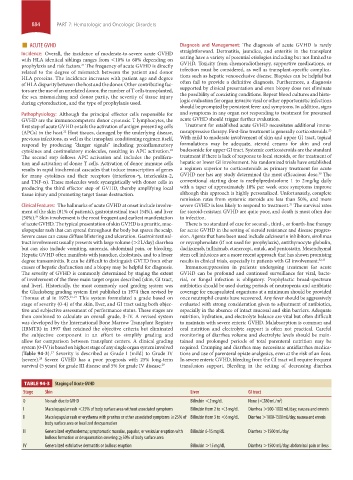
                 allow for comparison between transplant centers. A clinical grading     tained  and  prolonged  periods  of  total  parenteral  nutrition  may  be
                 system (0-IV) is based on highest stage of any single organ system involved   required. Cramping and diarrhea may necessitate antidiarrhea medica-
                 (Table 94-3).  Severity is described as Grade I (mild) to Grade IV    tions and use of parenteral opiate analgesics, even at the risk of an ileus.
                           27
                 (severe).  Severe GVHD has a poor prognosis with 25% long-term    In severe enteric GVHD, bleeding from the GI tract will require frequent
                       28
                 survival (5 years) for grade III disease and 5% for grade IV disease. 29  transfusion support. Bleeding in the setting of decreasing diarrhea

                   TABLE 94-3    Staging of Acute GVHD
                  Stage  Skin                                              Liver              GI tract
                  0      No rash due to GVHD                               Bilirubin <2 mg/dL  None (<280 mL/m )
                                                                                                         2
                  I      Maculopapular rash <25% of body surface area without associated symptoms  Bilirubin from 2 to <3 mg/dL  Diarrhea >500-1000 mL/day; nausea and emesis
                  II     Maculopapular rash or erythema with pruritus or other associated symptoms ≥25% of  Bilirubin from 3 to <6 mg/dL  Diarrhea >1000-1500 mL/day; nausea and emesis
                         body surface area or localized desquamation
                  III    Generalized erythroderma; symptomatic macular, papular, or vesicular eruption with   Bilirubin 6-15 mg/dL  Diarrhea >1500 mL/day
                         bullous  formation or desquamation covering ≥50% of body surface area
                  IV     Generalized exfoliative dermatitis or bullous eruption  Bilirubin >15 mg/dL  Diarrhea >1500 mL/day; abdominal pain or ileus


            section07.indd   884                                                                                       1/21/2015   7:43:03 AM

