


Page 1287 - Hall et al (2015) Principles of Critical Care-McGraw-Hill
P. 1287
894     PART 7: Hematologic and Oncologic Disorders


                 one might think, the risk of neutropenia is greatest earlier in treatment      ■  PULMONARY TOXICITY
                 (7-14 days). In retrospective studies as well as clinical trials, in 63% to   Due to the lack of definitive diagnostic testing, nonspecific clinical find-
                 65% and 75% of hospitalizations, febrile neutropenia occurred within
                 the first two cycles of treatment for NHL and advanced breast carcinoma   ings (dyspnea, hypoxemia, infiltrates), and significant overlap, diagnosing
                                                                       pulmonary toxicity due to anticancer agents is challenging as is determin-
                 respectively.  Late onset (>3-4 weeks after the last treatment) neutrope-
                          11
                 nia (LON) has been described in case reports following use of the mono-  ing the incidence of complications due to particular agents. The mecha-
                                                                       nisms  by  which  chemotherapies  can  cause  pulmonary  toxicity  include
                 clonal antibody rituximab. Wolach and colleagues presented a series of six
                 patients treated with rituximab as part of a regimen for DLBCL or follicu-  direct damage to pneumocytes or alveolar capillary endothelium, immu-
                                                                       nologic-mediated toxicity, and capillary leak. Any one or combination of
                 lar lymphoma who developed neutropenia anywhere from 42 to 168 days
                 after the last treatment.  All but one of these cases was associated with at   these mechanisms can lead to clinical manifestations such as interstitial
                                  12
                                                                       pneumonitis, hypersensitivity pneumonitis, noncardiogenic pulmonary
                 least one episode of febrile neutropenia. In their review of the literature,
                 they found an incidence range of 3% to 27% of late onset neutropenia   edema, alveolar hemorrhage, BOOP, pleural effusions, bronchospasm,
                                                                       and pulmonary venoocclusive disease.  Depending on the severity of
                                                                                                   16
                 associated with rituximab with a median onset of 38 to 175 days and dura-
                 tion of 5 to 77 days. Mortality rates associated with febrile neutropenia are   the clinical findings, a diagnosis of ALI/ARDS may be met. Many pul-
                                                                       monary manifestations secondary to chemotherapy are beyond the scope
                 8.4% and up to 13.2% in patients with hematologic cancers. 4
                   Neutropenia is also associated with dose reductions and treatment   of a critical care–oriented text and will not be addressed; rather the focus
                 delays, potentially compromising desired goals of long-term survival in   will be on agents with potentially life-threatening pulmonary toxicities.
                 patients being treated with curative intent. This has been supported by   Hypersensitivity reactions in response to many chemotherapeutic infu-
                                                                       sions may result in respiratory symptomatology, and will be discussed
                 studies demonstrating a direct relationship between dose intensity and
                 disease-free as well as overall survival. 13          later. In addition, complications due to underlying malignancy such as
                                                                       infection and metastatic disease may coexist and confound the diagnosis
                   Use of granulocyte colony-stimulating factor has been shown to
                 both decrease nadir and duration of neutropenia if administered prior   of treatment-induced lung disease.
                                                                         Acute respiratory distress and failure can be caused by a number of
                 to its development. Hartman et al performed a randomized controlled
                 clinical trial, which found no benefit (decreased rate of hospitalization,    anticancer therapies, and can be secondary to direct toxic drug effects or
                                                                       secondary to other complications caused by treatment side effects such
                 LOS, duration of antibiotics, or culture positive infections) to treating
                 neutropenia with granulocyte colony-stimulating factor compared to   as pancytopenia resulting in pulmonary hemorrhage and pneumonia, or
                                                                       pulmonary edema due to fluid overload. These entities are particularly
                 placebo once it developed even though the median time to achieve
                 ANC greater than 500 cells/mL was 2 days shorter.  Current recom-  notable for patients being treated for hematologic malignancies. Ameri
                                                       14
                                                                       et al performed a retrospective analysis at MD Anderson including over
                 mendations for use of granulocyte colony-stimulating factor are based
                 on  patient’s  risk factors for  developing  neutropenia (age  ≥65;  poor   1500 patients undergoing induction chemotherapy for AML or high-
                                                                       risk MDS (typically with an anthracycline plus cytarabine) and found
                 performance status; existing cytopenia due to marrow involvement of
                 malignancy; serious comorbidities; concurrent radiation therapy; exten-  an 8% incidence of acute respiratory failure requiring ventilator support
                                                                       within 2 weeks of initiation of treatment.  Seventy-three percent of
                                                                                                       17
                 sive prior chemotherapy; previous episode of febrile neutropenia; and
                 planned dose intensity >80%). 13                      those patients who experienced respiratory failure died with a median
                                                                       survival of 3 weeks, indicating substantial mortality associated with
                   Clinical practice guidelines for the management of febrile neutropenia
                 were most recently updated by the Infectious Disease Society of America   the need for ventilatory support in this patient population. Significant
                                                                       predictors of developing respiratory failure were identified and included
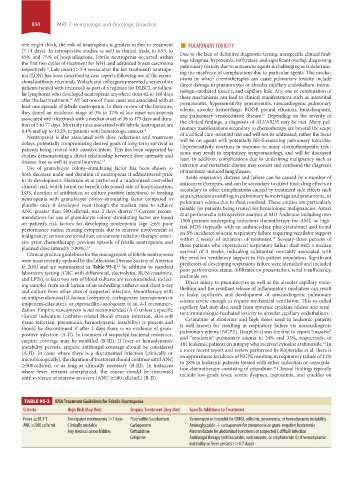
                 in 2010 and are summarized in Table 95-2.  In addition to standard
                                                  15
                 laboratory testing (CBC with differential, electrolytes, BUN/creatinine,   poor performance status, infiltrates on presentation, renal insufficiency,
                                                                       and male sex.
                 and LFTs), at least two sets of blood cultures are recommended, includ-
                                                                         Direct injury to pneumocytes as well as the alveolar capillary endo-
                 ing samples from each lumen of an indwelling catheter and chest x-ray   thelium and the resultant release of inflammatory mediators can result
                 and culture from other sites of suspected infection. Monotherapy with
                 an antipseudomonal β-lactam (cefepime), carbapenem (meropenem or   in leaky capillaries and development of noncardiogenic pulmonary
                                                                       edema severe enough to require mechanical ventilation. This so-called
                 imipenem-cilastatin), or piperacillin-tazobactam is an A-I recommen-
                 dation. Empiric vancomycin is not recommended (A-I) unless a specific   capillary leak may also result from systemic cytokine release and resul-
                                                                       tant immunologic-mediated toxicity to alveolar capillary endothelium.
                 clinical indication (catheter-related blood stream infection, skin-soft
                                                                         Cytarabine at moderate and high doses used in leukemic patients
                 tissue  infection,  pneumonia,  hemodynamic instability) is  present and   is  well  known  for  resulting  in  respiratory  failure  via  noncardiogenic
                 should be discontinued if after 2 days there is no evidence of gram-
                 positive infection (A-II). In instances of suspected bacterial resistance,   pulmonary edema (NCPE). Haupt et al was the first to report “massive”
                                                                       and “moderate” pulmonary edema in 24% and 33%, respectively, of
                 empiric  coverage  may  be  modified  (B-III).  If  fever  or  hemodynamic                             18
                 instability persists, empiric antifungal coverage  should be considered   181 leukemic patients on autopsy who received cytosine arabinoside.  In
                                                                       a more recent report and review performed by Kopterides et al, there is
                 (A-II). In cases where there is a documented infection (clinically or
                 microbiologically), the duration of treatment should continue until ANC   an approximate incidence of NCPE resulting in respiratory failure of 11%
                                                                       to 28% in leukemic patients treated with either induction or consolida-
                 ≥500 cells/mL or as long as clinically necessary (B-III). In instances                19
                 where fever remains unexplained, the course should be continued     tion chemotherapy consisting of cytarabine.  Clinical findings typically
                                                                       include low-grade fever, severe dyspnea, hypoxemia, and crackles on
                 until evidence of marrow recovery (ANC ≥500 cells/mL) (B-II).
                   TABLE 95-2    IDSA Treatment Guidelines for Febrile Neutropenia
                  Criteria       High Risk (Any One)  Empiric Treatment (Any One)  Specific Additions to Treatment
                  Fever ≥38.3°C  Anticipated neutropenia >7 days  Piperacillin/tazobactam  Vancomycin or linezolid for CRBSI, cellulitis, pneumonia, or hemodynamic instability
                  ANC ≤500 cells/mL  Clinically unstable  Carbapenem      Aminoglycoside + carbapenem for pneumonia or gram-negative bacteremia
                                 Any medical comorbidities  Ceftazidime   Metronidazole for abdominal symptoms or suspected C difficile infection
                                                      Cefepime            Antifungal therapy (echinocandin, voriconazole, or amphotericin B) if hemodynamic
                                                                          instability or fever persists (>4-7 days)

            section07.indd   894                                                                                       1/21/2015   7:43:06 AM

