


Page 1291 - Hall et al (2015) Principles of Critical Care-McGraw-Hill
P. 1291
898     PART 7: Hematologic and Oncologic Disorders


                 metoclopramide), dopamine receptor antagonists (prochlorperazine,   steatohepatitis demonstrates a postoperative mortality odds ratio of
                 haloperidol), and newer neurokinin-1 receptor antagonists (aprepitant).  10.5 and postoperative liver failure odds ratio of 7.7.  Adjuvant, locally
                                                                                                             64
                   Neutropenic enterocolitis, or typhlitis, is a necrotizing process involving     delivered chemotherapy with floxuridine via a hepatic artery pump is
                 the bowel as a result of neutropenia most commonly resulting from che-  associated with damage to bile ducts and can lead to biliary sclerosis in
                 motherapeutic treatment of leukemia. Onset is within the first month of   up to 35%. Due to this side effect and lack of clear survival advantage,
                 initiation of chemotherapy and may be occult as in most cases or present   use of hepatic artery pump is less common in recent years.
                 with diarrhea, abdominal pain, and fever. The incidence of neutropenic   Of the platinum agents, both carboplatin and oxaliplatin have one
                 enterocolitis in leukemic patients approaches 46% on autopsy series. 30  or more case reports describing fulminant liver failure, while 15% of
                   Various forms of hepatotoxicity may occur as a result of anticancer   patients treated with carboplatin can experience a transient, reversible
                 therapies. Venoocclusive or sinusoidal obstructive syndrome is a feared   elevation of LFTs (AST, alkaline phosphatase, and bilirubin).
                                                                                                                          62
                 complication of bone marrow transplant, which will be discussed below.   Dacarbazine has also been implicated in case reports as causing fulmi-
                 Other manifestations of hepatotoxicity include cholestasis; elevations in   nant hepatic failure in patients with melanoma via proposed mechanism
                 transaminases due to hepatocellular injury; steatosis as seen with treat-  of small vein thrombosis.
                 ment with L-asparaginase; and hepatitis B reactivation and increased   High-dose cytoreductive chemotherapy in anticipation of stem cell
                 hepatitis C viremia as a result of chemotherapy-induced immunosup-  transplantation is associated with hepatic venoocclusive disease or
                 pression particularly in patients being treated for hematologic malig-  sinusoidal obstruction syndrome. Incidence ranges from 5% to 60%
                 nancies and NHL (18% and 40% incidence, respectively). Underlying   and clinical diagnosis requires painful hepatomegaly, jaundice, ascites,
                 liver disease (cirrhosis and viral hepatitis) also increases the risks of   fluid retention, and weight gain. The mechanism of disease involves
                 hepatotoxicity due to dependence of cytochrome P450 oxidation for   chemotherapy-induced injury to sinusoidal endothelial cells followed
                 chemotherapy drug metabolism. Fulminant hepatic failure has been   by sinusoidal hemostasis, obstruction, and eventual hepatocyte ischemia
                 described with IFN-α, though is rare. 62              and necrosis. Secondary effects of sinusoidal obstruction include portal
                   Many of the anticancer therapies have been found to occasionally   hypertension, liver failure, encephalopathy, multiorgan dysfunction,
                 cause asymptomatic, transient elevations in LFTs. The more common   and death with mortality rates up to 98% to 100% in severe cases. 65,66
                 agents known to cause elevations in bilirubin and transaminases include   Until recently, treatment was largely supportive including diuresis and
                 carboplatin, 6-MCP, 5-FU, pentostatin, and taxanes. The mechanisms   dialysis, while efforts toward prevention centered on reduced-intensity
                 of these LFT abnormalities are largely unclear and incidences are dif-  conditioning. Experimental therapies such as t-PA, heparin, and anti-
                 ficult to determine due to comorbid conditions that may be present.   thrombin III have showed little promise in investigational studies.
                 Vincristine and dactinomycin have been shown to precipitate more   Defibrotide is an experimental agent with antithrombotic activity that
                 severe  hepatotoxicity following  radiation treatment  and  dose adjust-  has shown response rates of 36% to 76% and improved survival rates in
                 ments should be considered as in any individual with compromised   clinical trials of adult and pediatric patients with VOD. 66,67  A summary
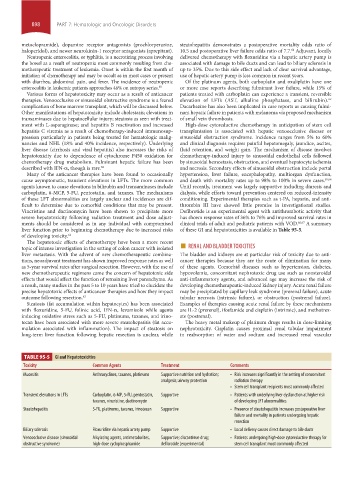
                 liver function prior to beginning chemotherapy due to increased risks   of these GI and hepatotoxicities is available in Table 95-5.
                 of developing toxicity. 62
                 topic of intense investigation in the setting of colon cancer with isolated   ■  RENAL AND BLADDER TOXICITIES
                   The hepatotoxic effects of chemotherapy have been a more recent
                 liver metastasis. With the advent of new chemotherapeutic combina-  The bladder and kidneys are at particular risk of toxicity due to anti-
                 tions, neoadjuvant treatment has shown improved response rates as well   cancer therapies because they are the route of elimination for many
                 as 5-year survival rates after surgical resection. However, with the use of   of these agents. Comorbid diseases such as hypertension, diabetes,
                 new chemotherapeutic regimens came the concern of hepatotoxic side   hypovolemia, concomitant nephrotoxic drug use such as nonsteroidal
                 effects that would affect the function of remaining liver parenchyma. As   anti-inflammatory agents, and advanced age may increase the risk of
                 a result, many studies in the past 5 to 10 years have tried to elucidate the   developing chemotherapeutic-induced kidney injury. Acute renal failure
                 precise hepatotoxic effects of anticancer therapies and how they impact   may be precipitated by capillary leak syndrome (prerenal failure), acute
                 outcome following resection. 63                       tubular necrosis (intrinsic failure), or obstruction (postrenal failure).
                   Steatosis (fat accumulation within hepatocytes) has been associated   Examples of therapies causing acute renal failure by these mechanisms
                 with floxuridine, 5-FU, folinic acid, IFN-α, levamisole while agents   are IL-2 (prerenal), ifosfamide and cisplatin (intrinsic), and methotrex-
                 inducing oxidative stress such as 5-FU, platinums, taxanes, and irino-  ate (postrenal).
                 tecan have been associated with more severe steatohepatitis (fat accu-  The heavy metal makeup of platinum drugs results in dose-limiting
                 mulation associated with inflammation). The impact of steatosis on   nephrotoxicity. Cisplatin causes proximal renal tubular impairment
                 long-term liver function following hepatic resection is unclear, while   in reabsorption of water and sodium and increased renal vascular


                   TABLE 95-5    GI and Hepatotoxicities
                  Toxicity               Common Agents           Treatment              Comments
                  Mucositis              Anthracyclines, taxanes, platinums  Supportive nutrition and hydration;    •  Risk increases significantly in the setting of  concomitant
                                                                 analgesia; airway protection  radiation therapy
                                                                                        •  Stem cell transplant recipients most commonly affected
                  Transient elevations in LFTs  Carboplatin, 6-MP, 5-FU, pentostatin,   Supportive  •  Patients with underlying liver dysfunction at higher risk
                                         taxanes, vincristine, dactinomycin               of developing LFT abnormalities
                  Steatohepatitis        5-FU, platinums, taxanes, irinotecan  Supportive  •  Presence of steatohepatitis increases postoperative liver
                                                                                          failure and mortality in patients undergoing hepatic
                                                                                          resection
                  Biliary sclerosis      Floxuridine via hepatic artery pump  Supportive  •  Local delivery causes direct damage to bile ducts
                  Venoocclusive disease (sinusoidal   Alkylating agents, antimetabolites,    Supportive; discontinue drug;   •  Patients undergoing high-dose cytoreductive therapy for
                  obstructive syndrome)  high-dose cyclophosphamide    defibrotide (experimental)  stem cell transplant most commonly affected


            section07.indd   898                                                                                       1/21/2015   7:43:07 AM

