


Page 1288 - Hall et al (2015) Principles of Critical Care-McGraw-Hill
P. 1288
CHAPTER 95: Toxicities of Chemotherapy  895


                    lung examination. The onset of respiratory failure is reported anywhere     peribronchial cuffing, GGOs, consolidation, nodules, air bronchograms,
                    from 2 to 21 days following treatment and in most cases, efforts to rule   and pleural effusions. 22-25
                    out alternate etiologies were carried out by sampling of respiratory   Bleomycin is best known for causing a late onset, dose-dependent
                    secretions and cardiac evaluations. Histological findings reported are   pulmonary fibrosis 1 to 6 months after administration in up to 10%
                    those showing massive alveolar edema with a highly proteinaceous,   of patients.  Bleomycin exerts its cytotoxic effect in the lungs via
                                                                                  26
                    noninflammatory infiltrate suggesting increased vascular permeability   generation of reactive oxygen species and resultant oxidative injury to
                    as the mechanism of disease. Radiographic findings ranged from a dif-  pneumocytes. The generation of ROS may be exacerbated by admin-
                    fuse interstitial pattern, mixed interstitial and alveolar patterns, alveolar   istration of supplemental oxygen and is felt to have contributed to the
                    pattern and normal. These findings were more often diffuse and bilateral   development of postoperative respiratory failure in patients previously
                    than localized. Mortality due to cytarabine-induced NCPE from case   treated with bleomycin in case reports.  A recent case report described
                                                                                                      27
                    reports range from 13% to 69%, though the number of total cases is   the use of nitric oxide in a case of postop ARDS as an oxygen-sparing
                      limited. Corticosteroids at doses ranging 0.75 to 4 mg/kg per day have   strategy to minimize hyperoxia-induced bleomycin toxicity. The study
                    been used with good results, though there are no clinical studies to better    confirmed earlier findings by Dellinger et al of an increase in Pa O 2  with
                    define their efficacy or optimal dosing. 19           the addition of nitric oxide to lowest possible concentration of oxygen.
                     Gemcitabine has also been associated with NCPE though much more   The mechanism of this benefit is likely due to improved V/Q matching;
                    rarely at approximately 0.1%. This entity is distinct from a transient,   however, the effects on mortality are less clear. 28,29
                    self-limited dyspnea that is associated with gemcitabine administration   Pulmonary venoocclusive disease  due to  deposition  of fibrinous
                    5% to 8% of the time. The pulmonary toxicity of gemcitabine is thought   material in the pulmonary veins and venules has been reported after
                    to escalate with each successive dose; however, cases of NCPE have   treatment with bleomycin as well as mitomycin and BCNU. Typical of
                    been reported on first administration.  There are less than a dozen case   any occlusive process with in the pulmonary circulatory bed, clinical
                                               20
                    reports, all demonstrating significant mortality unless identified early   findings include pulmonary hypertension with resultant dyspnea and
                    and systemic steroids administered and gemcitabine discontinued. 34  hypoxia. Onset is rarely acute and treatment involves discontinuation of
                     Administration of IL-2 has a 3% to 20% dose-related incidence of NCPE   the implicated drug and supportive therapy with mechanical ventilation.
                    in the context of a generalized vascular leak syndrome. Radiographic find-  Treatment of pulmonary hypertension with prostacyclin is currently not
                    ings include bilateral infiltrates and pleural effusions. With knowledge of   recommended due to adverse effects in case reports. 30,31
                    the mechanism of IL-2–induced pulmonary toxicity, careful attention to   Alveolar hemorrhage can been seen in instances of germ cell tumors
                    volume resuscitation can limit these effects. Clinical and radiographic   with pulmonary involvement undergoing initial chemotherapeutic
                    findings typically resolve with discontinuation of the IL-2. 16,21  Other che-  treatment, though this is as a result of tumor response to chemotherapy
                    motherapeutic agents rarely associated with NCPE and respiratory failure   rather than the chemotherapeutic agent itself. Bevacizumab has been
                    includes intrathecal methotrexate, vinblastine, and mitomycin C.  associated with pulmonary hemorrhage and hemoptysis in 2.3% of
                     Retinoic acid syndrome, or ATRA syndrome, is characterized by a   patients treated for NSCLC. 16
                    collection of clinical findings including fever, weight gain, elevated WBC   Finally,  innumerable  chemotherapeutic  agents  as  well  as  radiation
                    count, respiratory distress, interstitial infiltrates, pleural and pericardial   therapy have been demonstrated to cause pneumonitis and interstitial
                    effusions, episodic hypotension, and acute renal failure after initiation of   lung disease. This topic will not be discussed as it lies outside of the
                    therapy for APML. Respiratory distress and fever are represented most   focus of this text. For a review of the pulmonary manifestations likely to
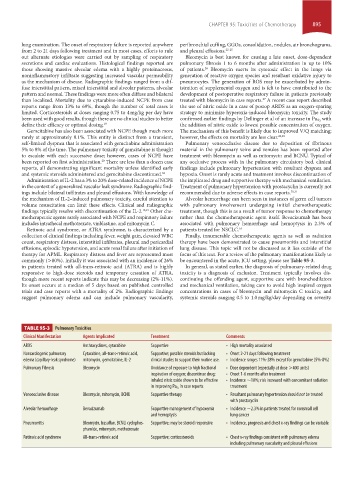
                    commonly (>80%). Initially it was associated with an incidence of 26%   be encountered in the acute, ICU setting, please see Table 95-3.
                    in patients treated with all-trans-retinoic acid (ATRA) and is highly   In general, as stated earlier, the diagnosis of pulmonary-related drug
                    responsive to high-dose steroids and temporary cessation of ATRA,   toxicity is a diagnosis of exclusion. Treatment typically involves dis-
                    though more recent reports indicate this may be decreasing (2%-11%).   continuing the offending agent, supportive care with bronchodilators
                    Its onset occurs at a median of 5 days based on published controlled   and mechanical ventilation, taking care to avoid high inspired oxygen
                    trials and case reports with a mortality of 2%. Radiographic findings   concentrations in cases of bleomycin and mitomycin C toxicity, and
                    suggest pulmonary edema and can include pulmonary vascularity,   systemic steroids ranging 0.5 to 1.0 mg/kg/day depending on severity.


                      TABLE 95-3    Pulmonary Toxicities
                    Clinical Manifestation  Agents Implicated   Treatment                Comments
                    ARDS                Anthracyclines, cytarabine  Supportive           •  High mortality associated
                    Noncardiogenic pulmonary   Cytarabine, all-trans-retinoic acid,   Supportive; possible steroids but lacking   •  Onset 2-21 days following treatment
                    edema (capillary-leak syndrome)    mitomycin, gemcitabine, IL-2  clinical studies to support their routine use.  •  Incidence ranges 11%-28% except for gemcitabine (5%-8%)
                    Pulmonary Fibrosis  Bleomycin               Avoidance of exposure to high fractional   •  Dose dependent (especially at dose >400 units)
                                                                inspiration of oxygen; discontinue drug;   •  Onset 1-6 months after treatment
                                                                inhaled nitric oxide shown to be effective   •  Incidence ∼10%; risk increased with concomitant radiation
                                                                          in case reports   treatment
                                                                in improving Pa O 2
                    Venoocclusive disease  Bleomycin, mitomycin, BCNU  Supportive therapy  •  Resultant pulmonary hypertension should not be treated
                                                                                           with prostacyclin
                    Alveolar hemorrhage  Bevacizumab            Supportive management of hypoxemia   •  Incidence ∼2.3% in patients treated for nonsmall cell
                                                                and hemoptysis             lung cancer
                    Pneumonitis         Bleomycin, busulfan, BCNU, cyclophos-  Supportive; may be steroid responsive  •  Incidence, prognosis and chest x-ray findings can be variable
                                        phamide, mitomycin, methotrexate
                    Retinoic acid syndrome  All-trans-retinoic acid  Supportive; corticosteroids  •  Chest x-ray findings consistent with pulmonary edema
                                                                                             including pulmonary vascularity and pleural effusions


            section07.indd   895                                                                                       1/21/2015   7:43:06 AM

