


Page 1360 - Hall et al (2015) Principles of Critical Care-McGraw-Hill
P. 1360
CHAPTER 98: Renal Replacement Therapy in the Intensive Care Unit  933


                                                                          diffusion; the movement of solutes will depend not only concentration
                        • Retrospective and observational studies suggest that the early ini-  gradient, but also on the size of the solute. Smaller solutes are more dif-
                      tiation of RRT may improve patient outcomes; however, definitive   fusible, because they randomly move more in solution than large solutes.
                      randomized, controlled trials have yet to be performed.  Convective clearance, used in hemofiltration, is an alternative means
                       • In the setting of acute kidney injury (AKI), no specific RRT modality   of achieving solute clearance that generally provides better clearance
                      (intermittent, continuous, or peritoneal) provides a mortality benefit   of larger size solutes (see below, “Modality of RRT: Convective Versus
                      over another. However, certain clinical scenarios (eg, hepatic failure,   Diffusive”). Ultrafiltration operates on the principle that water will move
                      increased intracranial pressure) may mandate a specific modality.  across a semipermeable membrane from a higher-pressure system to a
                        • In the setting AKI, randomized controlled trials have demon-  lower-pressure system. Solutes dissolved in ultrafiltered water also move
                                                                          across the membrane via “solvent drag,” or convection. Importantly,
                      strated that a minimum dose of 25 mL/kg/h of continuous renal   solute clearance by ultrafiltration requires high volumes of water move-
                      replacement  therapy  (CRRT)  be  delivered  in  order  to  improve   ment. Thus, low-volume hemofiltration, as utilized in slow continuous
                      patient survival. Data on dosing of intermittent dialysis suggest   ultrafiltration (SCUF), is effective at removing water, with limited solute
                      prescription of a minimum of three treatments per week.  removal (or “clearance”). Conversely, high-volume hemofiltration, such
                        • No singular method of systemic or regional anticoagulation, in the   as used in CVVH, is effective at removing solutes, but large amounts of
                      setting of AKI requiring renal replacement therapy, has demon-  water are removed and fluid must be returned to maintain blood volume
                      strated superiority. Several options including heparin, citrate, and   in the form of a replacement solution. The replacement solution also
                      no anticoagulation remain extremely common and each has their   contains supplemental electrolytes (eg, potassium, phosphorus, calcium)
                      own risks and benefits.                             and a buffer (lactate or bicarbonate) to prevent iatrogenic depletion of
                        • In the setting of AKI requiring RRT, nutritional support consistent   these solutes, in addition to treating metabolic acidosis, and both dilut-
                      with the current ESPEN guidelines and monitoring of parameters   ing and removing circulating uremic solutes. The use of acute peritoneal
                      of nutritional status in critically ill patients are appropriate.  dialysis in the setting of AKI has largely fallen out of favor in many
                        • Depending on the modality of RRT (intermittent, continuous, or   countries, although still commonly used in critically ill children and for
                      peritoneal), dosing strategies for medications (including antimi-  adult acute RRT in developing countries. In the large, multicenter inter-
                      crobials) differ significantly.                     national observational study of the epidemiology of AKI in the setting
                        • Adherence to dosing guidelines is critical to ensure that the tar-  of critical illness conducted by the Beginning and Ending Supportive
                                                                          Therapy for the Kidney (BEST for the Kidney) investigators, only 40 of
                      geted therapeutic dose is delivered in the setting of AKI and RRT,                                1
                      as inappropriate dosing has a significant impact on patient out-  1258 (3.2%) individuals requiring RRT underwent PD or SCUF.  Thus,
                                                                          the focus of this chapter will be on the use of blood-based extracorpo-
                      comes and increases the risk of mortality.
                                                                          real therapies to achieve small solute clearance, including IHD and the
                                                                          forms of CRRT outlined above. The choice of modality (intermittent vs
                                                                          continuous therapy and diffusive vs convective therapy) remains contro-
                    Despite advances in medicine and critical care, the nephrology commu-  versial and the data supporting the different modalities will be outlined
                    nity has yet to develop a consistent, proven intervention to predictably   in more detail in the sections below. Nevertheless, the goal of all RRT
                    prevent or hasten the recovery of all forms of acute kidney injury (AKI),   therapy remains the same; ameliorate the severe metabolic and volume
                    including its most severe form, acute tubular necrosis (ATN). Thus,   derangements that contribute to the poor prognosis of AKI in the setting
                    care for the patient with AKI is focused on supportive measures includ-  of critical illness. Combinations of these complementary therapies are
                    ing treatment of the underlying disease state and, when needed, renal   commonly used to support such patients at various stages of their acute
                    replacement therapy (RRT). While advances in nephrology have not   illness and recovery.
                    identified a consistent therapy for the prevention or improved recovery
                    for AKI, there have been considerable advances in the field of RRT.
                                                                          INDICATIONS FOR RENAL REPLACEMENT THERAPY
                    RRT: AN INTRODUCTION                                  AND TIMING OF INITIATION
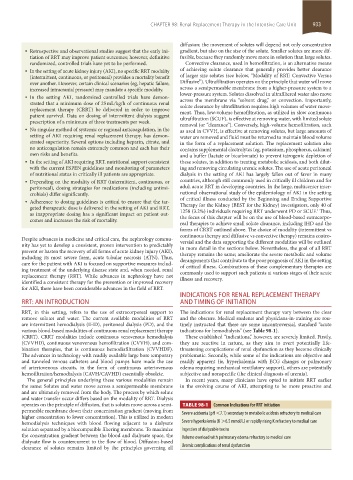
                    RRT, in this setting, refers to the use of extracorporeal support to   The indications for renal replacement therapy vary between the clear
                    remove solutes and water. The current available modalities of RRT   and the obscure. Medical students and physicians-in-training are rou-
                    are intermittent hemodialysis (IHD), peritoneal dialysis (PD), and the   tinely instructed that there are some uncontroversial, standard “acute
                    various blood-based modalities of continuous renal replacement therapy   indications for hemodialysis” (see Table 98-1).
                    (CRRT). CRRT modalities include continuous venovenous hemodialysis   These established “indications,” however, are severely limited. Firstly,
                    (CVVHD), continuous venovenous hemofiltration (CVVH), and com-  they are reactive in nature, as they aim to avert potentially life-
                    bination therapies, that is continuous hemodiafiltration (CVVHDF).   threatening complications of renal dysfunction as they become clinically
                    The advances in technology with readily available large bore temporary    problematic. Secondly, while some of the indications are objective and
                    and tunneled venous catheters and blood pumps have made the use   readily  apparent  (ie,  hyperkalemia  with  ECG  changes  or  pulmonary
                    of arteriovenous circuits, in the form of continuous arteriovenous     edema requiring mechanical ventilatory support), others are potentially
                    hemofiltration/hemodialysis (CAVH/CAVHD) essentially obsolete.  subjective and nonspecific (the clinical diagnosis of uremia).
                     The general principles underlying these various modalities remain   In recent years, many clinicians have opted to initiate RRT earlier
                    the same: Solutes and water move across a semipermeable membrane   in the evolving course of AKI, attempting to be more proactive and
                    and are ultimately removed from the body. The process by which solute
                    and water transfer occur differs based on the modality of RRT. Dialysis
                    operates on the principle of diffusion, that is solutes move across a semi-    TABLE 98-1    Common Indications for RRT initiation
                    permeable membrane down their concentration gradient (moving from   Severe acidemia (pH <7.1) secondary to metabolic acidosis refractory to medical care
                    higher concentration to lower concentration). This is utilized in modern
                    hemodialysis techniques with blood flowing adjacent to a dialysate   Severe hyperkalemia (K >6.5 mmol/L) or rapidly rising K refractory to medical care
                    solution separated by a biocompatible filtering membrane. To maximize   Ingestion of dialyzable toxins
                    the concentration gradient between the blood and dialysate space, the   Volume overload with pulmonary edema refractory to medical care
                    dialysate flow is countercurrent to the flow of blood. Diffusion-based
                    clearance of solutes remains limited by the principles governing all   Uremic complications of renal dysfunction


            section08.indd   933                                                                                       1/14/2015   8:27:59 AM

