


Page 1357 - Hall et al (2015) Principles of Critical Care-McGraw-Hill
P. 1357
930     PART 8: Renal and Metabolic Disorders


                 preferable to intermittent bolus administration.  However, a recent     5
                                                     141
                 randomized controlled trial which  compared bolus versus infusion                             Dopamine
                 of furosemide in 308 patients with acute decompensated heart failure                          Placebo
                 showed no difference in the patient’s global assessment of symptoms or   4
                 change in creatinine from baseline to 72 hours between the two groups. 142
                   Mannitol is an osmotic diuretic that can decrease cell swelling, scavenge
                 free radicals, and cause renal vasodilatation by inducing intrarenal pros-  3
                 taglandin production.  It may be beneficial when added to organ pres-  Serum creatinine (mg/dL)
                                 143
                 ervation solutions during renal transplantation and may protect against   2
                 AKI caused by rhabdomyolysis if given extremely early. 143-145  Otherwise,
                 mannitol has not been shown to be useful in the prevention of AKI. In fact,
                 mannitol may aggravate AKI due to radiocontrast agents.  Furthermore,   1
                                                          61
                 mannitol may precipitate pulmonary edema if given to volume-overloaded
                 patients who remain oliguric, can exacerbate the hyperosmolar state of
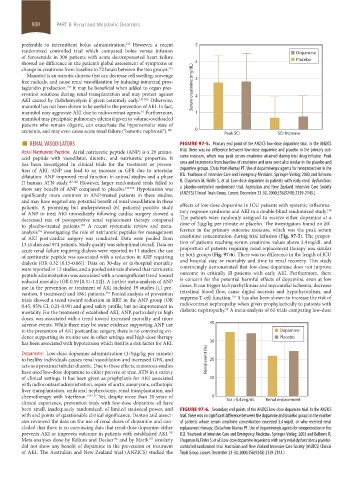
                 azotemia, and may even cause acute renal failure (“osmotic nephrosis”). 146  0  Peak SCr  SCr Increase
                     ■  RENAL VASODILATORS                             FIGURE 97-5.  Primary end point of the ANZICS low-dose dopamine trial. In the ANZICS

                 Atrial Natriuretic Peptide:  Atrial natriuretic peptide (ANP) is a 28 amino-  trial, there was no difference between low-dose dopamine and placebo in the primary out-
                 acid peptide with vasodilator, diuretic, and natriuretic properties. It   come measure, which was peak serum creatinine attained during trial drug infusion. Peak
                 has been investigated in clinical trials for the treatment or preven-  urea and increments from baseline of creatinine and urea were also similar in the placebo and
                 tion of AKI. ANP can lead to an increase in GFR due to arteriolar   dopamine groups. (Data from Murray PT. Use of dopaminergic agents for renoprotection in the
                 dilatation. ANP improved renal function in animal studies and a phase   ICU. Yearbook of Intensive Care and Emergency Medicine. Springer-Verlag; 2003 and Bellomo
                 II human ATN study. 147,148  However, larger randomized trials failed to   R, Chapman M, Finfer S, et al. Low-dose dopamine in patients with early renal dysfunction:
                 show any benefit of ANP compared to placebo. 149,150  Hypotension was   a placebo-controlled randomised trial. Australian and New Zealand Intensive Care Society
                 significantly more common in ANP-treated patients in these studies,   (ANZICS) Clinical Trials Group. Lancet. December 23-30, 2000;356(9248):2139-2143.)
                 and may have negated any potential benefit of renal vasodilation in these
                 patients. A promising but underpowered (61 patients) positive study   effects of low-dose dopamine in ICU patients with systemic inflamma-
                                                                                                                         158
                 of ANP to treat AKI immediately following cardiac surgery showed a   tory response syndrome and AKI in a double-blind randomized study.
                 decreased  rate  of  postoperative  renal  replacement  therapy  compared   The patients were randomly assigned to receive either dopamine at a
                 to placebo-treated patients.  A recent systematic review and meta-  dose of 2 µg/kg per minute or placebo. The investigators found no dif-
                                     151
                       152
                 analysis  investigating the role of natriuretic peptides for management   ference in the primary outcome measure, which was the peak serum
                 of  AKI post-cardiac surgery  was  conducted. Data were  pooled from     creatinine concentration during trial infusion (Fig. 97-5). The propor-
                 13 studies and 974 patients. Study quality was suboptimal overall. Data on   tion of patients reaching serum creatinine values above 3.4 mg/dL and
                 acute renal failure requiring dialysis were reported in 11 studies; the use   proportion of patients requiring renal replacement therapy was similar
                 of natriuretic peptide was associated with a reduction in ARF requiring   in both groups (Fig. 97-6). There was no difference in the length of ICU
                 dialysis (OR 0.32 [0.15-0.66]). Data on 30-day or in-hospital mortality   and hospital  stay, or  mortality and time to  renal  recovery. This  study
                 were reported in 12 studies, and a pooled estimate showed that natriuretic   convincingly demonstrated that low-dose dopamine does not improve
                 peptide administration was associated with a nonsignificant trend toward   outcome  in  critically  ill  patients  with  early  AKI.  Furthermore,  there
                 reduced mortality (OR 0.59 [0.31-1.12]). A further meta-analysis of ANP   is concern for the potential harmful effects of dopamine, even at low
                 use in the prevention or treatment of AKI included 19 studies (11 pre-  doses. It can trigger tachyarrhythmias and myocardial ischemia, decrease
                 vention, 8 treatment) and 1861 patients.  Pooled analysis of prevention   intestinal blood flow, cause digital necrosis and hypothyroidism, and
                                              153
                                                                                         154
                 trials showed a trend toward reduction in RRT in the ANP group (OR   suppress T-cell function.  It has also been shown to increase the risk of
                 0.45, 95% CI, 0.21-0.99) and good safety profile, but no improvement in   radiocontrast nephropathy when given prophylactically to patients with
                                                                                       59
                 mortality. For the treatment of established AKI, ANP, particularly in high   diabetic nephropathy.  A meta-analysis of 61 trials comparing low-dose
                 doses, was associated with a trend toward increased mortality and more
                 adverse events. While there may be some evidence supporting ANP use   40
                 in the prevention of AKI postcardiac surgery, there is no convincing evi-               Dopamine
                 dence supporting its routine use in other settings and high-dose therapy                Placebo
                 has been associated with hypotension which itself is a risk factor for AKI.  30
                 Dopamine:  Low-dose dopamine administration (1-3 µg/kg per minute)
                 to healthy individuals causes renal vasodilation and increased GFR, and   Renal event (%)  20
                 acts as a proximal tubular diuretic. Due to these effects, numerous studies
                 have used low-dose dopamine to either prevent or treat ATN in a variety
                 of clinical settings. It has been given as prophylaxis for AKI associated   10
                 with radiocontrast administration, repair of aortic aneurysms, orthotopic
                 liver transplantation, unilateral nephrectomy, renal transplantation, and
                 chemotherapy with interferon. 154-157  Yet, despite more than 20 years of   0
                 clinical experience, prevention trials with low-dose dopamine all have   Scr >3.4 mg/dL  Renal replacement
                 been small, inadequately randomized, of limited statistical power, and   FIGURE 97-6.  Secondary end points of the ANZICS low-dose dopamine trial. In the ANZICS
                 with end points of questionable clinical significance. Denton and associ-  trial, there was no significant difference between the dopamine and placebo groups in the number
                 ates reviewed the data on the use of renal doses of dopamine and con-  of patients whose serum creatinine concentration exceeded 3.4 mg/dL or who received renal
                 cluded that there is no convincing data that renal-dose dopamine either   replacement therapy. (Data from Murray PT. Use of dopaminergic agents for renoprotection in the
                 prevents AKI or improves outcome in patients with established AKI.    ICU. Yearbook of Intensive Care and Emergency Medicine. Springer-Verlag; 2003 and Bellomo R,
                                                                   155
                 Meta-analyses done by Kellum and Decker  and by Marik  similarly   Chapman M, Finfer S, et al. Low-dose dopamine in patients with early renal dysfunction: a placebo-
                                                             157
                                                 156
                 did not show any benefit of dopamine in the prevention or treatment   controlled randomised trial. Australian and New Zealand Intensive Care Society (ANZICS) Clinical
                 of  AKI.  The  Australian  and  New  Zealand  trial  (ANZICS)  studied  the   Trials Group. Lancet. December 23-30, 2000;356(9248):2139-2143.)


            section08.indd   930                                                                                       1/14/2015   8:27:58 AM

