


Page 1355 - Hall et al (2015) Principles of Critical Care-McGraw-Hill
P. 1355
928     PART 8: Renal and Metabolic Disorders


                 Terlipressin increases resistance in the splanchnic circulation  allowing   PREvENTION OF ACUTE RENAL FAILURE
                 redistribution of blood to extra-splanchnic organs including the kidney,
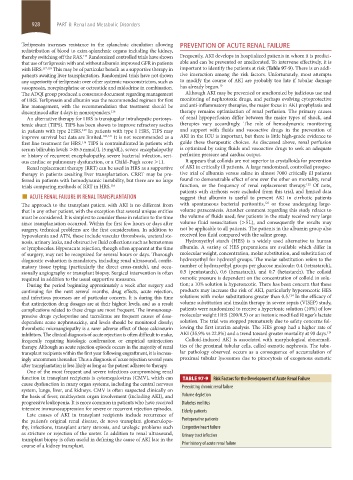
                 thereby switching off the RAS.  Randomized controlled trials have shown   Frequently, AKI develops in hospitalized patients in whom it is predict-
                                      114
                 that use of terlipressin with and without albumin improved GFR in patients   able and can be prevented or ameliorated. To intervene effectively, it is
                 with HRS. 117,118  This may be of particular benefit as a supportive therapy in   important to identify the patients at risk (Table 97-9). There is an addi-
                 patients awaiting liver transplantation. Randomized trials have not shown   tive interaction among the risk factors. Unfortunately, most attempts
                 any superiority of terlipressin over other systemic vasoconstrictors, such as   to modify the course of AKI are probably too late if tubular damage
                 vasopressin, norepinephrine or octreotide and midodrine in combination.   has already begun. 10
                 The ADQI group produced a consensus document regarding management   Although AKI may be prevented or ameliorated by judicious use and
                 of HRS. Terlipressin and albumin was the recommended regimen for first   monitoring of nephrotoxic drugs, and perhaps evolving cytoprotective
                 line  management,  with  the  recommendation  that  treatment  should  be    and anti-inflammatory therapies, the major focus in AKI prophylaxis and
                 discontinued after 4 days in nonresponders. 116       therapy remains optimization of renal perfusion. The primary causes
                   An alternative therapy for HRS is transjugular intrahepatic portosys-  of renal hypoperfusion differ between the major types  of shock, and
                 temic shunt (TIPS). TIPS has been shown to improve refractory ascites   therapies vary accordingly. The role of hemodynamic monitoring
                 in patients with type 2 HRS.  In patients with type 1 HRS, TIPS may   and support with fluids and vasoactive drugs in the prevention of
                                      119
                 improve survival but data are limited. 120,121  It is not recommended as a   AKI in the ICU is important, but there is little high-grade evidence to
                 first line treatment for HRS.  TIPS is contraindicated in patients with   guide these therapeutic choices. As discussed above, renal perfusion
                                      116
                 serum bilirubin levels >85.5 mmol/L (5 mg/dL), severe encephalopathy   is  optimized by using fluids and vasoactive drugs to seek an adequate
                 or history of recurrent encephalopathy, severe bacterial infection, seri-  perfusion pressure and cardiac output.
                 ous cardiac or pulmonary dysfunction, or a Child–Pugh score >11.  It appears that colloids are not superior to crystalloids for prevention
                   Renal replacement therapy (RRT) can be used in HRS as a supportive   of AKI in critically ill patients. A large randomized, controlled prospec-
                 therapy in patients awaiting liver transplantation. CRRT may be pre-  tive trial of albumin versus saline in almost 7000 critically ill patients
                 ferred in patients with hemodynamic instability, but there are no large   found no demonstrable effect of one over the other on mortality, renal
                                                                                                                  122
                 trials comparing methods of RRT in HRS. 116           function,  or  the  frequency  of  renal  replacement  therapy.   Of  note,
                     ■  ACUTE RENAL FAILURE IN RENAL TRANSPLANTATION   patients with cirrhosis were excluded from this trial, and limited data
                                                                       suggest that albumin is useful to prevent AKI in cirrhotic patients
                                                                                                    123
                 The approach to the transplant patient with AKI is no different from   with spontaneous bacterial peritonitis,  or those undergoing large-
                 that in any other patient, with the exception that several unique entities   volume paracentesis. Another comment regarding this study relates to
                 must be considered. It is simplest to consider these in relation to the time   the volume of fluids used; few patients in the study received very large
                 since transplantation occurred. Within the first few hours or days after   volume fluid resuscitation (>5 L), and consequently the results may
                 surgery, technical problems are the first consideration. In addition to   not be applicable to all patients. The patients in the albumin group also
                 hypovolemia and ATN, these include vascular thrombosis, ureteral ste-  received less fluid compared with the saline group.
                 nosis, urinary leaks, and obstructive fluid collections such as hematomas   Hydroxyethyl  starch (HES)  is  a widely used  alternative to  human
                 or lymphoceles. Hyperacute rejection, though often apparent at the time   albumin. A variety of HES preparations are available which differ in
                 of surgery, may not be recognized for several hours or days. Thorough   molecular weight, concentration, molar substitution, and substitution of
                 diagnostic evaluation is mandatory, including renal  ultrasound, confir-  hydroxyethyl for hydroxyl groups. The molar substitution refers to the
                 matory tissue typing (particularly the direct cross-match), and occa-  number of hydroxyethyl groups per glucose molecule: 0.4 (tetrastarch),
                 sionally angiography or transplant biopsy. Surgical intervention is often   0.5 (pentastarch), 0.6 (hexastarch), and 0.7 (hetastarch). The colloid
                 required in addition to the usual supportive measures.  osmotic pressure is dependent on the concentration of colloid in solu-
                   During  the period beginning  approximately  a week  after surgery and   tion; a 10% solution is hyperoncotic. There has been concern that these
                 continuing for  the next  several months,  drug effects, acute rejection,   products may increase the risk of AKI, particularly hyperoncotic HES
                                                                                                            124
                 and infectious processes are of particular concern. It is during this time   solutions with molar substitutions greater than 0.5.  In the efficacy of
                 that antirejection drug dosages are at their highest levels, and as a result   volume substitution and insulin therapy in severe sepsis (VISEP) study,
                 complications related to these drugs are most frequent. The immunosup-  patients were randomized to receive a hypertonic solution (10%) of low
                 pressive drugs cyclosporine and tacrolimus are frequent causes of dose-  molecular weight HES (200/0.5) or an isotonic modified Ringer’s lactate
                 dependent acute nephrotoxicity, and levels should be monitored closely;   solution. The trial was stopped prematurely due to safety concerns fol-
                 thrombotic microangiopathy is a rarer adverse effect of these calcineurin   lowing the first interim analysis. The HES group had a higher rate of
                 inhibitors. The clinical diagnosis of acute rejection is often difficult to make,     AKI (35.9% vs 22.8%) and a trend toward greater mortality at 90 days. 124
                 frequently requiring histologic confirmation or empirical antirejection   Colloid-induced AKI is associated with morphological abnormali-
                 therapy. Although an acute rejection episode occurs in the majority of renal   ties of the proximal tubular cells, called osmotic nephrosis. The tubu-
                 transplant recipients within the first year following engraftment, it is increas-  lar pathology observed occurs as a consequence of accumulation of
                 ingly uncommon thereafter. Thus a diagnosis of acute rejection several years   proximal tubular lysosomes due to pinocytosis of exogenous osmotic
                 after transplantation is less likely as long as the patient adheres to therapy.
                   One of the most frequent and severe infections compromising renal
                 function in transplant recipients is cytomegalovirus (CMV), which can     TABLE 97-9    Risk Factors for the Development of Acute Renal Failure
                 cause dysfunction in many organ systems, including the central nervous   Preexisting chronic renal failure
                 system, lungs, liver, and kidneys. CMV is often suspected clinically on
                 the basis of fever, multisystem organ involvement (including AKI), and   Volume depletion
                 progressive leukopenia. It is more common in patients who have received   Diabetes mellitus
                 intensive immunosuppression for severe or recurrent rejection episodes.  Elderly patients
                   Late causes of AKI in transplant recipients include recurrence of
                 the patient’s original renal disease, de novo transplant glomerulopa-  Postoperative patients
                 thy, infections, transplant artery stenosis, and urologic problems such   Congestive heart failure
                 as stricture or rejection of the ureter. In addition to renal ultrasound,   Urinary tract infection
                 transplant biopsy is often useful in defining the cause of AKI late in the
                 course of a kidney transplant.                         Prior history of acute renal failure


            section08.indd   928                                                                                       1/14/2015   8:27:56 AM

