


Page 1362 - Hall et al (2015) Principles of Critical Care-McGraw-Hill
P. 1362
CHAPTER 98: Renal Replacement Therapy in the Intensive Care Unit  935


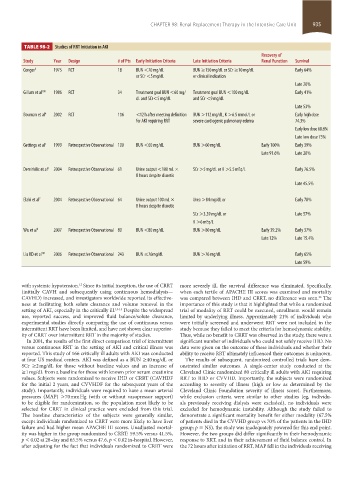
                      TABLE 98-2    Studies of RRT Initiation in AKI
                                                                                                     Recovery of
                    Study      Year  Design         # of Pts  Early Initiation Criteria  Late Initiation Criteria  Renal Function  Survival
                    Conger 3   1975  RCT            18     BUN <70 mg/dL      BUN ≥150 mg/dL or SCr ≥10 mg/dL    Early 64%
                                                           or SCr <5 mg/dL    or clinical indication
                                                                                                                 Late 20%
                    Gillum et al 100  1986  RCT     34     Treatment goal BUN <60 mg/  Treatment goal BUN <100 mg/dL    Early 41%
                                                           dL and SCr<5 mg/dL  and SCr <9 mg/dL
                                                                                                                 Late 53%
                    Bouman et al 4  2002  RCT       106    <12 h after meeting definition   BUN >112 mg/dL, K >6.5 mmol/L or   Early high dose
                                                           for AKI requiring RRT  severe cardiogenic pulmonary edema  74.3%
                                                                                                                 Early low dose 68.6%
                                                                                                                 Late low dose 75%
                    Gettings et al 5  1999  Retrospective Observational 100  BUN <60 mg/dL  BUN >60 mg/dL  Early 100%  Early 39%
                                                                                                     Late 91.6%  Late 20%


                    Demirkilic et al 6  2004  Retrospective Observational 61  Urine output <100 mL ×    SCr >5 mg/dL or K >5.5 mEq/L  Early 76.5%
                                                           8 hours despite diuretic
                                                                                                                 Late 45.5%

                    Elahi et al 7  2004  Retrospective Observational  64  Urine output 100 mL ×    Urea >84 mg/dL or  Early 78%
                                                           8 hours despite diuretic
                                                                              SCr >3.39 mg/dL or                 Late 57%
                                                                              K >6 mEq/L
                    Wu et al 8  2007  Retrospective Observational 80  BUN <80 mg/dL  BUN >80 mg/dL   Early 39.2%  Early 37%
                                                                                                     Late 12%    Late 15.4%

                    Liu KD et al 101  2006  Retrospective Observational 243  BUN ≤76mg/dL  BUN >76 mg/dL         Early 65%
                                                                                                                 Late 59%


                    with systemic hypotension.  Since its initial inception, the use of CRRT   more severely ill, the survival difference was eliminated. Specifically,
                                       12
                    (initially CAVH and subsequently using continuous hemodialysis—  when each tertile of APACHE III scores was examined and mortality
                    CAVHD) increased, and investigators worldwide reported its effective-  was compared between IHD and CRRT, no difference was seen.  The
                                                                                                                         16
                    ness at facilitating both solute clearance and volume removal in the   importance of this study is that it highlighted that while a randomized
                    setting of AKI, especially in the critically ill. 13-15  Despite the widespread   trial of modality of RRT could be executed, enrollment would remain
                    use, reported success, and improved fluid balance/solute clearance,   limited by underlying illness. Approximately 21% of individuals who
                    experimental studies directly comparing the use of continuous versus   were initially screened and underwent RRT were not included in the
                    intermittent RRT have been limited, and have not shown clear superior-  study because they failed to meet the criteria for hemodynamic stability.
                    ity of CRRT over intermittent RRT in the majority of studies.  Thus, while no benefit to CRRT was observed in the study, there were a
                     In 2001, the results of the first direct comparison trial of intermittent   significant number of individuals who could not safely receive IHD. No
                    versus continuous RRT in the setting of AKI and critical illness was   data were given on the outcome of these individuals and whether their
                    reported. This study of 166 critically ill adults with AKI was conducted   ability to receive RRT ultimately influenced their outcomes is unknown.
                    at four US medical centers. AKI was defined as a BUN ≥40 mg/dL or   The  results of subsequent,  randomized  controlled  trials  have  dem-
                    SCr  ≥2 mg/dL  for  those  without  baseline  values  and  an  increase  of   onstrated similar outcomes. A single-center study conducted at the
                    ≥1 mg/dL from a baseline for those with known prior serum creatinine   Cleveland Clinic randomized 80 critically ill adults with AKI requiring
                    values. Subjects were randomized to receive IHD or CRRT (CAVHDF   RRT to IHD or CVVHD. Importantly, the subjects were randomized
                    for the initial 2 years, and CVVHDF for the subsequent years of the   according to severity of illness (high or low as determined by the
                    study). Importantly, individuals were required to have a mean arterial   Cleveland Clinic Foundation severity of illness score). Furthermore,
                    pressures (MAP)  >70 mm Hg (with or without vasopressor support)   while  exclusion  criteria were similar  to other studies  (eg, individu-
                    to be eligible for randomization, so the population most likely to be   als previously receiving dialysis were excluded), no individuals were
                    selected for CRRT in clinical practice were excluded from this trial.   excluded  for  hemodynamic  instability.  Although  the  study  failed  to
                    The baseline characteristics of the subjects were generally similar,   demonstrate a significant mortality benefit for either modality (67.5%
                    except individuals randomized to CRRT were more likely to have liver   of patients died in the CVVHD group vs 70% of the patients in the IHD
                    failure and had higher mean APACHE III scores. Unadjusted mortal-  group; p = NS), the study was inadequately powered for this end point.
                    ity was higher in the group randomized to CRRT: 59.5% versus 41.5%,     However, the two groups did differ significantly in their hemodynamic
                    p < 0.02 at 28-day and 65.5% versus 47.6, p < 0.02 in-hospital. However,   response to RRT, and in their achievement of fluid balance control. In
                    after adjusting for the fact that individuals randomized to CRRT were   the 72 hours after initiation of RRT, MAP fell in the individuals receiving


            section08.indd   935                                                                                       1/14/2015   8:27:59 AM

