


Page 1459 - Hall et al (2015) Principles of Critical Care-McGraw-Hill
P. 1459
998     PART 9: Gastrointestinal Disorders


                   CHAPTER   Jaundice, Diarrhea,                                       Heme catabolism
                                                                                               Unconjugated
                  104        Obstruction, and                                                  bilirubin
                             Pseudoobstruction
                                                                                           Liver
                             Paul T. Engels
                             L. N. Tremblay                                             Conjugated
                                                                                        bilirubin               ~95% bilirubin
                                                                                                                absorbed by
                  KEY POINTS                                                                                    terminal ileum
                                https://kat.cr/user/tahir99/
                     • Jaundice (hyperbilirubinemia) is seen in critically ill patients and   Via blood if      Enterohepatic
                    can occur due to prehepatic, intrahepatic, or posthepatic causes.  liver dysfunction          recycling
                                                                             or biliary
                     • Biliary obstruction and acalculous cholecystitis are two common   obstruction
                    surgical problems requiring urgent intervention.
                     • For acalculous or calculous cholecystitis, cholecystectomy removes
                    the inflamed and ischemic gallbladder and prevents recurrence
                    and thus is preferred in those able to tolerate the procedure. A               Urobilinogen?
                    cholecystostomy tube is indicated for nonsurgical candidates.
                     • Diarrhea commonly occurs in critical illness (up to 60% of those on   Fecal
                    enteral feeds) and may be related to infection, medications, malab-  Urinary  excretion
                    sorption, composition of the enteral feeds, or gastrointestinal disease.  excretion
                     • Clostridium difficile should be ruled out as the cause of diarrhea in   FIGURE 104-1.  Bilirubin metabolism and excretion.
                    the ICU or any patient with risk factors (particularly antibiotics or
                    contact) as morbidity and mortality increase with delay in treatment.
                                                                               1
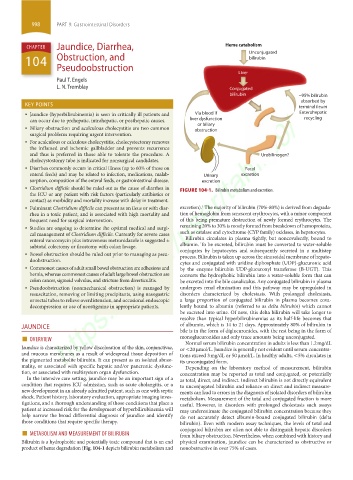
                     • Fulminant Clostridium difficile can present as an ileus or with diar-  excretion).  The majority of bilirubin (70%-80%) is derived from degrada-
                    rhea in a toxic patient, and is associated with high mortality and   tion of hemoglobin from senescent erythrocytes, with a minor component
                    frequent need for surgical intervention.           of this being premature destruction of newly formed erythrocytes. The
                     • Studies are ongoing to determine the optimal medical and surgi-  remaining 20% to 30% is mostly formed from breakdown of hemoproteins,
                    cal management of Clostridium difficile. Currently for severe cases   such as catalase and cytochrome (CYP family) oxidases, in hepatocytes.
                    enteral vancomycin plus intravenous metronidazole is suggested ±   Bilirubin circulates in plasma tightly, but noncovalently, bound to
                    subtotal colectomy or ileostomy with colon lavage.  albumin. To be excreted, bilirubin must be converted to water-soluble
                     • Bowel obstruction should be ruled out prior to managing as pseu-  conjugates  by  hepatocytes  and  subsequently  secreted  in  a  multistep
                                                                       process. Bilirubin is taken up across the sinusoidal membrane of hepato-
                    doobstruction.                                     cytes and conjugated with uridine diphosphate (UDP)-glucuronic acid
                     • Commonest causes of adult small bowel obstruction are adhesions and   by the enzyme bilirubin UDP-glucuronyl transferase (B-UGT). This
                    hernia, whereas commonest causes of adult large bowel obstruction are   converts the hydrophobic bilirubin into a water-soluble form that can
                    colon cancer, sigmoid volvulus, and stricture from diverticulitis.  be excreted into the bile canaliculus. Any conjugated bilirubin in plasma
                     • Pseudoobstruction (nonmechanical obstruction) is managed by   undergoes renal elimination and this pathway may be upregulated in
                    resuscitation, removing or limiting precipitants, using nasogastric   disorders characterized by cholestasis. With prolonged cholestasis,
                    or rectal tubes to relieve overdistension, and occasional endoscopic   a large proportion of  conjugated  bilirubin  in plasma becomes  cova-
                    decompression or use of neostigmine in appropriate patients.  lently bound to albumin (referred to as delta bilirubin) which cannot
                                                                       be excreted into urine. Of note, this delta bilirubin will take longer to
                                                                       resolve than typical hyperbilirubinemias as its half-life becomes that
                 JAUNDICE                                              of albumin, which is 14 to 21 days. Approximately 80% of bilirubin in
                                                                       bile is in the form of diglucuronides, with the rest being in the form of
                     ■  OVERVIEW                                       monoglucuronides and only trace amounts being unconjugated.
                                                                         Normal serum bilirubin concentration in adults is less than 1.2 mg/dL
                 Jaundice is characterized by yellow discoloration of the skin, conjunctivae,    or <20 µmol/L. Jaundice is generally not evident until serum concentra-
                 and mucous membranes as a result of widespread tissue deposition of   tions exceed 3 mg/dL or 50 µmol/L. In healthy adults, <5% circulates in
                 the pigmented metabolite bilirubin. It can present as an isolated abnor-  its unconjugated form.
                 mality, or associated with specific hepatic and/or pancreatic dysfunc-  Depending on the laboratory method of measurement, bilirubin
                 tion, or associated with multisystem organ dysfunction.  concentration may be reported as total and conjugated, or potentially
                   In the intensive care setting, jaundice may be an important sign of a   as total, direct, and indirect. Indirect bilirubin is not directly equivalent
                 condition that requires ICU admission, such as acute cholangitis, or a   to unconjugated bilirubin and reliance on direct and indirect measure-
                 new development in an already admitted patient, such as one with septic   ments can lead to errors in the diagnosis of isolated disorders of bilirubin
                 shock. Patient history, laboratory evaluation, appropriate imaging inves-  metabolism. Measurement of the total and conjugated fraction is more
                 tigations, and a thorough understanding of those conditions that place a   useful. However, in disorders with prolonged cholestasis such assays
                 patient at increased risk for the development of hyperbilirubinemia will   may underestimate the conjugated bilirubin concentration because they
                 help narrow the broad differential diagnosis of jaundice and identify   do not accurately detect albumin-bound conjugated bilirubin (delta
                 those conditions that require specific therapy.       bilirubin). Even with modern assay techniques, the levels of total and
                     ■  METABOLISM AND MEASUREMENT OF BILIRUBIN        conjugated bilirubin are often not able to distinguish hepatic disorders
                                                                       from biliary obstruction. Nevertheless, when combined with history and
                 Bilirubin is a hydrophobic and potentially toxic compound that is an end   physical examination, jaundice can be characterized as obstructive or
                 product of heme degradation (Fig. 104-1 depicts bilirubin metabolism and   nonobstructive in over 75% of cases.


            section09.indd   998                                                                                       1/14/2015   9:27:03 AM

