


Page 1461 - Hall et al (2015) Principles of Critical Care-McGraw-Hill
P. 1461
1000     PART 9: Gastrointestinal Disorders


                 stones, it provides excellent visualization of the intrahepatic and proxi-
                 mal biliary tree and gallbladder, thereby allowing a diagnosis of biliary
                 dilation to be made and the level of biliary obstruction (intrahepatic,
                 proximal extrahepatic, or distal extrahepatic) to be determined. More
                 recently, studies have demonstrated favorable accuracy of endoscopic
                 ultrasound (EUS) and magnetic resonance cholangiopancreatography
                 (MRCP) when compared to endoscopic retrograde cholangiopancrea-
                 tography (ERCP),  as well as favorable accuracy of computed tomo-
                              11
                 graphic cholangiography (CTC) when compared to EUS in the diagnosis
                 of choledocholithiasis.  EUS has been recently recommended by the
                                  12
                 American Society for Gastrointestinal Endoscopy as being highly accu-
                 rate with fewer complications than ERCP in the detection of choledo-
                 cholithiasis.  Computed tomography provides imaging of not just the
                          13
                 biliary system but the surrounding liver, pancreas, and foregut as well,
                 making it an important investigative technique in determining the etiol-
                 ogy of the biliary obstruction. ERCP is generally reserved as a primarily
                 therapeutic procedure,  although it may be used for diagnosis in centers
                                  3
                 without the availability of other noninvasive modalities.
                   Treatment of acute cholangitis depends on its severity and response to
                 supportive therapies. Supportive care with early intravenous fluid resus-
                 citation and broad-spectrum antibiotics is standard. The most common
                 bacterial pathogens include  Escherichia coli,  Klebsiella,  Enterobacter,
                 Streptococcus, and  Enterococcus, 14,15  with  Clostridium being the most
                 common anaerobe. Patients with biliary stents in situ have a higher
                 rate of polymicrobial infection (90% vs 45% of those without stents).
                                                                    15
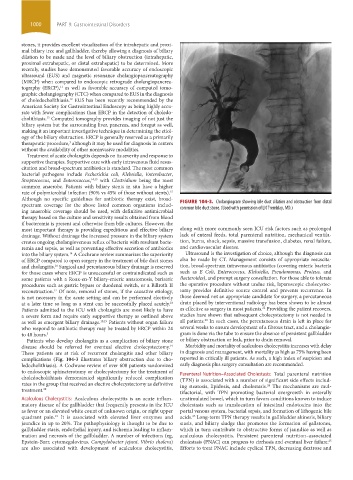
                 Although no specific guidelines for antibiotic therapy exist, broad-  FIGURE 104-3.  Cholangiogram showing bile duct dilation and obstruction from distal
                 spectrum coverage for the above listed common organisms includ-
                 ing  anaerobic  coverage should  be  used,  with  definitive  antimicrobial   common bile duct stone. (Used with permission of LN Tremblay, MD.)
                 therapy based on the culture and sensitivity results obtained from blood
                 if bacteremia is present and otherwise from bile cultures. However, the
                 most  important  therapy  is  providing  expeditious  and  effective  biliary   along with more commonly seen ICU risk factors such as prolonged
                 drainage. Without drainage the increased pressure in the biliary system   lack of enteral feeds, total parenteral nutrition, mechanical ventila-
                 creates ongoing cholangiovenous reflux of bacteria with resultant bacte-  tion, burns, shock, sepsis, massive transfusion, diabetes, renal failure,
                 remia and sepsis, as well as preventing effective secretion of antibiotics   and cardiovascular disease.
                 into the biliary system.  A Cochrane review summarizes the superiority   Ultrasound is the investigation of choice, although the diagnosis can
                                  14
                 of ERCP compared to open surgery in the treatment of bile duct stones   also be made by CT. Management consists of appropriate resuscita-
                 and cholangitis.  Surgical and percutaneous biliary drainage is reserved   tion, broad-spectrum intravenous antibiotics (covering enteric bacteria
                             16
                 for those cases where ERCP is unsuccessful or contraindicated such as   such as  E  Coli,  Enterococcus,  Klebsiella,  Pseudomonas,  Proteus, and
                 some patients with a Roux-en-Y biliary-enteric anastomosis, bariatric   Bacteroides), and prompt surgery consultation. For those able to tolerate
                 procedures such as gastric bypass or duodenal switch, or a Billroth II   the operative procedure without undue risk, laparoscopic cholecystec-
                 reconstruction.  Of note, removal of stones, if the causative etiology,   tomy provides definitive source control and prevents recurrence. In
                            17
                 is not necessary in the acute setting and can be performed electively   those deemed not an appropriate candidate for surgery, a percutaneous
                 at a later time so long as a stent can be successfully placed acutely.    drain placed by interventional radiology has been shown to be almost
                                                                    18
                                                                                                   22
                 Patients admitted to the ICU with cholangitis are most likely to have   as effective as surgery in most patients.  Providing the patient recovers,
                 a severe form and require early supportive therapy as outlined above   studies have shown that subsequent cholecystectomy is not needed in
                                                                                23
                 as well as emergent biliary drainage. 10,19  Patients without organ failure   all patients.  In such cases, the percutaneous drain is left in place for
                 who respond to antibiotic therapy may be treated by ERCP within 24   several weeks to ensure development of a fibrous tract, and a cholangio-
                 to 48 hours. 5                                        gram is done via the tube to ensure the absence of persistent gallbladder
                   Patients who develop cholangitis as a complication of biliary stone   or biliary obstruction or leak, prior to drain removal.
                 disease should be referred for eventual elective cholecystectomy.      Morbidity and mortality of acalculous cholecystitis increases with delay
                                                                    19
                 These patients are at risk of recurrent cholangitis and other biliary   in diagnosis and management, with mortality as high as 75% having been
                 complications (Fig. 104-3 illustrates biliary obstruction due to cho-  reported in critically ill patients. As such, a high index of suspicion and
                 ledocholithiasis). A Cochrane review of over 600 patients randomized   early diagnosis plus surgery consultation are recommended.
                 to endoscopic sphincterotomy or cholecystectomy for the treatment of   Parenteral  Nutrition–Associated  Cholestasis:  Total  parenteral  nutrition
                 choledocholithiasis demonstrated significantly reduced complication   (TPN) is associated with a number of significant side effects includ-
                 rates in the group that received an elective cholecystectomy as definitive   ing steatosis, lipidosis, and cholestasis.  The mechanisms are mul-
                                                                                                     24
                 treatment. 20                                         tifactorial, with TPN promoting bacterial overgrowth in enterally
                 Acalculous Cholecystitis:  Acalculous  cholecystitis  is  an  acute  inflam-  unstimulated bowel, which in turn favors conditions known to induce
                 matory disease of the gallbladder that frequently presents in the ICU   cholestasis such as translocation of intestinal endotoxins into the
                 as fever or an elevated white count of unknown origin, or right upper   portal venous system, bacterial sepsis, and formation of lithogenic bile
                 quadrant pain.  It is associated with elevated liver enzymes and   acids.  Long-term TPN therapy results in gallbladder akinesis, biliary
                                                                           25
                             21
                 jaundice in up to 20%. The pathophysiology is thought to be due to   stasis, and biliary sludge that promotes the formation of gallstones,
                 gallbladder stasis, endothelial injury, and ischemia leading to inflam-  which in turn contribute to obstructive forms of jaundice as well as
                 mation and necrosis of the gallbladder. A number of infections (eg,   acalculous cholecystitis. Persistent parenteral nutrition– associated
                 Epstein-Barr, cytomegalovirus, Campylobacter jejuni, Vibrio cholera)   cholestasis (PNAC) can progress to cirrhosis and eventual liver failure.
                                                                                                                          25
                 are also  associated  with development of acalculous cholecystitis,   Efforts to treat PNAC include cyclical TPN, decreasing  dextrose and


            section09.indd   1000                                                                                      1/14/2015   9:27:05 AM

