


Page 1460 - Hall et al (2015) Principles of Critical Care-McGraw-Hill
P. 1460
CHAPTER 104: Jaundice, Diarrhea, Obstruction, and Pseudoobstruction  999

                        ■  ETIOLOGY OF JAUNDICE                                   Jaundice

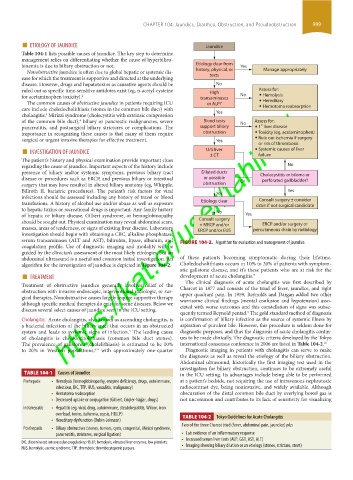
                    Table 104-1 lists possible causes of jaundice. The key step to determine
                    management relies on differentiating whether the cause of hyperbiliru-
                    binemia is due to biliary obstruction or not.              Etiology clear from  Yes
                     Nonobstructive jaundice is often due to global hepatic or systemic dis-  history, physical, or  Manage appropriately
                    ease for which the treatment is supportive and directed at the underlying   tests
                    disease. However, drugs and hepatotoxins as causative agents should be   No
                    ruled out as specific time-sensitive antidotes exist (eg, n-acetyl-cysteine   High  Assess for:
                    for acetaminophen toxicity). 2                               transaminases  No      Hemolysis
                     The common causes of obstructive jaundice in patients requiring ICU   or ALP?      Hereditary
                                  https://kat.cr/user/tahir99/
                    care include choledocholithiasis (stones in the common bile duct) with              Hemotoma reabsorption
                            3
                    cholangitis,  Mirizzi syndrome (cholecystitis with extrinsic compression   Yes
                    of the common bile duct),  biliary or pancreatic malignancies, severe   Blood tests  No  Assess for:
                                       4
                                                                                                     º
                    pancreatitis, and postsurgical biliary strictures or complications. The   support biliary      1  liver disease
                    importance in recognizing these causes is that many of them require   obstruction      Toxicity (eg, acetaminophen)
                    surgical or urgent invasive therapies for effective treatment.    Yes              Rule out ischemia if surgery
                        ■  INVESTIGATION OF JAUNDICE                               U/S liver           Systemic causes of liver
                                                                                                       or risk of thrombosis
                    The patient’s history and physical examination provide important clues   ± CT      failure
                    regarding the cause of jaundice. Important aspects of the history include                 No
                    presence of biliary and/or systemic symptoms, previous biliary tract   Dilated ducts  Cholecystitis or biloma or
                    disease or procedures such as ERCP, and previous biliary or intestinal   or possible  Or  perforated gallbladder?
                    surgery that may have resulted in altered biliary anatomy (eg, Whipple,   obstruction
                    Billroth II, bariatric procedures). The patient’s risk factors for viral   Yes            Yes
                    infections should be assessed including any history of travel or blood
                                                                                                    Consult surgery ± consider
                    transfusions. A history of alcohol use and/or abuse as well as exposure   Etiology clear  drain if not surgical candidate
                    to hepatic toxins or recreational drugs is important. Any family history
                    of hepatic or biliary disease, Gilbert syndrome, or hemoglobinopathy   No   Yes
                    should be sought out. Physical examination may reveal abdominal scars,   Consult surgery  ERCP and/or surgery or
                                                                                + MRCP and/or
                    masses, areas of tenderness, or signs of existing liver disease. Laboratory   ERCP and/or EUS  percutaneous drain by radiology
                    investigation should begin with obtaining a CBC, alkaline phosphatase,
                    serum transaminases (ALT and AST), bilirubin, lipase, albumin, and   FIGURE 104-2.  Algorithm for evaluation and management of jaundice.
                    coagulation profile. Use of diagnostic imaging and modality will be
                    guided by the clinician’s assessment of the most likely etiologies, but an
                    abdominal ultrasound is a useful and common initial investigation. An   of these patients becoming symptomatic during their lifetime.
                    algorithm for the investigation of jaundice is depicted in Figure 104-2.  Choledocholithiasis occurs in 10% to 20% of patients with symptom-
                        ■  TREATMENT                                      atic gallstone disease, and it’s these patients who are at risk for the
                                                                            development of acute cholangitis.
                                                                                                   5
                                                                           The clinical diagnosis  of acute  cholangitis was first  described  by
                    Treatment of obstructive jaundice generally involves relief of the   Charcot in 1877 and consists of the triad of fever, jaundice, and right
                    obstruction with invasive endoscopic, interventional radiologic, or sur-  upper quadrant pain. In 1959, Reynolds and Dargan added two other
                    gical therapies. Nonobstructive causes largely require supportive therapy   worrisome clinical findings (mental confusion and hypotension) asso-
                    although specific medical therapies do exist for some diseases. Below we   ciated with worse outcomes and this constellation of signs was subse-
                    discuss several select causes of jaundice seen in the ICU setting.
                                                                          quently termed Reynold pentad.  The gold standard method of diagnosis
                                                                                                 9
                    Cholangitis:  Acute cholangitis, also known as ascending cholangitis, is   is confirmation of biliary infection as the source of systemic illness by
                    a bacterial infection of the biliary tract that occurs in an obstructed   aspiration of purulent bile. However, this procedure is seldom done for
                                                        5
                    system and leads to systemic signs of infection.  The leading cause   diagnostic purposes, and thus the diagnosis of acute cholangitis contin-
                    of cholangitis is choledocholithiasis (common bile duct stones).   ues to be made clinically. The diagnostic criteria developed by the Tokyo
                    The prevalence of gallstones (cholelithiasis) is estimated to be 10%   international consensus conference in 2006 are listed in Table 104-2. 10
                    to 20% in Western populations,  with approximately one-quarter    Diagnostic imaging in patients  with cholangitis can serve to make
                                             6-8
                                                                          the diagnosis as well as reveal the etiology of the biliary obstruction.
                                                                          Abdominal ultrasound, historically the first imaging test used in the
                                                                          investigation for biliary obstruction, continues to be extremely useful
                      TABLE 104-1    Causes of Jaundice                   in the ICU setting. Its advantages include being able to be performed
                    Prehepatic  •  Hemolysis (hemoglobinopathy, enzyme deficiency, drugs, autoimmune,    at a patient’s bedside, not requiring the use of intravenous nephrotoxic
                               infectious, DIC, TTP, HUS, vasculitis, malignancy)  radiocontrast dye, being noninvasive, and widely available. Although
                              •  Hematoma reabsorption                    obscuration of the distal common bile duct by overlying bowel gas is
                              •  Decreased uptake or conjugation (Gilbert, Crigler-Najjar, drugs)  not uncommon and contributes to its lack of sensitivity for visualizing
                    Intrahepatic  •  Hepatitis (eg, viral, drug, autoimmune, steatohepatitis, Wilson, iron
                               overload, toxins, ischemia, sepsis, HELLP)    TABLE 104-2    Tokyo Guidelines for Acute Cholangitis
                              •  Hereditary dysfunction (Dubin-Johnson)
                                                                          Two of the three Charcot triad (fever, abdominal pain, jaundice) plus
                    Posthepatic  •  Biliary obstruction (stones, tumors, cysts, congenital, Mirizzi syndrome,
                               pancreatitis, strictures, surgical ligation)  •  Lab evidence of an inflammatory response
                                                                          •  Increased serum liver tests (ALP, GGT, AST, ALT)
                    DIC, disseminated intravascular coagulation; HELLP, hemolysis, elevated liver enzymes, low platelets;   •  Imaging showing biliary dilation or an etiology (stones, stricture, stent)
                    HUS, hemolytic-uremic syndrome; TTP, thrombotic thrombocytopenic purpura.


            section09.indd   999                                                                                       1/14/2015   9:27:04 AM

