


Page 1474 - Hall et al (2015) Principles of Critical Care-McGraw-Hill
P. 1474
CHAPTER 105: Gastrointestinal Hemorrhage  1013


                        A                                                 placement because inadvertent inflation of the balloon in the esopha-
                                                                          gus can lead to esophageal perforation. Once adequate positioning
                                                                          is ensured, the gastric balloon can be inflated fully according to the
                                                                          manufacturer’s recommendations (gastric balloons are inflated to
                                                                          predetermined volumes, whereas the esophageal balloon component
                                                                          is inflated according to pressure). If hemostasis is not achieved by
                                                                          isolated inflation of the gastric balloon, the esophageal balloon can be
                                                                          inflated to 35 mm Hg, a pressure exceeding the intravariceal pressure.
                                                                          Following inflation, traction should be applied to the apparatus at
                                                                          the insertion site to maintain proper positioning. A maximum dura-
                                                                          tion of 48 hours is recommended for variceal compression because
                                                    Varix                 prolonged tamponade can lead to esophageal wall ischemia. A naso-
                                                                          gastric tube inserted above the esophageal balloon is mandatory to
                                                                          prevent aspiration of oropharyngeal secretions that collect above the
                                                                          inflated apparatus (eg, Sengstaken-Blakemore tube), unless the tube
                                 Lumen
                                                                          has its own lumen for esophageal suction (eg, Minnesota tube). A
                                                                          major limitation of tamponade therapy is the high risk of rebleeding
                                                                          following deflation of the balloon. Furthermore, given the serious
                                                                          complications of pulmonary aspiration and esophageal ulceration
                                                                          and perforation, this mode of therapy should be performed by skilled
                                                                          personnel and generally as a temporizing step while planning defini-
                        B                                                 tive treatment such as a TIPS. For gastric varices, balloon tamponade
                                                                          should be attempted using the Linton-Nachlas tube which has a
                                                                          600-mL volume single gastric balloon that seems to be more effective
                                                                          in controlling fundal variceal bleeding. 47
                                                                          Transjugular Intrahepatic Portosystemic Shunt:  Following temporary stabi-
                                                                          lization with balloon tamponade, further definitive treatment to achieve
                                                                          hemostasis involves the creation of an artificial vascular shunt between
                                                                          the systemic and portal circulation in order to decompress the variceal
                                                                          vasculature. This can be accomplished surgically (discussed below) or via
                                                                          TIPS, which offers a less invasive method for obtaining a vascular shunt.
                                                                          The TIPS consists of an expandable metallic stent placed intrahepatically
                                                                          between  portal  and  hepatic  veins using  radiologically  guided access.
                                                     Rubber band          Traditionally, TIPS has been recommended as secondary prophylactic
                                                                          therapy  for  variceal  bleeding  in  the  setting  of  mild  to  moderate  liver
                                                                          disease, and advanced cirrhosis has been regarded as a contraindication
                                        Varix                             to TIPS therapy due to increased mortality after TIPS in this setting.
                                                                          However, recent studies with favorable hemostasis and mortality data
                              Edge                                        have supported the use of emergent TIPS as salvage therapy for refractory
                             of ligator                                   variceal hemorrhage, even in advanced cirrhosis. 48,49  Therefore, when vari-
                                                                          ceal hemorrhage is refractory to pharmacologic and endoscopic therapy,
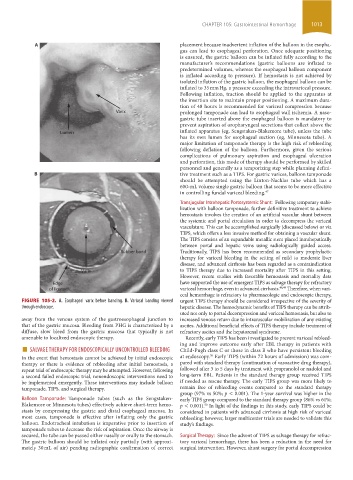
                    FIGURE 105-2.  A. Esophageal varix before banding.  B.  Variceal banding viewed     urgent TIPS therapy should be considered irrespective of the severity of
                    through endoscope.                                    hepatic disease. The hemodynamic benefits of TIPS therapy can be attrib-
                                                                          uted not only to portal decompression and variceal hemostasis, but also to
                    away from the venous system of the gastroesophageal junction to   increased venous return due to intravascular mobilization of any existing
                    that of the gastric mucosa. Bleeding from PHG is characterized by a     ascites. Additional beneficial effects of TIPS therapy include treatment of
                    diffuse, slow bleed from the gastric mucosa that typically is not    refractory ascites and the hepatorenal syndrome.
                    amenable to localized endoscopic therapy.              Recently, early TIPS has been investigated to prevent variceal rebleed-
                        ■  SALVAGE THERAPY FOR ENDOSCOPICALLY UNCONTROLLED BLEEDING  ing and improve outcome early after EBL therapy in patients with
                                                                          Child-Pugh class C or those in class B who have persistent bleeding
                                                                                    50
                    In the event that hemostasis cannot be achieved by initial endoscopic   at endoscopy.  Early TIPS (within 72 hours of admission) was com-
                    therapy or there is evidence of rebleeding after initial hemostasis, a   pared with standard therapy (continuation of vasoactive drug therapy),
                    repeat trial of endoscopic therapy may be attempted. However, following   followed after 3 to 5 days by treatment with propranolol or nadolol and
                    a second failed endoscopic trial, nonendoscopic interventions need to   long-term EBL. Patients in the standard therapy group received TIPS
                    be implemented emergently. These interventions may include balloon   if needed as rescue therapy. The early TIPS group was more likely to
                    tamponade, TIPS, and surgical therapy.                remain free of rebleeding events compared to the standard therapy
                                                                          group (97% vs 50%; p < 0.001). The 1-year survival was higher in the
                    Balloon Tamponade:  Tamponade tubes (such as the Sengstaken-  early TIPS group compared to the standard therapy group (86% vs 61%;
                    Blakemore or Minnesota tubes) effectively achieve short-term hemo-  p < 0.001).  In light of the findings in this study, early TIPS could be
                                                                                  50
                    stasis by compressing the gastric and distal esophageal mucosa. In   considered in patients with advanced cirrhosis at high risk of variceal
                    most cases, tamponade is effective after inflating only the gastric   rebleeding; however, larger multicenter trials are needed to validate this
                    balloon. Endotracheal intubation is imperative prior to insertion of   study’s findings.
                    tamponade tubes to decrease the risk of aspiration. Once the airway is
                    secured, the tube can be passed either nasally or orally to the stomach.   Surgical Therapy:  Since the advent of TIPS as salvage therapy for refrac-
                    The gastric balloon should be inflated only partially (with approxi-  tory variceal hemorrhage, there has been a reduction in the need for
                    mately  30 mL  of  air)  pending  radiographic  confirmation  of  correct   surgical intervention. However, shunt surgery for portal decompression


            section09.indd   1013                                                                                      1/14/2015   9:27:11 AM

