


Page 1477 - Hall et al (2015) Principles of Critical Care-McGraw-Hill
P. 1477
1016     PART 9: Gastrointestinal Disorders


                      A                                                rebleeding. Studies comparing standard-dose PPIs given by intermittent
                                                                       intravenous infusion once or twice daily to continuous high-dose infu-
                                             Pylorus
                                                                       sion over 72 hours have shown equal efficacy of both regimens, with
                                                                       similar rebleeding rates and mortality. 67,68  This suggests that intermittent
                               Gastric                                 dosing may be an equally efficacious regimen for prevention of bleeding.
                               antrum                                  Splanchnic vasoconstrictors such as somatostatin and octreotide are not
                                                                       routinely recommended for patients with acute ulcer bleeding.  These
                                                                                                                     16
                                                                       can be considered in patients that cannot get endoscopy for any reason,
                                                                       or for those with profuse bleeding awaiting surgery.
                                                                       Angiography:  In most cases of nonvariceal hemorrhage, endoscopic
                                                                       evaluation is able to visualize the bleeding lesion and deliver effective
                                                                       hemostatic therapy. However, in a minority of patients, the bleeding
                                                                       source  is  not  visualized  by  endoscopy,  thereby  necessitating  angio-
                                                                       graphic localization. Also, angiography offers the option of hemostatic
                                                                       therapy using arterial vasoconstrictors or embolization; however, this
                                                                       generally is reserved for patients who are poor surgical candidates or for
                                                                       the control of bleeding in an unstable patient awaiting surgery.
                                  Bleeding ulcer                       Localization  As mentioned previously, angiography can successfully local-
                                                                       ize  brisk  UGI  bleeding  (rate  >0.5 mL/min)  in  75%  of  cases,   with
                                                                                                                      69
                                                                       most  bleeding  episodes  (85%)  originating  from  a  branch  of  the  left
                      B                                                gastric artery. The right gastric and short gastric arteries account for the
                                                                       remainder of the sources.
                                          Pylorus
                                                                       Hemostatic Therapy  UGI arterial bleeding can be controlled by the selective
                                                                       arterial infusion of vasoconstrictors such as vasopressin or embolization
                                                                       of particulate matter. Most studies indicate that selective intra-arterial
                                                                       vasopressin is more effective than a peripheral intravenous infusion in
                                                                       achieving hemostasis.  Since the vasoconstrictive action of vasopres-
                                                                                       70
                                                                       sin is more pronounced on terminal blood vessels such as arterioles,
                                                                       venules, and capillaries, this therapy is more effective in controlling
                                                                       bleeding from such vessels, as in diffuse hemorrhagic gastritis, rather
                                                                       than a duodenal ulcer bleed originating from a large gastroduodenal
                                                                       artery. In the setting of gastric bleeding, therapy appears to be equally
                                                                                                                    71
                                           Hemostasis at               effective when administered via the left gastric or celiac artery.  A usual
                                           bleeding site               therapeutic vasopressin dose is 0.2 unit/min, with a recommended
                                                                       maximum dose of 0.4 unit/min. If hemostasis is achieved, the infu-
                                                                       sion is continued in the ICU for 24 to 36 hours and then tapered over
                                                                       24 hours. Rebleeding after cessation of the infusion is a concern  and
                                                                                                                       71
                                                                       can be treated with repeat vasopressin treatment or embolization.
                                                                         Embolization therapy uses various substances, most frequently a gela-
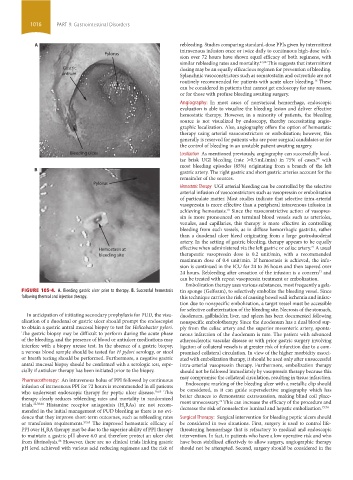
                 FIGURE  105-4.  A. Bleeding gastric ulcer prior to therapy.  B. Successful hemostasis   tin sponge (Gelfoam), to selectively embolize the bleeding vessel. Since
                   following thermal and injection therapy.            this technique carries the risk of causing bowel wall ischemia and infarc-
                                                                       tion due to nonspecific embolization, a target vessel must be accessible
                                                                       for selective catheterization of the bleeding site. Necrosis of the stomach,
                   In anticipation of initiating secondary prophylaxis for PUD, the visu-  duodenum, gallbladder, liver, and spleen has been documented following
                 alization of a duodenal or gastric ulcer should prompt the endoscopist   nonspecific embolotherapy. Since the duodenum has a dual blood sup-
                 to obtain a gastric antral mucosal biopsy to test for Helicobacter pylori.   ply from the celiac artery and the superior mesenteric artery, sponta-
                 The gastric biopsy may be difficult to perform during the acute phase   neous infarction of the duodenum is rare. The patient with advanced
                 of the bleeding, and the presence of blood or antiulcer medications may   atherosclerotic vascular disease or with prior gastric surgery involving
                 interfere with a biopsy urease test. In the absence of a gastric biopsy,   ligation of collateral vessels is at greater risk of infarction due to a com-
                 a venous blood sample should be tested for H pylori serology, or stool   promised collateral circulation. In view of the higher morbidity associ-
                 or breath testing should be performed. Furthermore, a negative gastric   ated with embolization therapy, it should be used only after unsuccessful
                 antral mucosal biopsy should be confirmed with a serologic test, espe-  intra-arterial vasopressin therapy. Furthermore, embolization therapy
                 cially if antiulcer therapy has been initiated prior to the biopsy.  should not be followed immediately by vasopressin therapy because this
                 Pharmacotherapy:  An intravenous bolus of PPI followed by continuous   may compromise the collateral circulation, resulting in tissue infarction.
                 infusion of intravenous PPI for 72 hours is recommended in all patients   Endoscopic marking of the bleeding ulcer with a metallic clip should
                 who underwent endoscopic therapy for peptic ulcer disease. 16,63  This   be  considered,  as  it  can  guide  superselective  angiography  which  has
                 therapy clearly reduces rebleeding rates and mortality in randomized   better chances to demonstrate extravasation, making blind coil place-
                                                                                     72
                 trials. 22,58,64   Histamine  receptor  antagonists  (H RAs)  are  not  recom-  ment unnecessary.  This can increase the efficacy of the procedure and
                                                    2
                                                                                                                        73,74
                 mended in the initial management of PUD bleeding as there is no evi-  decrease the risk of nonselective luminal and hepatic embolization.
                 dence that they improve short-term outcomes, such as rebleeding rates   Surgical Therapy:  Surgical intervention for bleeding peptic ulcers should
                 or transfusion requirements. 57,65  The improved hemostatic efficacy of   be considered in two situations. First, surgery is used to control life-
                 PPI over H RA therapy may be due to the superior ability of PPI therapy   threatening hemorrhage that is refractory to medical and endoscopic
                         2
                 to maintain a gastric pH above 6.0 and therefore protect an ulcer clot   intervention. In fact, in patients who have a low operative risk and who
                 from fibrinolysis.  However, there are no clinical trials linking gastric   have been stabilized effectively to allow surgery, angiographic therapy
                              66
                 pH level achieved with various acid reducing regimens and the risk of   should not be attempted. Second, surgery should be considered in the


            section09.indd   1016                                                                                      1/14/2015   9:27:13 AM

