


Page 1472 - Hall et al (2015) Principles of Critical Care-McGraw-Hill
P. 1472
CHAPTER 105: Gastrointestinal Hemorrhage  1011


                      TABLE 105-3    Child-Pugh Classification of Hepatic Disease Severity  should be the vasoactive agent of choice. Agents that have β -agonist
                                                                                                                       2
                                                                          activity, such as dopamine, should be avoided because they potentially
                    Points Assigned                                       could cause splanchnic vasodilation and therefore worsen the variceal
                    Parameter          1          2             3         bleed. Splanchnic vasoconstrictors such as octreotide and terlipressin
                                                                          (discussed later) can have a beneficial effect on systemic blood pressure
                    Ascites            Absent     Slight        Moderate
                                                                          by diverting blood away from the splanchnic circulation. Endotracheal
                    Bilirubin (mg/dL)  <2         2-3           >3        intubation for airway protection is critical, especially in the setting of
                    Albumin (g/dL)     >3.5       2.8-3.5       <2.8      encephalopathy, active hematemesis, or emergent endoscopy.
                    INR                <1.7       1.8-2.3       >2.3      Infection:  Cirrhosis is characterized by cellular and humoral immune
                    Encephalopathy     None       Grade 1-2     Grade 3-4  dysfunction, and increased bacterial translocation from the gut into
                                                                          the bloodstream, facilitating the development of infections. The most
                    Total Score (Five Parameters)           Child-Pugh Stage  common bacterial infections are caused by gram-negative bacteria, pro-
                    5-6                                     A             ducing spontaneous bacterial peritonitis (25%), urinary tract infections
                                                                          (20%), pneumonia (15%), and bacteremia (12%). 29,30  The presence of
                    7-9                                     B
                                                                          infection has been associated with failure to control the initial bleed and
                    10-15                                   C             an increase in the recurrence of rebleeding, likely owing to the induc-
                                                                          tion of a hyperdynamic circulation and increased portal pressure. 31,32
                    hemorrhage in the setting of cirrhosis predisposes the patient to specific   A recent meta-analysis and systematic review of studies regarding the
                    derangements, including hepatic encephalopathy, type 1 hepatorenal   use of prophylactic antibiotics in cirrhotics with upper gastrointestinal
                    syndrome, and systemic infection. These processes contribute to the   bleeding  concluded that antibiotics reduced bacterial infections, all-
                    high mortality associated with variceal bleeding, and therefore, the man-  cause mortality, bacterial infection–related mortality, rebleeding events,
                                                                                             29
                    agement should address these issues in addition to achieving hemostasis   and hospitalization length ; therefore, the administration of antibiot-
                    and hemodynamic stability.                            ics in the setting of variceal bleeding has become the standard of care.
                                                                          Although most of the pertinent studies include a quinolone, the optimal
                    Cardiopulmonary:  Fluid resuscitation should be aimed at achieving   choice and duration of antibiotic therapy have not been defined, and
                    a euvolemic status because this approach prevents persistent portal   therefore, the choice of empiric antibiotic therapy should be institution
                    hypertension and  recurrent variceal bleeding.   To  this  end,  invasive   specific. One study from Spain showed that intravenous ceftriaxone is
                                                      28
                    hemodynamic monitoring with a central venous catheter can be used   more effective than oral norfloxacin ; however, this was likely second-
                                                                                                    33
                    to guide fluid therapy. In the setting of hypotension that is refractory to   ary to high incidence of quinolone resistance in that patient population.
                    fluid resuscitation, a peripheral vasoconstrictor such as  norepinephrine   The choice of nonfluoroquinolone antibiotic therapy is an important


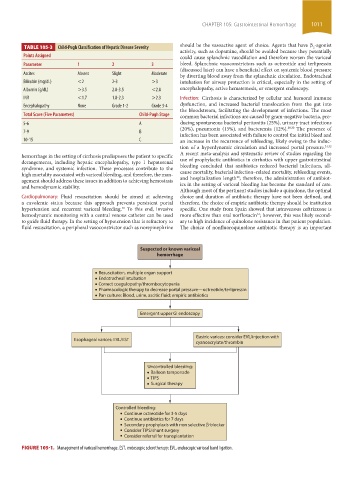
                                                            Suspected or known variceal
                                                                  hemorrhage


                                             •  Resuscitation, multiple organ support
                                             •  Endotracheal intubation
                                             •  Correct coagulopathy/thrombocytopenia
                                             •  Pharmacologic therapy to decrease portal pressure—octreotide/terlipressin
                                             •  Pan culture: Blood, urine, ascitic fluid; empiric antibiotics


                                                            Emergent upper GI endoscopy


                                                                               Gastric varices: consider EVL/injection with
                                      Esophageal varices: EVL/EST
                                                                               cyanoacrylate/thrombin


                                                              Uncontrolled bleeding:
                                                              •  Balloon tamponade
                                                              •  TIPS
                                                              •  Surgical therapy


                                                    Controlled bleeding:
                                                       Continue octreotide for 3-5 days
                                                       Continue antibiotics for 7 days
                                                       Secondary prophylaxis with non selective  -blocker
                                                       Consider TIPS/shunt surgery
                                                       Consider referral for transplantation
                    FIGURE 105-1.  Management of variceal hemorrhage. EST, endoscopic sclerotherapy; EVL, endoscopic variceal band ligation.


            section09.indd   1011                                                                                      1/19/2015   10:54:27 PM

