


Page 1483 - Hall et al (2015) Principles of Critical Care-McGraw-Hill
P. 1483
1022     PART 9: Gastrointestinal Disorders


                   CHAPTER   Acute Liver Failure                       in volume; splenomegaly is a feature and ascites may be present. This
                                                                       group has a very poor chance of spontaneous survival while the acute/
                  106        Julia Wendon                              fulminant presentations have a greater chance of spontaneous recovery
                                                                       despite having a greater manifestation of extrahepatic organ failure.
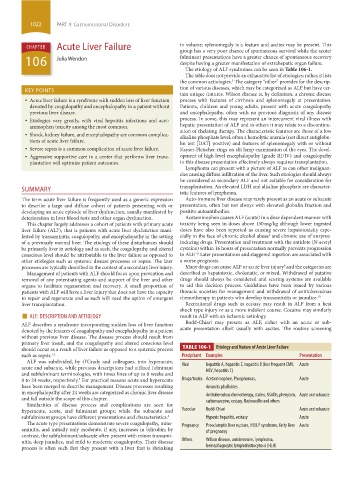
                                                                         The etiology of ALF syndromes can be seen in Table 106-1.
                                                                         The table does not provide an exhaustive list of etiologies; rather, it lists
                                                                       the common aetiologies.  The category “other” provides for the descrip-
                                                                                         5
                                                                       tion of various diseases, which may be categorized as ALF but have cer-
                  KEY POINTS
                                                                       tain unique features. Wilson disease is, by definition, a chronic disease
                     • Acute liver failure is a syndrome with sudden loss of liver function   process with  features  of  cirrhosis  and  splenomegaly  at  presentation.
                    denoted by coagulopathy and encephalopathy in a patient without   Patients,  children  and  young  adults,  present with  acute  coagulopathy
                    previous liver disease.                            and encephalopathy, often with no previous diagnosis of any disease
                     • Etiologies vary greatly, with viral hepatitis infections and acet-  process. In some, this may represent an intercurrent viral illness with
                    aminophen toxicity among the most common.          hepatic presentation of ALF and in others it may relate to a discontinu-
                     • Shock, kidney failure, and encephalopathy are common complica-  ation of chelating therapy. The characteristic features are those of a low
                                                                       alkaline phosphate level, often a hemolytic anemia (not direct antiglobu-
                    tions of acute liver failure.                      lin test [DAT] positive) and features of splenomegaly with or without
                     • Severe sepsis is a common complication of acute liver failure.  Kayser-Fleischer rings on slit lamp examination of the eyes. The devel-
                     • Aggressive supportive care in a center that performs liver trans-  opment of high level encephalopathy (grade III/IV) and coagulopathy
                    plantation will optimize patient outcomes.         in this disease presentation effectively always requires transplantation.
                                                                         Lymphoma can present with a picture of ALF as can other malignan-
                                                                       cies causing diffuse infiltration of the liver. Such etiologies should always
                                                                       be considered as secondary ALF and not suitable for consideration for
                 SUMMARY                                               transplantation. An elevated LDH and alkaline phosphate are character-
                                                                       istic features of lymphoma.
                 The term acute liver failure is frequently used as a generic expression   Auto-immune liver disease may rarely present as an acute or subacute
                 to describe a large and diffuse cohort of patients presenting with or   presentation, often but not always with elevated globulin fraction and
                 developing an acute episode of liver dysfunction, usually manifested by   positive autoantibodies.
                 deterioration in liver blood tests and other organ dysfunction.  Acetaminophen causes ALF (acute) in a dose dependent manner with
                   This chapter largely addresses a cohort of patients with primary acute   toxicity being seen in doses above 150 mg/kg although lower ingested
                 liver failure (ALF), that is patients with acute liver dysfunction mani-  doses have also been reported as causing severe hepatotoxicity espe-
                 fested by transaminitis, coagulopathy, and encephalopathy in the setting   cially in the face of chronic alcohol abuse  and chronic use of enzyme-
                                                                                                     6
                 of a previously normal liver. The etiology of these disturbances should   inducing drugs. Presentation and treatment with the antidote (N-acetyl
                 be primarily liver in aetiology and as such, the coagulopathy and altered   cysteine) within 16 hours of presentation normally prevents progression
                                                                            7,8
                 conscious level should be attributable to the liver failure as opposed to   to ALF.  Later presentations and staggered ingestion are associated with
                 other etiologies such as systemic disease processes or sepsis. The later   a worse prognosis.
                 processes are typically described in the context of a secondary liver injury.  Many drugs can cause ALF or acute liver injury  and the categories are
                                                                                                           9
                   Management of patients with ALF should focus upon prevention and   described as hepatotoxic, cholestatic, or mixed. Withdrawal of putative
                 removal of any potentiating agents and support of the liver and other   drugs  should  always  be  considered  and  scoring  systems  are  available
                 organs to facilitate regeneration and recovery. A small proportion of   to aid this decision process. Guidelines have been issued by various
                 patients with ALF will have a liver injury that does not have the capacity   thoracic societies for management and withdrawal of antituberculous
                 to repair and regenerate and as such will need the option of emergent   chemotherapy in patients who develop transaminitis or jaundice. 10
                 liver transplantation.                                  Recreational drugs such as ecstasy may result in ALF from a heat
                     ■  ALF: DESCRIPTION AND AETIOLOGY                 shock type injury or as a more indolent course. Cocaine may similarly
                                                                       result in ALF with an ischemic aetiology.
                 ALF describes a syndrome incorporating sudden loss of liver function   Budd-Chiari may present as ALF, either with an acute or sub-
                 denoted by the features of coagulopathy and encephalopathy in a patient   acute presentation albeit usually with ascites. The routine screening
                 without previous liver disease. The disease process should result from
                 primary liver insult, and the coagulopathy and altered conscious level
                 should occur as a result of liver failure as opposed to a systemic process     TABLE 106-1    Etiology and Nature of Acute Liver Failure
                 such as sepsis. 1,2                                    Precipitant Examples                    Presentation
                   ALF was subdivided, by O’Grady and colleagues, into hyperacute,
                 acute and subacute, while previous descriptions had utilized fulminant   Viral  hepatitis A, hepatitis E, hepatitis B (less frequent CMV,  Acute
                 and subfulminant terminologies, with times lines of up to 8 weeks and   HSV, hepatitis C)
                 8 to 24 weeks, respectively.  For practical reasons acute and hyperacute   Drugs/toxins Acetaminophen, Phosphorous,  Acute
                                     3
                 have been merged to describe management. Disease processes resulting   Amanita phalloides
                 in encephalopathy after 24 weeks are categorized as chronic liver disease   Antituberculous chemotherapy, statins, NSAIDs, phenytoin,  Acute and subacute
                 and fall outside the scope of this chapter.                    carbamazepine, ecstasy, flucloxacillin and others
                   Similarities of  disease  process and  complications are seen for
                 hyperacute,  acute,  and  fulminant  groups;  while  the  subacute  and   Vascular  Budd-Chiari  Acute and subacute
                 subfulminant groups have different presentations and characteristics. 4  Hypoxic hepatitis, ecstasy  Acute
                   The acute type presentations demonstrate severe coagulopathy, trans-  Pregnancy  Preeclamptic liver rupture, HELLP syndrome, fatty liver   Acute
                 aminitis, and initially only moderate, if any, increases in bilirubin; by     of pregnancy
                 contrast, the subfulminant/subacute often present with minor transami-
                 nitis, deep jaundice, and mild to moderate coagulopathy. Their disease   Others  Wilson disease, autoimmune, lymphoma,
                 process is often such that they present with a liver that is shrinking     hemophagocytic lymphohistiocytosis (HLH)


            section09.indd   1022                                                                                      1/14/2015   9:27:16 AM

