


Page 1488 - Hall et al (2015) Principles of Critical Care-McGraw-Hill
P. 1488
CHAPTER 107: Management of the Patient With Cirrhosis  1027


                    on chronic liver failure require a systematic multiorgan system approach     TABLE 107-1    Grading of Hepatic Encephalopathy Based on West Haven Criteria
                    to management in order to address hepatic and extrahepatic organ dys-
                    function. An optimization of  hepatic and extrahepatic derangements,   Clinical Manifestations
                    including cardiopulmonary, neurologic and renal dysfunction, is essential   Grade I  Decreased attention span/concentration; abnormal sleep pattern; mildly
                    for the successful management of the critically ill cirrhotic patient.  slowed mentation; mild confusion; minimal changes in memory
                        ■  ACUTE ON CHRONIC LIVER FAILURE                 Grade II   Lethargy; inappropriate behavior; slurred speech; personality changes

                    The pathophysiology and sequelae of chronic liver disease warrant a   Grade III  Somnolence; disorientation; marked confusion; incomprehensible speech
                    unique approach to ICU management and treatment of disease. Namely,   Grade IV  Unresponsive to verbal or noxious stimuli; coma
                    portal hypertension marks the transition from compensated to decom-
                    pensated cirrhosis, resulting in life-threatening conditions including
                    gastrointestinal variceal bleeding, hepatorenal syndrome, pulmonary   the ICU setting, given that patients with cirrhosis are sensitive to sedat-
                    complications, and hepatic encephalopathy. 1          ing agents, a shorter acting agent such as propofol is preferred.  Imaging
                                                                                                                      7
                     Portal hypertension in cirrhosis is a result of the combined effect   of the brain should also be considered to rule out other etiologies of
                    of intrahepatic resistance to portal flow and increased portal inflow.   altered mental status including CVA, intracranial bleed, or masses. The
                    The resistance to portal flow consists of both fixed and functional   precipitating factor(s) of hepatic encephalopathy must be identified and
                    components. The fixed component occurs from sinusoidal fibrosis and   treated. These include gastrointestinal bleeding, infection, alkalosis or
                    compression by regenerative nodules. The functional component is sec-  acidosis, electrolyte disturbances, overdiuresis, dehydration, placement
                    ondary to vasoconstriction, resulting from both decreased intrahepatic   of recent TIPS, constipation, medication or dietary noncompliance,
                    nitric oxide and enhanced intrahepatic vasoconstrictor activity. The   sedatives, tranquilizers, narcotics,  or  progressive hepatic dysfunc-
                    paradoxical decreased intrahepatic nitric oxide and overproduction of   tion. Supportive care with IV fluid hydration, correction of electrolyte
                    extrahepatic nitric oxide produces splanchnic vasodilation and increased     disturbances, and aspiration and fall precautions should be instituted.
                    portal inflow. Combined, the effects of the intrahepatic resistance to flow   Nonabsorbable disaccharides such as lactulose are the main phar-
                    and increased portal inflow result in a portal hypertensive state.  In addi-  macological agent to aid in the clearance of ammonia in treatment of
                                                                 2
                    tion, the pathologic splanchnic vasodilation results in a shunting of the   hepatic encephalopathy. These drugs work by decreasing ammonia
                    cardiac output to the splanchnic circulation, and an associated decrease   production in the gastrointestinal tract and increasing fecal nitrogen
                    in effective systemic arterial blood volume perfusing other organ systems.    excretion. Specifically, when oral lactulose reaches the cecum, it is
                    These hemodynamic derangements in the splanchnic and systemic   metabolized by enteric bacteria, causing a drop in the pH. This leads
                    circulation form the basis for current management strategies in decom-  to a shift in bacteria favoring uptake of ammonia, leaving less for
                    pensated cirrhosis. An organ-system-based review of the management of   mucosal absorption.  If the patient is unable to take oral lactulose,
                                                                                         1
                    specific disease manifestations in acute on chronic liver failure follows.  then an NG tube must be placed for luminal administration, or lactu-
                                                                          lose enemas should be administered. The dosage should be titrated to
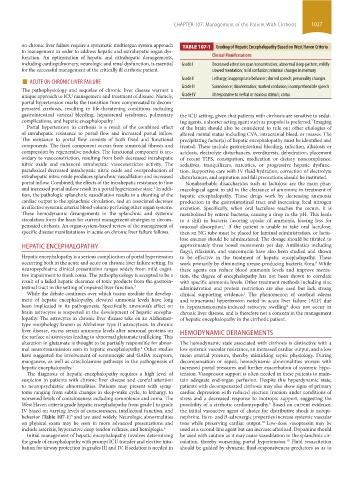
                    HEPATIC ENCEPHALOPATHY                                approximately three bowel movements per day. Antibiotics including
                                                                          flagyl, rifaximin, and vancomycin have also been studied and shown
                    Hepatic encephalopathy is a serious complication of portal hypertension   to be effective in the treatment of hepatic encephalopathy. These
                    occurring both in the acute and acute on chronic liver failure setting. Its   work primarily by eliminating urease-producing bacteria flora.  While
                                                                                                                        8
                    neuropsychiatric clinical presentation ranges widely from mild cogni-  these  agents  can  reduce  blood  ammonia  levels  and  improve  menta-
                    tive impairment to frank coma. The pathophysiology is accepted to be a   tion, the degree of encephalopathy has not been shown to correlate
                    result of a failed hepatic clearance of toxic products from the gastroin-  with specific ammonia levels. Other treatment methods including zinc
                    testinal tract in the setting of impaired liver function. 3  administration  and  protein  restriction  are  also  used  but  lack  strong
                     While the debate continues over which toxins mediate the develop-  clinical supporting evidence.  The phenomenon of cerebral edema
                                                                                               1
                    ment of hepatic encephalopathy, elevated ammonia levels have long   and intracranial hypertension noted in acute liver failure (ALF) due
                    been implicated in its pathogenesis. Specifically, ammonia’s effect on   to hyperammonemia-induced astrocyte swelling  does not occur in
                                                                                                              4
                    brain  astrocytes  is suspected in  the development of  hepatic  encepha-  chronic liver disease, and is therefore not a concern in the management
                    lopathy. The astrocytes in chronic liver disease take on an Alzheimer-  of hepatic encephalopathy in the cirrhotic patient.
                    type morphology known as Alzheimer type II astrocytosis. In chronic
                    liver disease, excess serum ammonia levels alter neuronal proteins on   HEMODYNAMIC DERANGEMENTS
                    the surface of astrocytes leading to abnormal glutamate trafficking. This
                    alteration in glutamate is thought to be partially responsible for abnor-  The hemodynamic state associated with cirrhosis is distinctive with a
                    mal neurotransmission seen in hepatic encephalopathy.  Other studies   low systemic vascular resistance, an increased cardiac output, and a low
                                                            4
                    have suggested the involvement of serotonergic and GABA receptors,   mean  arterial  pressure,  thereby  mimicking  septic  physiology.  During
                    manganese, as well as catecholamine pathways in the pathogenesis of   decompensation  or  sepsis,  hemodynamic  abnormalities  worsen  with
                    hepatic encephalopathy. 1                             increased portal pressures and further exacerbation of systemic hypo-
                     The diagnosis of hepatic encephalopathy requires a high level of   tension. Vasopressor support is often needed in these patients to main-
                    suspicion  in patients  with  chronic liver  disease  and careful attention   tain adequate end-organ perfusion. Despite this hyperdynamic state,
                    to  neuropsychiatric  abnormalities.  Patients  may  present  with  symp-  patients with decompensated cirrhosis may also show signs of primary
                    toms ranging from subtle changes in sleep-wake cycle, to lethargy, to   cardiac depression with reduced ejection fraction under conditions of
                    worsened levels of consciousness including somnolence and coma. The   stress and a decreased response to inotropic support, suggesting the
                    West Haven criteria grade hepatic encephalopathy from grade I to grade   possibility of a cirrhotic cardiomyopathy.  Based on current evidence,
                                                                                                        9
                    IV based on varying levels of consciousness, intellectual function, and   the initial vasoactive agent of choice for distributive shock is norepi-
                    behavior (Table 107-1)  and are used widely. Neurologic abnormalities   nephrine. Its α- and β-adrenergic properties increase systemic vascular
                                    5
                    on physical exam may be seen in more advanced presentations and   tone while preserving cardiac output.  Low-dose vasopressin may be
                                                                                                     10
                    include asterixis, hyperactive deep tendon reflexes, and hemiplegia. 6  used as a second-line agent but can increase afterload. Dopamine should
                     Initial management of hepatic encephalopathy involves determining   be used with caution as it may cause vasodilation in the splanchnic cir-
                    the grade of encephalopathy with prompt ICU transfer and elective intu-  culation, thereby worsening portal hypertension.  Fluid resuscitation
                                                                                                              10
                    bation for airway protection in grades III and IV. If sedation is needed in   should be guided by dynamic fluid-responsiveness predictors so as to


            section09.indd   1027                                                                                      1/14/2015   9:27:18 AM

