


Page 1487 - Hall et al (2015) Principles of Critical Care-McGraw-Hill
P. 1487
1026     PART 9: Gastrointestinal Disorders


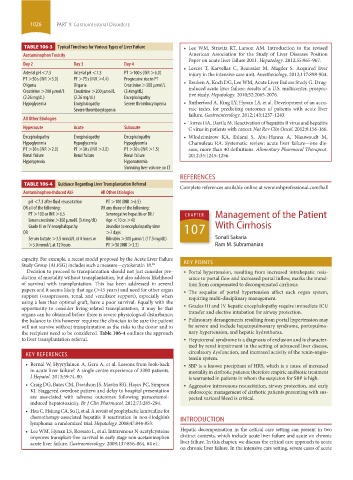
                   TABLE 106-3    Typical Timelines for Various Types of Liver Failure    • Lee WM, Stravitz RT, Larson AM. Introduction to the revised
                  Acetaminophen Toxicity                                  American Association for the Study of Liver Diseases Position
                                                                          Paper on acute liver failure 2011. Hepatology. 2012;55:965-967.
                  Day 2            Day 3            Day 4
                                                                           • Lescot T, Karvellas C, Beaussier M, Magder S. Acquired liver
                  Arterial pH <7.3  Arterial pH <7.3  PT >100 s (INR >6.0)  injury in the intensive care unit. Anesthesiology. 2012;117:898-904.
                  PT >50 s (INR >3.0)  PT >75 s (INR >4.4)  Progressive rise in PT    • Reuben A, Koch DG, Lee WM, Acute Liver Failure Study G. Drug-
                  Oliguria         Oliguria         Creatinine >300 µmol/L   induced acute liver failure: results of a U.S. multicenter, prospec-
                  Creatinine >200 µmol/L   Creatinine >200 µmol/L   (3.4 mg/dL)  tive study. Hepatology. 2010;52:2065-2076.
                  (2.26 mg/dL)     (2.26 mg/dL)     Encephalopathy
                  Hypoglycemia     Encephalopathy   Severe thrombocytopenia    • Rutherford A, King LY, Hynan LS, et al. Development of an accu-
                                   Severe thrombocytopenia                rate index for predicting outcomes of patients with acute liver
                                                                          failure. Gastroenterology. 2012;143:1237-1243.
                  All Other Etiologies
                                                                           • Torres HA, Davila M. Reactivation of hepatitis B virus and hepatitis
                  Hyperacute       Acute            Subacute              C virus in patients with cancer. Nat Rev Clin Oncol. 2012;9:156-166.
                  Encephalopathy   Encephalopathy   Encephalopathy         • Wlodzimirow KA, Eslami S, Abu-Hanna A, Nieuwoudt M,
                  Hypoglycemia     Hypoglycemia     Hypoglycemia          Chamuleau RA. Systematic review: acute liver failure—one dis-
                  PT >30 s (INR >2.0)  PT >30 s (INR >2.0)  PT >20 s (INR >1.5)  ease, more than 40 definitions. Alimentary Pharmacol Therapeut.
                  Renal failure    Renal failure    Renal failure         2012;35:1245-1256.
                  Hyperpyrexia                      Hyponatremia
                                                    Shrinking liver volume on CT
                                                                       REFERENCES
                   TABLE 106-4    Guidance Regarding Liver Transplantation Referral
                                                                       Complete references available online at www.mhprofessional.com/hall
                  Acetaminophen-Induced ALF  All Other Etiologies
                    pH <7.3 after fluid resuscitation    PT >100 (INR >6.5)
                  OR all of the following:  OR any three of the following:
                    PT >100 or INR >6.5       Seronegative hepatitis or DILI  CHAPTER  Management of the Patient
                    Serum creatinine >300 µmol/L (3.4 mg/dL)   Age <10 or >40
                    Grade III or IV encephalopathy     Jaundice to encephalopathy time    107  With Cirrhosis
                  OR                          >7 days
                     Serum lactate >3.5 mmol/L at 4 hours or    Bilirubin >300 µmol/L (17.5 mg/dL)  Sonali Sakaria
                    >3.0 mmol/L at 12 hours    PT >50 (INR >3.5)                   Ram M. Subramanian

                   capacity. For example, a recent model proposed by the Acute Liver Failure
                 Study Group (ALFSG) includes such a measure—cytokeratin 18. 26  KEY POINTS
                   Decision to proceed to transplantation should not just consider pre-    • Portal hypertension, resulting from increased intrahepatic resis-
                 diction of mortality without transplantation, but also address likelihood   tance to portal flow and increased portal inflow, marks the transi-
                 of survival with transplantation. This has been addressed in several   tion from compensated to decompensated cirrhosis.
                 papers and it seems likely that age (>45 years) and need for other organ     • The sequelae of portal hypertension affect each organ system,
                 support (vasopressors, renal, and ventilator support), especially when   requiring multi-disciplinary management.
                 using a less than optimal graft, have a poor survival. Equally with the
                 opportunity to consider living-related transplantation, it may be that     • Grades III and IV hepatic encephalopathy require immediate ICU
                 organs can be obtained before there is severe physiological disturbance;   transfer and elective intubation for airway protection.
                 the balance to this however requires the clinician to be sure the patient     • Pulmonary derangements resulting from portal hypertension may
                 will not survive without transplantation as the risks to the donor and to   be severe and include hepatopulmonary syndrome, portopulmo-
                 the recipient need to be considered. Table 106-4 outlines the approach   nary hypertension, and hepatic hydrothorax.
                 to liver transplantation referral.                        • Hepatorenal syndrome is a diagnosis of exclusion and is character-
                                                                          ized by renal impairment in the setting of advanced liver disease,
                   KEY REFERENCES                                         circulatory dysfunction, and increased activity of the renin-angio-
                                                                          tensin system.
                     • Bernal W, Hyyrylainen A, Gera A, et al. Lessons from look-back     • SBP is a known precipitant of HRS, which is a cause of increased
                    in acute liver failure? A single centre experience of 3300 patients.   mortality in cirrhotic patients; therefore empiric antibiotic treatment
                    J Hepatol. 2013;59:74-80.                             is warranted in patients in whom the suspicion for SBP is high.
                     • Craig DG, Bates CM, Davidson JS, Martin KG, Hayes PC, Simpson     • Aggressive intravenous resuscitation, airway protection, and early
                    KJ. Staggered overdose pattern and delay to hospital presentation   endoscopic management of cirrhotic patients presenting with sus-
                    are associated with adverse outcomes following paracetamol-  pected variceal bleed is critical.
                    induced hepatotoxicity. Br J Clin Pharmacol. 2012;73:285-294.
                     • Hsu C, Hsiung CA, Su IJ, et al. A revisit of prophylactic lamivudine for
                    chemotherapy-associated hepatitis B reactivation in non- Hodgkin’s   INTRODUCTION
                    lymphoma: a randomized trial. Hepatology. 2008;47:844-853.
                     • Lee WM, Hynan LS, Rossaro L, et al. Intravenous N-acetylcysteine   Hepatic decompensation in the critical care setting can present in two
                    improves transplant-free survival in early stage non-acetaminophen    distinct contexts, which include acute liver failure and acute on chronic
                    acute liver failure. Gastroenterology. 2009;137:856-864, 64 e1.  liver failure. In this chapter, we discuss the critical care approach to acute
                                                                       on chronic liver failure. In the intensive care setting, severe cases of acute


            section09.indd   1026                                                                                      1/14/2015   9:27:18 AM

