


Page 1486 - Hall et al (2015) Principles of Critical Care-McGraw-Hill
P. 1486
CHAPTER 106: Acute Liver Failure  1025


                    patients with subacute presentations, the development of encephalopathy   Resistant elevations of ICP with associated hyperemia may be consid-
                    as a trigger for transplantation consideration should be tempered. In such   ered for treatment with bolus indomethacin based on case series, which
                    situations, the sentiment of some is that decisions to proceed to trans-  have demonstrated a reduction in ICP.
                    plantation should be based on consideration of other variables, such as   In Europe, the incidence of elevated ICP has fallen steadily over the
                    coagulopathy and perhaps liver volume.                last 30 years. This is not only attributable to the institution of transplan-
                     In the acute and hyperacute presentations, encephalopathy is a fre-  tation given that the same observation is seen for patients with grade III/
                    quent finding. Low levels of encephalopathy (grade I and II) can often   IV coma who are not proceeding to transplantation. Table 106-2 lists the
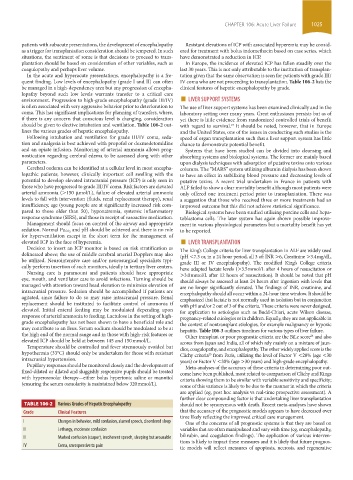
                    be managed in a high-dependency area but any progression of encepha-  clinical features of hepatic encephalopathy by grade.
                      environment. Progression to high-grade encephalopathy (grade III/IV)    ■  LIVER SUPPORT SYSTEMS
                    lopathy beyond such low levels warrants transfer to a critical care
                    is often associated with very aggressive behavior prior to deterioration to   The use of liver support systems has been examined clinically and in the
                    coma. This has significant implications for planning of transfers, where,   laboratory setting over many years. Great enthusiasm persists but as of
                    if there is any concern that conscious level is changing, consideration   yet there is little evidence from randomized controlled trials of benefit
                    should be given to elective intubation and ventilation. Table 106-2 out-  with regard to survival.  It should be noted, however, that in Europe
                                                                                           23
                    lines the various grades of hepatic encephalopathy.   and the United States, one of the issues in conducting such studies is the
                     Following  intubation  and  ventilation  for  grade  III/IV  coma,  seda-  speed of organ transplantation such that a liver support system has little
                    tion and analgesia is best achieved with propofol or dexmedetomidine   chance to demonstrate potential benefit.
                    and an opiate infusion. Monitoring of arterial ammonia allows prog-  Systems that have been studied can be divided into cleansing and
                    nostication regarding cerebral edema to be assessed along with other   absorbing systems and biological systems. The former are mainly based
                    parameters.                                           upon dialysis techniques with adsorption of putative toxins onto various
                     Cerebral oedema can be identified at a cellular level in most encepha-  columns. The “MARS” system utilizing albumin dialysis has been shown
                    lopathic patients; however, clinically important cell swelling with the   to have an effect in stabilizing blood pressure and decreasing levels of
                    potential to develop elevated intracranial pressure (ICP) is only seen in   putative toxins. A recent trial undertaken in France in patients with
                    those who have progressed to grade III/IV coma. Risk factors are elevated   ALF failed to show a clear mortality benefit although most patients were
                    arterial ammonia (>150 µmol/L), failure of elevated arterial ammonia   only offered one treatment period prior to transplantation. There was
                    levels to fall with intervention (fluids, renal replacement therapy), renal   a suggestion that those who received three or more treatments had an
                    insufficiency, age (young people are at significantly increased risk com-  improved outcome but this did not achieve statistical significance.
                    pared to those older than 50), hyponatremia, systemic inflammatory   Biological systems have been studied utilizing porcine cells and hepa-
                    response syndrome (SIRS), and those in receipt of vasoactive medication.  toblastoma cells. The later system has again shown possible improve-
                     Management should focus on control of the airway and appropriate   ment in various physiological parameters but a mortality benefit has yet
                                     and pH should be achieved and there is no role
                    sedation. Normal Pa CO 2                              to be reported.
                    for hyperventilation except in the short term for the management of
                    elevated ICP in the face of hyperemia.                    ■  LIVER TRANSPLANTATION
                     Decision to insert an ICP monitor is based on risk stratification as   The King’s College criteria for liver transplantation in ALF are widely used
                    delineated above; the use of middle cerebral arterial Dopplers may also   (pH <7.3 or, in a 24 hour period, all 3 of: INR >6, Creatinine >3.4 mg/dL,
                    be utilized. Neurointensive care and/or neurosurgical specialists typi-  grade III or IV encephalopathy). The modified King’s College criteria
                    cally perform insertion of such monitors, ideally in tertiary liver centers.  have adapted lactate levels (>3.5 mmol/L after 4 hours of resuscitation or
                     Nursing care is paramount and patients should have appropriate   >3.0 mmol/L after 12 hours of resuscitation). It should be noted that pH
                    eye, mouth, and ventilator care to avoid infections. Turning should be   should always be assessed at least 24 hours after ingestion with levels that
                    managed with attention toward head elevation to minimize elevation of   are no longer significantly elevated. The findings of INR, creatinine, and
                    intracranial pressure. Sedation should be accomplished if patients are   encephalopathy should all occur within a 24-hour time window. It should be
                    agitated, since failure to do so may raise intracranial pressure. Renal   emphasized that lactate is not normally used in isolation but in conjunction
                    replacement should be instituted to facilitate control of ammonia if   with pH and/or 2 out of 3 of the criteria. These criteria were never designed,
                    elevated. Initial enteral feeding may be modulated depending upon   for application to aetiologies such as Budd-Chiari, acute Wilson disease,
                    response of arterial ammonia to feeding. Lactulose in the setting of high-  pregnancy-related etiologies or in children. Equally, they are not applicable in
                    grade encephalopathy has not been shown to have a beneficial role and   the context of nontransplant etiologies, for example malignancy or hypoxic
                    may contribute to an ileus. Serum sodium should be modulated to be at   hepatitis. Table 106-3 outlines timelines for various types of liver failure.
                    the high end of the normal range and in those with high-risk features or   Other transplant or poor prognostic criteria are the BiLe score  and also
                                                                                                                      24
                    elevated ICP should be held at between 145 and 150 mmol/L.  scores from Japan and India, all of which rely mainly on a mixture of jaun-
                     Temperature should be controlled and fever strenuously avoided but   dice, coagulopathy, and encephalopathy. The other widely applied score is the
                    hypothermia (33°C) should only be undertaken for those with resistant   Clichy criteria  from Paris, utilizing the level of Factor V <20% (age <30
                                                                                   25
                    intracranial hypertension.                            years) or Factor V <30% (age >30 years) and high-grade encephalopathy.
                     Pupillary responses should be monitored closely and the development of   Meta-analyses of the accuracy of these criteria in determining poor out-
                    fixed-dilated or dilated and sluggishly responsive pupils should be treated   come have been published, most related to comparison of Clichy and Kings
                    with  hyperosmolar  therapy—either bolus  hypertonic saline  or mannitol   criteria showing them to be similar with variable sensitivity and specificity;
                    (ensuring the serum osmolarity is maintained below 320 mmol/L).  some of this variance is likely to be due to the manner in which the criteria
                                                                          are applied (eg, post hoc analysis vs real-time prospective assessment). A
                                                                          further clear compounding factor is that undertaking liver transplantation
                      TABLE 106-2    Various Grades of Hepatic Encephalopathy  should not be synonymous with death. Recent meta-analyses have shown
                    Grade       Clinical Features                         that the accuracy of the prognostic models appears to have decreased over
                                                                          time likely reflecting the improved critical care management.
                    I           Changes in behavior, mild confusion, slurred speech, disordered sleep  One of the concerns of all prognostic systems is that they are based on
                    II          Lethargy, moderate confusion              variables that are often manipulated and vary with time (eg, encephalopathy,
                    II          Marked confusion (stupor), incoherent speech, sleeping but arousable  bilirubin, and coagulation findings). The application of various interven-
                                                                          tions is likely to impact these measures and it is likely that future prognos-
                    IV          Coma, unresponsive to pain
                                                                          tic models will reflect measures of apoptosis, necrosis, and regenerative


            section09.indd   1025                                                                                      1/14/2015   9:27:17 AM

