


Page 1528 - Hall et al (2015) Principles of Critical Care-McGraw-Hill
P. 1528
CHAPTER 110: Special Considerations in the Surgical Patient   1047


                    nutritional support before and immediately after surgery.  Early insti-
                                                              17
                    tution of enteric feeding has been shown to be of benefit, including
                    a reduction in septic sequelae, in surgical patients undergoing intra-
                    abdominal procedures.  If daily caloric intake goal could not be
                                     18
                    achieved with enteral feeding alone before day 8 of ICU admission, insti-  hemorrhage
                    tution of parenteral nutritional support should be considered to prevent              Hypertension
                                                                                          Compensated
                    further loss of muscle mass.  Earlier initiation of parenteral nutrition   Hemorrhagic
                                        19
                    appears to be associated with more infectious complications, delayed   shock
                    recovery, and higher health care costs.  Adequate nutrition affects not
                                                19
                    only the maintenance of muscle mass, but also the maintenance of respi-  Increasing vascular tone
                    ratory function, and thus both dependence on ventilatory support and
                    weaning from mechanical ventilatory assistance.                               Anesthesia
                        ■  MAGNITUDE AND DURATION OF SURGICAL INSULT
                    Since the duration and magnitude of surgical procedures affect the   Hypotension
                    intensity of the metabolic and endocrine response, the aim should be to       Septic
                    decrease the magnitude, duration, and frequency of surgical insults           shock
                    to the critically ill patient, particularly patients with poor nutritional and
                    cardiorespiratory reserve. This goal, however, must be considered in the
                    context of the underlying  problem.  The  magnitude  and duration  of     Increasing blood volume
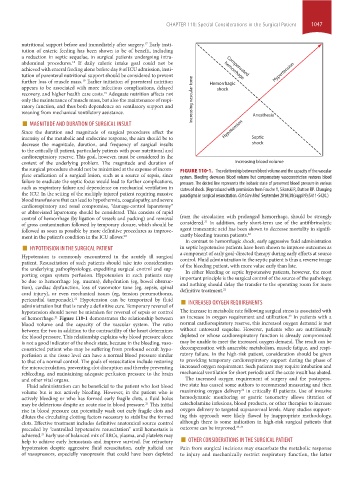
                    the surgical procedure should not be minimized at the expense of incom-  FIGURE 110-1.  The relationship between blood volume and the capacity of the vascular
                    plete eradication of a surgical lesion, such as a source of sepsis, since   system.  Bleeding decreases blood volume but compensatory vasoconstriction restores blood
                    failure to eradicate the septic focus would lead to further complications,   pressure. The dotted line represents the isobaric state of preserved blood pressure in various
                    such as respiratory failure and dependence on mechanical ventilation in   states of shock. (Reproduced with permission from Fouche Y, Sikorski R, Dutton RP. Changing
                    the ICU. In the setting of the multiply injured patient requiring massive   paradigms in surgical resuscitation. Crit Care Med. September 2010;38(suppl 9):S411-S420.)
                    blood transfusions that can lead to hypothermia, coagulopathy, and severe
                    cardiorespiratory and renal compromise, “damage-control laparotomy”
                    or abbreviated laparotomy should be considered. This consists of rapid
                    control of hemorrhage (by ligation of vessels and packing) and removal   from the circulation with prolonged hemorrhage, should be strongly
                                                                                  21
                    of gross contamination followed by temporary closure, which should be     considered.  In addition, early short-term use of the antifibrinolytic
                    followed as soon as possible by more definitive procedures as improve-  agent tranexamic acid has been shown to decrease mortality in signifi-
                    ment in the patient’s condition in the ICU allows. 20  cantly bleeding trauma patients. 22
                        ■  HYPOTENSION IN THE SURGICAL PATIENT            in septic hypotensive patients have been shown to improve outcomes as
                                                                           In contrast to hemorrhagic shock, early aggressive fluid  administration
                    Hypotension is commonly encountered in the acutely ill surgical   a component of early goal-directed therapy during early efforts at source
                    patient. Resuscitation of such patients should take into consideration   control. Fluid administration in the septic patient is thus a reverse image
                                                                          of the bleeding patient, with more value early than late.
                    the underlying pathophysiology, expediting surgical control and sup-
                                                                           In either bleeding or septic hypotensive patients, however, the most
                    porting organ system perfusion. Hypotension in such patients may   important principle is the surgical control of the source of the pathology,
                    be due to hemorrhage (eg, trauma), dehydration (eg, bowel obstruc-
                    tion), cardiac dysfunction, loss of vasomotor tone (eg, sepsis, spinal   and nothing should delay the transfer to the operating room for more
                                                                          definitive treatment.
                                                                                        21
                    cord injury), or even mechanical issues (eg, tension pneumothorax,
                    pericardial tamponade).  Hypotension can be temporized by fluid     ■  INCREASED OXYGEN REQUIREMENTS
                                      21
                    administration but that is rarely a definitive cure. Temporary reversal of
                    hypotension should never be mistaken for reversal of sepsis or control   The increase in metabolic rate following surgical stress is associated with
                                                                                                               23
                    of hemorrhage.  Figure 110-1 demonstrates the relationship between   an increase in oxygen requirement and utilization.  In patients with a
                               21
                    blood volume and the capacity of the vascular system. The ratio   normal cardiorespiratory reserve, this increased oxygen demand is met
                    between the two in addition to the contractility of the heart determines   without untoward sequelae. However, patients who are nutritionally
                    the blood pressure. This relationship explains why blood pressure alone   depleted or  whose cardiorespiratory function  is already compromised
                    is not a good indicator of the shock state, because in the bleeding, vaso-  may be unable to meet the increased oxygen demand. The result can be
                    constricted patient who may be suffering from profound occult hypo-  decompensation with anaerobic metabolism, muscle fatigue, and respi-
                    perfusion at the tissue level can have a normal blood pressure similar   ratory failure. In the high-risk patient, consideration should be given
                    to that of a normal control. The goals of resuscitation include restoring   to providing temporary cardiorespiratory support during the phase of
                    the microcirculation, preventing clot disruption and thereby preventing   increased oxygen requirement. Such patients may require intubation and
                    rebleeding, and maintaining adequate perfusion pressure to the brain   mechanical ventilation for short periods until the acute insult has abated.
                    and other vital organs.                                The increased oxygen requirement of surgery and the postopera-
                     Fluid administration can be beneficial to the patient who lost blood   tive state has caused some authors to recommend measuring and then
                                                                                              22
                    volume but is not actively bleeding. However, in the patient who is   maximizing oxygen delivery  in critically ill patients. Use of invasive
                    actively bleeding or who has formed early fragile clots, a fluid bolus   hemodynamic monitoring or gastric tonometry allows titration of
                    may be deleterious despite an acute rise in blood pressure.  This initial   catecholamine infusions, blood products, or other therapies to increase
                                                              21
                    rise in blood pressure can potentially wash out early fragile clots and   oxygen delivery to targeted supranormal levels. Many studies support-
                    dilutes the circulating clotting factors necessary to stabilize the formed   ing this approach were likely flawed by inappropriate methodology,
                    clots. Effective treatment includes definitive anatomical source control   although  there  is  some  indication  in  high-risk  surgical  patients  that
                    preceded by “controlled hypotensive resuscitation” until hemostasis is    outcome can be improved. 23-25
                    help to achieve early hemostasis and improve survival. For refractory   ■  OTHER CONSIDERATIONS IN THE SURGICAL PATIENT
                    achieved.  Early use of balanced mix of RBCs, plasma, and platelets may
                          21
                    hypotension despite aggressive fluid resuscitation, early judicial use   Pain from surgical incisions may exacerbate the metabolic response
                    of vasopressors, especially vasopressin that could have been depleted   to injury and mechanically restrict respiratory function, the latter


            section10.indd   1047                                                                                      1/20/2015   9:19:29 AM

