


Page 1530 - Hall et al (2015) Principles of Critical Care-McGraw-Hill
P. 1530
CHAPTER 110: Special Considerations in the Surgical Patient   1049


                    in  the  surgical  patient  is  the  early  identification  of  occult  sources  of   lung is thought to occur within 5 minutes after induction of general
                    sepsis, aggressive investigation for abdominal causes of sepsis, and the   anesthesia.
                    provision of adequate drainage and treatment of septic foci, particularly   Shunting results from continued perfusion of nonventilated lung
                    within the abdomen.                                   units, and the major cause of this imbalance in the surgical patient is
                     Although both increased microvascular hydrostatic pressure and    perioperative atelectasis, although alveolar edema from fluid overload or
                    pulmonary capillary permeability are important factors in the elabora-  capillary leakage could also result in an increase in shunting.
                    tion of extravascular lung water, manipulation of the microvascular
                    pressure (by the use of vasoactive agents and regulation of the state of   Age, Position, and Airway Closure:  Most surgical patients undergo proce-
                    hydration) is the most direct means of altering pulmonary edema in   dures in the supine position, and we are operating increasingly on elderly
                    the surgical patient. A search for a septic focus in the surgical patient is   patients. Also, one of the major effects of surgery is the pain resulting
                    crucial whenever there is evidence of increased capillary permeability.   from surgical incisions. Body position, incisional pain, and age all affect
                    Control of capillary permeability can then be achieved, although only   the relationship between the functional residual capacity (FRC) and the
                    indirectly, by treating the source of sepsis, which may be surgically   closing volume. The FRC has been considered the most important index
                    approachable. The link between sepsis and capillary permeability is thus   of mechanical abnormality in the lung because it represents the balance
                    broken, and the capillary permeability lesion is allowed to resolve with   of opposing forces on the rib cage at resting lung volume. The closing
                    time; its resolution is accompanied by improvement in perioperative   volume is the volume of the lungs at which airway closure begins. When
                    respiratory failure.  Until  the  permeability  corrects  itself,  reduction  of   FRC exceeds closing volume, lower airway patency is maintained, while
                                                                                                                            39
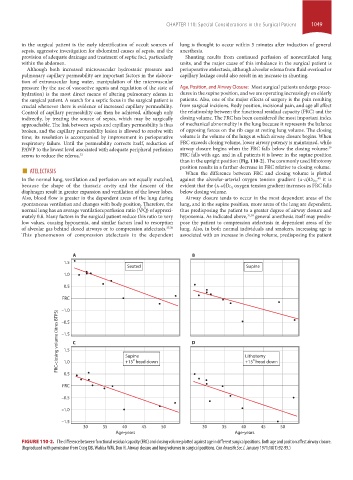
                    PAWP to the lowest level associated with adequate peripheral perfusion   airway closure begins when the FRC falls below the closing volume.
                    seems to reduce the edema. 32                         FRC falls with age, and in all patients it is lower in the supine position
                                                                          than in the upright position (Fig. 110-2). The commonly used lithotomy
                        ■  ATELECTASIS                                    position results in a further decrease in FRC relative to closing volume.
                                                                           When the difference between FRC and closing volume is plotted
                    In the normal lung, ventilation and perfusion are not equally matched,   against the alveolar-arterial oxygen tension gradient (a-a)D O 2 ,  it is
                                                                                                                        40
                    because the shape of the thoracic cavity and the descent of the    evident that the (a-a)D O 2  oxygen tension gradient increases as FRC falls
                    diaphragm result in greater expansion and ventilation of the lower lobes.   below closing volume.
                    Also, blood flow is greater in the dependent areas of the lung during   Airway closure tends to occur in the most dependent areas of the
                    spontaneous ventilation and changes with body position. Therefore, the   lung, and in the supine position, more areas of the lung are dependent,
                                                            x x
                    normal lung has an average ventilation:perfusion ratio (V /Q) of approxi-  thus predisposing the patient to a greater degree of airway closure and
                    mately 0.8. Many factors in the surgical patient reduce this ratio to very   hypoxemia. As indicated above, 37,38  general anesthesia itself may predis-
                    low values, causing hypoxemia, and similar factors lead to resorption   pose the patient to compression atelectasis in dependent areas of the
                    of alveolar gas behind closed airways or to compression atelectasis. 37,38    lung. Also, in both normal individuals and smokers, increasing age is
                    This phenomenon of compression atelectasis in the dependent     associated with an increase in closing volume, predisposing the patient


                                     A                                        B
                                  1.5
                                                        Seated                                  Supine
                                  1.0

                                  0.5

                                 FRC
                                 –1.0
                                FRC-closing volume (litres BTPS)  –1.5  C  Supine  D            Lithotomy
                                 –0.5


                                  1.5

                                                                                                  º
                                                          º
                                  1.0
                                  0.5                  +15 head down                            +15 head down
                                 FRC

                                 –0.5
                                 –1.0

                                 –1.5
                                         30    35     40     45    50            30     35    40     45     50
                                                    Age-years                               Age-years
                    FIGURE 110-2.  The difference between functional residual capacity (FRC) and closing volume plotted against age in different surgical positions. Both age and position affect airway closure.
                    (Reproduced with permission from Craig DB, Wahba WM, Don H. Airway closure and lung volumes in surgical positions. Can Anaesth Soc J. January 1971;18(1):92-99.)


            section10.indd   1049                                                                                      1/20/2015   9:19:30 AM

