


Page 1531 - Hall et al (2015) Principles of Critical Care-McGraw-Hill
P. 1531
1050     PART 10: The Surgical Patient


                 to airway closure at higher lung volumes.  As a group, smokers tend to   Patients undergoing upper abdominal operations have a significant
                                               41
                 have higher closing volumes, so that the combination of age and smoking     decrease in the maximal transdiaphragmatic pressure at FRC, which is not
                 increases the likelihood of significant postoperative hypoxemia. It has   altered by use of epidural analgesia.  This finding suggests that the respira-
                                                                                                50
                 generally been accepted that chronic cigarette smoking increases the   tory dysfunction after upper abdominal surgery may result from a primary
                 incidence of postoperative respiratory complications, which may result   effect of the procedure on diaphragmatic function. Ford and coworkers
                 not only from an alteration in the respiratory defense mechanisms, but   showed that there is a switch from predominantly abdominal breathing to
                 also an increase in airway resistance and the work of breathing. It has   rib cage breathing in the postoperative period in patients undergoing upper
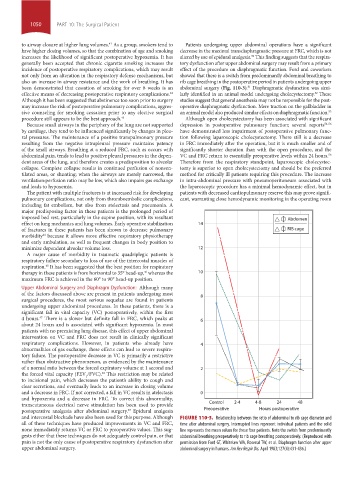
                 been  demonstrated  that cessation of  smoking  for  over 8  weeks  is  an   abdominal surgery (Fig. 110-3).  Diaphragmatic dysfunction was simi-
                                                                                              51
                 effective means of decreasing postoperative respiratory complications.    larly identified in an animal model undergoing cholecystectomy.  These
                                                                                                                     52
                                                                    42
                 Although it has been suggested that abstinence too soon prior to surgery   studies suggest that general anesthesia may not be responsible for the post-
                 may increase the risk of postoperative pulmonary complications, aggres-  operative diaphragmatic dysfunction. Mere traction on the gallbladder in
                 sive counseling for smoking cessation prior to any elective surgical    an animal model also produced similar effects on diaphragmatic function. 53
                 procedure still appears to be the best approach. 43     Although open cholecystectomy has been associated with significant
                   Because small airways in the periphery of the lung are not supported   depression in postoperative pulmonary function; several reports 54-56
                 by cartilage, they tend to be influenced significantly by changes in pleu-  have demonstrated less impairment of postoperative pulmonary func-
                 ral pressures. The maintenance of a positive transpulmonary pressure   tion  following  laparoscopic  cholecystectomy.  There  still  is  a  decrease
                 resulting from the  negative intrapleural pressure maintains patency   in FRC immediately after the operation, but it is much smaller and of
                 of the small airways. Breathing at a reduced FRC, such as occurs with   significantly shorter duration than with the open procedure, and the
                 abdominal pain, tends to lead to positive pleural pressures in the depen-  VC and FRC return to essentially preoperative levels within 24 hours.
                                                                                                                          56
                 dent areas of the lung, and therefore creates a predisposition to alveolar   Therefore from the respiratory standpoint, laparoscopic cholecystec-
                 collapse. Complete collapse results in continued perfusion of nonven-  tomy is superior to open cholecystectomy and should be the preferred
                 tilated areas, or shunting; when the airways are merely narrowed, the   method for critically ill patients requiring this procedure. The increase
                 ventilation:perfusion ratio may be low, which also impairs gas exchange   in intra-abdominal pressure with pneumoperitoneum associated with
                 and leads to hypoxemia.                               the laparoscopic procedure has a minimal hemodynamic effect, but in
                   The patient with multiple fractures is at increased risk for developing   patients with decreased cardiopulmonary reserve this may prove signifi-
                 pulmonary complications, not only from thromboembolic complications,   cant, warranting close hemodynamic monitoring in the operating room
                 including  fat embolism, but  also  from atelectasis and  pneumonia.  A
                 major predisposing factor in these patients is the prolonged period of
                 imposed bed rest, particularly in the supine position, with its resultant                  Abdomen
                 effect on lung mechanics and lung volumes. Early operative stabilization   14
                 of fractures in these patients has been shown to decrease pulmonary                        RIB cage
                 morbidity  because it allows more effective respiratory physiotherapy
                        44
                 and early ambulation, as well as frequent changes in body position to
                 minimize dependent alveolar volume loss.                    12
                   A major cause  of morbidity in  traumatic quadriplegic  patients  is
                 respiratory failure secondary to loss of use of the intercostal muscles of
                 respiration.  It has been suggested that the best position for respiratory
                         45
                 therapy in these patients is from horizontal to 35° head-up,  whereas the   10
                                                           46
                 maximum FRC is achieved in the 60° to 90° head-up position.
                 Upper Abdominal Surgery and Diaphragm Dysfunction:  Although many
                 of the factors discussed above are present in patients undergoing most
                 surgical procedures, the most serious sequelae are found in patients   8
                 undergoing upper abdominal procedures. In these patients, there is a
                 significant  fall  in  vital  capacity  (VC)  postoperatively,  within  the  first
                 4 hours.  There is a  slower but  definite fall in  FRC, which peaks  at   6
                       47
                 about 24 hours and is associated with significant hypoxemia. In most
                 patients with no preexisting lung disease, this effect of upper abdominal
                 intervention on VC and FRC does not result in clinically significant
                 respiratory complications. However, in patients who already have   4
                 abnormalities of gas exchange, these effects can lead to severe respira-
                 tory failure. The postoperative decrease in VC is primarily a restrictive
                 rather than obstructive phenomenon, as evidenced by the maintenance
                 of a normal ratio between the forced expiratory volume at 1 second and   2
                 the forced vital capacity (FEV /FVC).  This restriction may be related
                                             48
                                       1
                 to incisional pain, which decreases the patient’s ability to cough and
                 clear secretions, and eventually leads to an increase in closing volume
                 and a decrease in FRC. If not corrected, a fall in VC results in atelectasis   0
                 and hypoxemia and a decrease in FRC. To correct this abnormality,
                 transcutaneous electrical nerve stimulation has been used to provide   Control  2-4  4-8  24  48
                 postoperative analgesia after abdominal surgery.  Epidural analgesia   Preoperative  Hours postoperative
                                                     49
                 and intercostal blockade have also been used for this purpose. Although   FIGURE 110-3.  Relationship between the ratio of abdominal to rib cage diameter and
                 all of these techniques have produced improvements in VC and FRC,   time after abdominal surgery. Interrupted lines represent individual patients and the solid
                 none immediately returns VC or FRC to preoperative values. This sug-  line represents the mean values for these four patients. Note the switch from predominantly
                 gests either that these techniques do not adequately control pain, or that   abdominal breathing preoperatively to rib cage breathing postoperatively. (Reproduced with
                 pain is not the only cause of postoperative respiratory dysfunction after   permission from Ford GT, Whitelaw WA, Rosenal TW, et al. Diaphragm function after upper
                 upper abdominal surgery.                              abdominal surgery in humans. Am Rev Respir Dis. April 1983;127(4):431-436.)


            section10.indd   1050                                                                                      1/20/2015   9:19:30 AM

