


Page 1532 - Hall et al (2015) Principles of Critical Care-McGraw-Hill
P. 1532
CHAPTER 110: Special Considerations in the Surgical Patient   1051


                                             +20


                                               0


                                            % Change VC  –20


                                             –40


                                                                                        Superficial (spinal)
                                                                                        Superficial (gen)
                                             –60
                                                                                        Thoracotomy
                                                                                        Lower abdominal
                                                                                        Posterior
                                                                                        Upper abdominal
                                             –80
                                              Preop       0         1          2         3          5
                                                                     Postoperative day
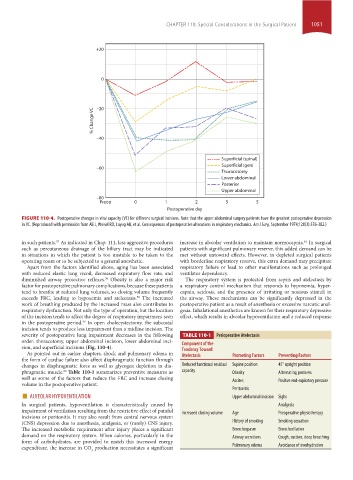
                    FIGURE 110-4.  Postoperative changes in vital capacity (VC) for different surgical incisions. Note that the upper abdominal surgery patients have the greatest postoperative depression
                    in VC. (Reproduced with permission from Ali J, Weisel RD, Layug AB, et al. Consequences of postoperative alterations in respiratory mechanics. Am J Surg. September 1974;128(3):376-382.)

                    in such patients.  As indicated in Chap. 111, less aggressive procedures   increase in alveolar ventilation to maintain normocapnia.  In surgical
                               57
                                                                                                                    61
                    such as percutaneous drainage of the biliary tract may be indicated   patients with significant pulmonary reserve, this added demand can be
                    in situations in which the patient is too unstable to be taken to the    met without untoward effects. However, in depleted surgical patients
                    operating room or to be subjected to a general anesthetic.  with borderline respiratory reserve, this extra demand may precipitate
                     Apart from the factors identified above, aging has been associated   respiratory failure or lead to other manifestations such as prolonged
                    with reduced elastic lung recoil, decreased expiratory flow rate, and   ventilator dependency.
                    diminished  airway  protective  reflexes.   Obesity  is  also  a  major  risk    The  respiratory  system  is  protected  from  sepsis  and  atelectasis  by
                                                38
                    factor for postoperative pulmonary complications, because these patients   a respiratory control mechanism that responds to hypoxemia, hyper-
                    tend to breathe at reduced lung volumes, so closing volume frequently   capnia, acidosis, and the presence of irritating or noxious stimuli in
                    exceeds FRC, leading to hypoxemia and atelectasis.  The increased   the  airway. These mechanisms can  be  significantly depressed in  the
                                                           58
                    work of breathing produced by the increased mass also contributes to   postoperative patient as a result of anesthesia or excessive narcotic anal-
                    respiratory dysfunction. Not only the type of operation, but the location   gesia. Inhalational anesthetics are known for their respiratory depressive
                    of the incision tends to affect the degree of respiratory impairment seen   effect, which results in alveolar hypoventilation and a reduced response
                    in the postoperative period.  In open cholecystectomy, the subcostal
                                        59
                    incision tends to produce less impairment than a midline incision. The
                    severity of postoperative lung impairment decreases in the following     TABLE 110-1    Perioperative Atelectasis
                    order: thoracotomy, upper abdominal incision, lower abdominal inci-  Component of the
                    sion, and superficial incisions (Fig. 110-4).         Tendency Toward
                     As pointed out in earlier chapters, shock and pulmonary edema in   Atelectasis  Promoting Factors  Preventing Factors
                    the form of cardiac failure also affect diaphragmatic function through
                    changes  in  diaphragmatic  force  as  well  as  glycogen  depletion  in  dia-  Reduced functional residual  Supine position  45° upright position
                    phragmatic muscle.  Table 110-1 summarizes preventive measures as   capacity  Obesity  Alternating postures
                                  60
                    well as some of the factors that reduce the FRC and increase closing   Ascites         Positive end-expiratory pressure
                    volume in the postoperative patient.                                   Peritonitis
                        ■  ALVEOLAR HYPOVENTILATION                                        Upper abdominal incision Sighs

                    In surgical patients, hypoventilation is characteristically caused by                  Analgesia
                    impairment of ventilation resulting from the restrictive effect of painful   Increased closing volume  Age  Preoperative physiotherapy
                    incisions or peritonitis. It may also result from central nervous system
                    (CNS) depression due to anesthesia, analgesia, or (rarely) CNS injury.   History of smoking  Smoking cessation
                    The increased metabolic requirement after injury places a significant   Bronchospasm   Bronchodilation
                    demand on the respiratory system. When calories, particularly in the   Airway secretions  Cough, suction, deep breathing
                    form of carbohydrates, are provided to match this increased energy
                    expenditure, the increase in CO  production necessitates a significant   Pulmonary edema  Avoidance of overhydration
                                           2


            section10.indd   1051                                                                                      1/20/2015   9:19:31 AM

