


Page 1563 - Hall et al (2015) Principles of Critical Care-McGraw-Hill
P. 1563
1082     PART 10: The Surgical Patient


                 or other pliable material to the fascia or skin to prevent postoperative   frequently have multiple intra-abdominal fluid collections and free
                 evisceration, and the wound is packed with saline-soaked gauze. 28-30    air that could be a result of the laparotomy. If the patient displays any
                 These patients are particularly at risk for the formation of enterocuta-  signs of sepsis, such as fever or leukocytosis, despite being treated with
                 neous fistulae at the surface of their open wounds, and this complica-  antibiotics, another search for the fever is warranted.  However, the
                                                                                                               31
                 tion is easily diagnosed by inspection.  Tubes should be inspected to   intensivist must keep in mind there are many noninfectious causes for
                                              28
                 make sure that they have not been dislodged and are functioning as   fever and leukocytosis in the ICU patient.  The patient who is dete-
                                                                                                       31
                 intended. For example, sump drains should be checked to make sure   riorating in the first week following surgery for peritonitis and who
                 that the air inlet ports are not occluded.            is thought to have persistent or recurrent peritoneal infection usually
                   Second, the intensivist must determine whether the gastrointestinal   requires repeat laparotomy for source control. Beyond this early phase,
                 tract is functioning well enough for enteral feedings, difficult to deter-  when abscesses are better formed and sterile collections have been
                 mine in the sedated, ventilated patient, and it is frequently necessary   resorbed, image-guided percutaneous drainage offers a safe and effec-
                                https://kat.cr/user/tahir99/
                 to challenge the patient by starting tube feedings and simply checking   tive method to diagnose and control abscesses.
                 the gastric residual volume every 4 hours. As discussed in Chap. 20,   Open Abdomen Treatment  In certain circumstances, patients with peri-
                 enteral feeding is preferred  over parenteral feeding in this patient   tonitis require “open abdomen” treatment. The skin and fascia are
                 population, if technically feasible. Jejunal feeds are almost always tol-  not closed and  evisceration is  prevented by  suturing  an artificial
                 erated, even in patients with severe peritonitis. Early enteral feeding   mesh  or  other  flexible  soft  material  to  the  fascia  or  skin. 28-30   These
                 may improve outcome.  Enteral nutrition has not improved survival   patients fall into two categories—patients whose fascia could not
                                  25
                 but has reduced infectious morbidity—specifically intra-abdominal   be closed for technical reasons but who are otherwise stable and
                 abscess in trauma patients.  Before starting enteral feeds, it is neces-  patients whose peritonitis is so severe that in the surgeon’s opinion
                                     25
                 sary to ensure the bowel is in continuity. Occasionally surgeons may   the abdomen should be left open to facilitate repeated laparotomies
                 first perform a “damage control” operation and leave the bowel in dis-  for peritoneal toilet. The latter group presents a major problem to the
                 continuity with the intent of doing another laparotomy for definitive   intensivist  and the  ICU nursing staff. These  patients may undergo
                 repair in 24 to 72 hours.                             relaparotomy (through the mesh) every 1 to 3 days until the surgeon
                   Third, the intensivist must determine if the patient is septic and   feels that the peritoneal cavity is sufficiently clean. Weaning from
                 if the septic focus is intra-abdominal. The most common abdomi-  ventilatory   support is almost always impossible until after the last
                 nal complication of peritonitis surgery is abscess formation, which   scheduled relaparotomy. Furthermore, during this period of repeated
                 occurred in 21 of the 107 peritonitis patients who required postopera-  laparotomies, large quantities of proteinaceous fluids are lost through
                 tive ventilation in our series.  It is often difficult to determine when   the open abdominal wound, and the patients may therefore require
                                       21
                 a patient’s original septic response is abating and when a new septic   support with aggressive nutrition. 25
                 response is being mounted. In general, if the patient is not improving
                 way, a CT scan of the abdomen (with IV contrast, if possible) should   ■  VISCERAL ABSCESS
                 steadily following surgery or if the patient begins to deteriorate in any
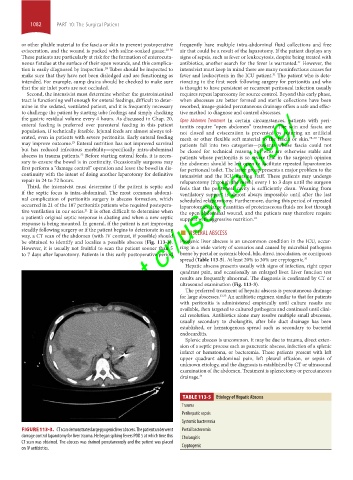
                 be obtained to identify and localize a possible abscess (Fig. 113-3).   Pyogenic liver abscess is an uncommon condition in the ICU, occur-
                 However, it is usually not fruitful to scan the patient sooner than 5   ring in a wide variety of scenarios and caused by microbial pathogens
                 to 7 days after laparotomy. Patients in this early postoperative period   borne by portal or systemic blood, bile, direct inoculation, or contiguous
                                                                       spread (Table 113-5). At least 20% to 30% are cryptogenic. 32
                                                                         Hepatic abscess presents usually with signs of infection, right upper
                                                                       quadrant pain, and occasionally an enlarged liver. Liver function test
                                                                       results are frequently abnormal. The diagnosis is confirmed by CT or
                                                                       ultrasound examination (Fig. 113-3).
                                                                         The preferred treatment of hepatic abscess is percutaneous drainage
                                                                       for large abscesses. 32,33  An antibiotic regimen similar to that for patients
                                                                       with  peritonitis  is  administered  empirically  until  culture  results  are
                                                                       available, then targeted to cultured pathogens and continued until clini-
                                                                       cal resolution. Antibiotics alone may resolve multiple small abscesses,
                                                                       usually  secondary to cholangitis,  after bile  duct  drainage has been
                                                                       established, or hematogenous spread such as secondary to bacterial
                                                                       endocarditis.
                                                                         Splenic abscess is uncommon. It may be due to trauma, direct exten-
                                                                       sion of a septic process such as pancreatic abscess, infection of a splenic
                                                                       infarct or hematoma, or bacteremia. These patients present with left
                                                                       upper quadrant abdominal pain, left pleural effusion, or sepsis of
                                                                       unknown etiology, and the diagnosis is established by CT or ultrasound
                                                                       examination of the abdomen. Treatment is splenectomy or percutaneous
                                                                       drainage. 34


                                                                         TABLE 113-5    Etiology of Hepatic Abscess
                                                                        Trauma
                                                                        Perihepatic sepsis
                                                                        Systemic bacteremia
                 FIGURE 113-3.  CT scan demonstrates large pyogenic liver abscess. The patient underwent    Portal bacteremia
                 damage control laparotomy for liver trauma. He began spiking fevers POD 5 at which time this    Cholangitis
                 CT scan was obtained. The abscess was drained percutaneously and the patient was placed
                 on IV antibiotics.                                     Cryptogenic


            section10.indd   1082                                                                                      1/20/2015   9:19:49 AM

