


Page 1560 - Hall et al (2015) Principles of Critical Care-McGraw-Hill
P. 1560
CHAPTER 113: The Acute Abdomen and Intra-abdominal Sepsis   1079


                                                                            TABLE 113-2    Classification of intra-abdominal Sepsis by Source
                                                                          Primary peritonitis
                                                                            Infected ascites
                                                                            Infected peritoneal dialysis catheter
                                                                            Miscellaneous (eg, tuberculosis)
                                                                          Secondary peritonitis
                                                                            Intraperitoneal
                                                                             Biliary tree
                                                                             Gastrointestinal tract
                                                                              Female reproductive system
                                                                            Retroperitoneal
                                                                             Pancreas
                                                                             Urinary tract
                                                                            Visceral abscess
                                                                             Liver
                                                                             Spleen


                                                                           The importance of prompt diagnosis and treatment cannot be
                                                                          overemphasized. This is one of the few prognostic variables that physi-
                                                                          cians can control, and prompt treatment has been shown repeatedly to
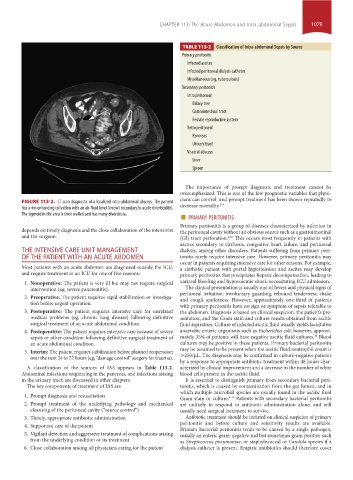
                    FIGURE 113-2.  CT scan diagnostic of a localized intra-abdominal abscess. The patient   decrease mortality. 5-8
                    has a rim enhancing collection with an air-fluid level (arrow) secondary to acute diverticulitis.
                    The sigmoid in the area is thick walled and has many diverticula.    ■  PRIMARY PERITONITIS
                                                                          Primary peritonitis is a group of diseases characterized by infection in
                    depends on timely diagnosis and the close collaboration of the intensivist   the peritoneal cavity without an obvious source such as a gastrointestinal
                    and the surgeon.                                      (GI) tract perforation.  This occurs most frequently in patients with
                                                                                          9,10
                                                                          ascites secondary to cirrhosis, congestive heart failure, and peritoneal
                    THE INTENSIVE CARE UNIT MANAGEMENT                    dialysis, among other disorders. Patients suffering from primary peri-
                    OF THE PATIENT WITH AN ACUTE ABDOMEN                  tonitis rarely require intensive care. However, primary peritonitis may
                                                                          occur in patients requiring intensive care for other reasons. For example,
                    Most patients with an acute abdomen are diagnosed outside the ICU,   a cirrhotic patient with portal hypertension and ascites may develop
                    and require treatment in an ICU for one of five reasons:  primary peritonitis that precipitates hepatic decompensation, leading to
                      1.  Nonoperative: The patient is very ill but may not require surgical   variceal bleeding and hypovolemic shock necessitating ICU admission.
                       intervention (eg, severe pancreatitis).             The clinical presentation is usually one of fevers and physical signs of
                      2.  Preoperative: The patient requires rapid stabilization or investiga-  peritoneal irritation: involuntary guarding, rebound tenderness, shake
                                                                          and cough tenderness. However, approximately one-third of patients
                       tion before urgent operation.                      with primary peritonitis have no sign or symptom of sepsis referable to
                      3.  Postoperative: The patient requires intensive care for unrelated   the abdomen. Diagnosis is based on clinical suspicion, the patient’s pre-
                       medical  problems  (eg,  chronic  lung  disease)  following  definitive   sentation, and the Gram stain and culture results obtained from ascitic
                       surgical treatment of an acute abdominal condition.  fluid aspiration. Culture of infected ascitic fluid usually yields facultative
                      4.  Postoperative: The patient requires intensive care because of severe   anaerobic enteric organisms such as Escherichia coli; however, approxi-
                                                                                                                       10
                       sepsis or other condition following definitive surgical treatment of   mately 35% of patients will have negative ascitic fluid cultures.  Blood
                       an acute abdominal condition.                      cultures may be positive in these patients. Primary bacterial peritonitis
                      5.  Interim: The patient requires stabilization before planned reoperation   may be assumed to be present when the ascitic fluid neutrophil count is
                       over the next 24 to 72 hours (eg, “damage control” surgery for trauma).  >250/µL. The diagnosis may be confirmed in culture-negative patients
                                                                          by a response to appropriate antibiotic treatment within 48 hours char-
                     A classification of the sources of IAS appears in  Table 113-2.   acterized by clinical improvement and a decrease in the number of white
                    Abdominal infections originating in the pancreas, and infections arising   blood cells present in the ascitic fluid.
                    in the urinary tract, are discussed in other chapters.  It is essential to distinguish primary from secondary bacterial peri-
                     The key components of treatment of IAS are           tonitis, which is caused by contamination from the gut lumen, and in
                                                                          which multiple microbial species are usually found in the ascitic fluid
                      1.  Prompt diagnosis and resuscitation              Gram stain or culture. 9-10  Patients with secondary bacterial peritonitis
                      2.  Prompt treatment of the underlying pathology and mechanical   are  unlikely  to  respond  to  antibiotic  administration  alone,  and  will
                       cleansing of the peritoneal cavity (“source control”)    usually need surgical treatment to survive.
                      3.  Timely, appropriate antibiotic administration    Antibiotic treatment should be initiated on clinical suspicion of primary
                      4.  Supportive care of the patient                  peritonitis and before culture and sensitivity results are available.
                                                                          Primary bacterial peritonitis tends to be caused by a single pathogen,
                      5.  Vigilant detection and aggressive treatment of complications arising   usually an enteric gram-negative rod but sometimes gram positive such
                       from the underlying condition or its treatment     as Streptococcus pneumoniae, or staphylococcal or Candida species if a
                      6.  Close collaboration among all physicians caring for the patient  dialysis catheter is present. Empiric antibiotics should therefore cover


            section10.indd   1079                                                                                      1/20/2015   9:19:48 AM

