


Page 1566 - Hall et al (2015) Principles of Critical Care-McGraw-Hill
P. 1566
CHAPTER 114: Abdominal Compartment Syndrome  1085


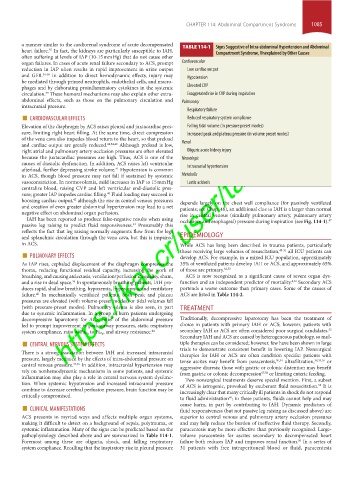
                    a manner similar to the cardiorenal syndrome of acute decompensated     TABLE 114-1     Signs Suggestive of intra-abdominal Hypertension and Abdominal
                    heart failure.  In fact, the kidneys are particularly susceptible to IAH,   Compartment Syndrome, Unexplained by Other Causes
                             35
                    often suffering at levels of IAP (10-15 mm Hg) that do not cause other
                    organ failures. In cases of acute renal failure secondary to ACS, prompt   Cardiovascular
                    reduction in IAP often results in rapid improvement in urine output     Low cardiac output
                    and GFR. 36-38  In addition to direct hemodynamic effects, injury may     Hypotension
                    be mediated through primed neutrophils, endothelial cells, and macro-
                    phages and by elaborating proinflammatory cytokines in the systemic     Elevated CVP
                    circulation.  These humoral mechanisms may also explain other extra-    Exaggerated rise in CVP during inspiration
                            39
                    abdominal effects, such as those on the pulmonary circulation and   Pulmonary
                    intracranial pressure.                                  Respiratory failure
                                  https://kat.cr/user/tahir99/
                        ■  CARDIOVASCULAR EFFECTS                           Reduced respiratory system compliance
                    Elevation of the diaphragm by ACS raises pleural and juxtacardiac pres-    Falling tidal volume (in pressure preset modes)
                    sure, limiting right heart filling. At the same time, direct compression     Increased peak and plateau pressure (in volume preset modes)
                    of the vena cava also impedes blood return to the heart, so that preload
                    and cardiac output are greatly reduced. 24,34,40  Although preload is low,   Renal
                    right atrial and pulmonary artery occlusion pressures are often elevated     Oliguric acute kidney injury
                    because the juxtacardiac pressures are high. Thus, ACS is one of the   Neurologic
                    causes of diastolic dysfunction. In addition, ACS raises left ventricular     Intracranial hypertension
                    afterload, further depressing stroke volume.  Hypotension is common
                                                    41
                    in  ACS, though blood pressure may  not fall  if sustained by  systemic   Metabolic
                    vasoconstriction. In normovolemia, mild increases in IAP to 15 mm Hg     Lactic acidosis
                    centralize blood, raising CVP and left ventricular end-diastolic pres-
                    sure; greater IAP impedes cardiac filling.  Fluid loading may succeed in
                                                 40
                    boosting cardiac output,  although the rise in central venous pressures   depends  largely  on  the  chest  wall  compliance  (for  passively  ventilated
                                     42
                    and creation of even greater abdominal hypertension may lead to a net   patients; see Chap. 48), an additional clue to IAH is a larger than normal
                    negative effect on abdominal organ perfusion.         rise in central venous (similarly pulmonary artery, pulmonary artery
                     IAH has been reported to produce false-negative results when using   occlusion, and esophageal) pressure during inspiration (see Fig. 114-1). 47
                    passive leg raising to predict fluid responsiveness.  Presumably this
                                                         43
                    reflects the fact that leg raising normally augments flow from the legs
                    and splanchnic circulation through the vena cava, but this is impaired   EPIDEMIOLOGY
                    in ACS.                                               While ACS has long been described in trauma patients, particularly
                        ■  PULMONARY EFFECTS                              those receiving large volumes of resuscitation, 48-51  all ICU patients can
                                                                          develop ACS. For example, in a mixed ICU population, approximately
                    As IAP rises, cephalad displacement of the diaphragm compresses the   35% of ventilated patients develop IAH or ACS, and approximately 65%
                    thorax, reducing functional residual capacity, increasing the work of   of those are primary. 52,53
                    breathing, and causing atelectasis, ventilation/perfusion inequality, shunt,   ACS is now recognized as a significant cause of severe organ dys-
                    and a rise in dead space.  In spontaneously breathing patients, IAH pro-  function and an independent predictor of mortality.  Secondary ACS
                                     26
                                                                                                                4,52
                    duces rapid, shallow breathing, hypoxemia, hypercapnia, and ventilatory   portends a worse outcome than primary cases. Some of the causes of
                    failure.  In mechanically ventilated patients, both peak and plateau    ACS are listed in Table 114-2.
                         42
                    pressures are elevated (with volume-preset modes) or tidal  volumes fall
                    (with pressure-preset modes). Pulmonary edema is also seen, in part   TREATMENT
                    due to systemic inflammation. In a group of burn patients undergoing
                    decompressive laparotomy for ACS, relief of the abdominal pressure   Traditionally, decompressive laparotomy has been the treatment of
                    led to prompt improvement in peak airway pressures, static respiratory    choice in patients with primary IAH or ACS; however, patients with
                                                                                                                            52
                                               , and airway resistance. 44  secondary IAH or ACS are often considered poor surgical candidates.
                    system compliance, ratio of Pa O 2  to Fi O 2         Secondary IAH and ACS are caused by heterogeneous pathology, so mul-
                        ■  CENTRAL NERVOUS SYSTEM EFFECTS                 tiple therapies can be considered; however, few have been shown in large
                    There is a strong association between IAH and increased intracranial   trials to demonstrate consistent benefit in lowering IAP. Nonsurgical
                                                                          therapies for IAH or ACS are often condition specific: patients with
                    pressure, largely mediated by the effects of intra-abdominal pressure on   tense  ascites  may  benefit  from  paracentesis, 50,54   ultrafiltration, 38,55,56   or
                    central venous pressure. 45,46  In addition, intracranial hypertension may   aggressive diuresis; those with gastric or colonic distention may benefit
                    rely on nonhemodynamic mechanisms in some patients, and systemic   from gastric or colonic decompression 57,58  or limiting enteric feeding.
                    inflammation may also play a role in central nervous system dysfunc-  Two nonsurgical treatments deserve special mention. First, a subset
                    tion. When systemic hypotension and increased intracranial pressure   of ACS is iatrogenic, provoked by exuberant fluid resuscitation.  It is
                                                                                                                         59
                    combine to decrease cerebral perfusion pressure, brain function may be   increasingly clear that many critically ill patients in shock do not respond
                    critically compromised.                               to fluid administration ; in these patients, fluids cannot help and may
                                                                                          60
                        ■  CLINICAL MANIFESTATIONS                        cause harm, in part by contributing to IAH. Dynamic predictors of
                                                                          fluid responsiveness (but not passive leg raising as discussed above) are
                    ACS presents in myriad ways and affects multiple organ systems,    superior to central venous and pulmonary artery occlusion pressures
                    making it difficult to detect on a background of sepsis, polytrauma, or   and may help reduce the burden of ineffective fluid therapy. Secondly,
                    systemic inflammation. Many of the signs can be predicted based on the   paracentesis may be more effective than previously recognized. Large-
                    pathophysiology described above and are summarized in Table 114-1.    volume paracentesis for ascites secondary to decompensated heart
                    Foremost among these are oliguria, shock, and falling respiratory    failure both reduces IAP and improves renal function.  In a series of
                                                                                                                  56
                    system compliance. Recalling that the inspiratory rise in pleural pressure   31 patients with free intraperitoneal blood or fluid, paracentesis


            section10.indd   1085                                                                                      1/20/2015   9:19:50 AM

