


Page 1567 - Hall et al (2015) Principles of Critical Care-McGraw-Hill
P. 1567
1086     PART 10: The Surgical Patient


                                https://kat.cr/user/tahir99/


                            30

                          20

                        10

                       0


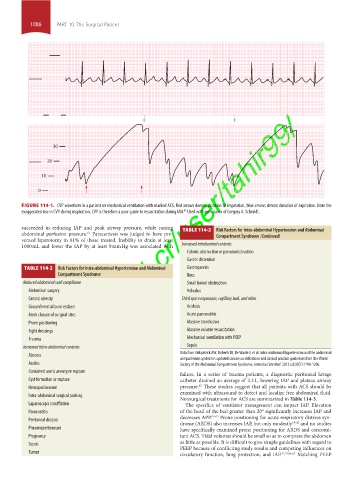
                 FIGURE 114-1.  CVP waveform in a patient on mechanical ventilation with marked ACS. Red arrows denote duration of inspiration, blue arrows denote duration of expiration. Note the
                                                                         47
                 exaggerated rise in CVP during inspiration. CVP is therefore a poor guide to resuscitation during IAH.  Used with permission of Gregory A. Schmidt.
                 succeeded in reducing IAP and peak airway pressure, while raising     TABLE 114-2     Risk Factors for intra-abdominal Hypertension and Abdominal
                 abdominal perfusion pressure.  Paracentesis was judged to have pre-  Compartment Syndrome (Continued)
                                        61
                 vented  laparotomy  in  81%  of  those  treated.  Inability  to  drain  at  least
                 1000 mL and lower the IAP by at least 9 mm Hg was associated with   Increased intraluminal contents
                                                                          Colonic obstruction or pseudoobstruction
                                                                          Gastric distention
                   TABLE 114-2     Risk Factors for intra-abdominal Hypertension and Abdominal     Gastroparesis
                              Compartment Syndrome                        Ileus
                  Reduced abdominal wall compliance                       Small bowel obstruction
                    Abdominal surgery                                     Volvulus
                    Central obesity                                     Third space expansion, capillary leak, and other
                    Circumferential burn eschars                          Acidosis
                    Mesh closure of surgical sites                        Acute pancreatitis
                    Prone positioning                                     Massive transfusion
                    Tight dressings                                       Massive volume resuscitation
                    Trauma                                                Mechanical ventilation with PEEP
                  Increased intra-abdominal contents                      Sepsis
                                                                       Data from Kirkpatrick AW, Roberts DJ, De Waele J, et al. Intra-abdominal hypertension and the  abdominal
                    Abscess
                                                                       compartment syndrome: updated consensus definitions and clinical practice guidelines from the World
                    Ascites                                            Society of the Abdominal Compartment Syndrome. Intensive Care Med. 2013 Jul;39(7):1190-1206.
                    Contained aortic aneurysm rupture
                                                                       failure. In a series of trauma patients, a diagnostic peritoneal lavage
                    Cyst formation or rupture                          catheter drained an average of 2.2 L, lowering IAP and plateau airway
                                                                              62
                    Hemoperitoneum                                     pressure.  These studies suggest that all patients with ACS should be
                                                                       examined with ultrasound to detect and localize free abdominal fluid.
                    Intra-abdominal surgical packing
                                                                       Nonsurgical treatments for ACS are summarized in Table 114-3.
                    Laparoscopic insufflation                            The specifics of ventilator management can impact IAP. Elevation
                    Pancreatitis                                       of the head of the bed greater than 20° significantly increases IAP and
                                                                       decreases APP. 63-65  Prone positioning for acute respiratory distress syn-
                    Peritoneal dialysis                                drome (ARDS) also increases IAP, but only modestly 18-20  and no studies
                    Pneumoperitoneum                                   have specifically examined prone positioning for ARDS and concomi-
                    Pregnancy                                          tant ACS. Tidal volumes should be small so as to compress the abdomen
                    Sepsis                                             as little as possible. It is difficult to give simple guidelines with regard to
                                                                       PEEP because of conflicting study results and competing influences on
                    Tumor                                              circulatory function, lung protection, and IAP. 21,22,66,67  Matching PEEP


            section10.indd   1086                                                                                      1/20/2015   9:19:51 AM

