


Page 1592 - Hall et al (2015) Principles of Critical Care-McGraw-Hill
P. 1592
CHAPTER 116: Care of the Multiorgan Donor  1111


                    positive for antibody to HCV did not appear to cause increased 1-   Fortunately, the use of trimethoprim-sulfamethoxazole as prophylaxis for
                    or 5-year mortality.  But a more recent report with a large cohort    Pneumocystis carinii infection prevents transmission of T gondii. 39
                                  34
                    (>36,000 cases) has shown that kidney transplantation from HCV-  Regional directives will need to be implemented as necessary with
                    donors does increase posttransplant mortality even in the subgroup of   regard to novel infectious agents carrying alarming epidemic/pandemic
                    HCV-seropositive recipients.  Transplantation of an HCV-positive lung   life-threatening potential.  Regions of North America have been faced
                                        35
                                                                                            40
                    or heart-lung allograft when a HCV-negative recipient’s life is in danger   with a relatively new entity, West Nile virus  and more recently, H1N1
                                                                                                         40
                    may be the only alternative to immediate death because an HCV anti-  influenza virus infection.  Organ donors should be tested for evidence
                                                                                            41
                    body–positive donor is an independent poor prognostic indicator for   of West Nile virus viremia by polymerase chain reaction (PCR), nucleic
                    1- and 5-year survivals. 34,36  Table 116-1 shows the relative risk of viral   acid amplification,  or early antibody response (IgM) to West Nile virus.
                                                                                       42
                    transmission for hepatitis B and C viruses.           Influenza  virus  can  be  reliably  detected  by  PCR.  The  donor’s  clinical
                     Transplantation of an organ from a CMV-positive donor can result in   history relative to the last 10 days prior to donor assessment with regard
                    subsequent reactivation of latent virus and replication in the immuno-  to signs  or symptoms associated with such viral infections, and epi-
                    suppressed host.  The specific CMV serological status of the donor and   demiologic links related to direct contact with patients with SARS or
                               37
                    recipient has implications for prophylaxis, the highest-risk group being   influenza virus should be carefully assessed for further investigations. 41
                    CMV-seronegative recipients of CMV-seropositive donor organs (ie, the     ■
                    so-called primary mismatch group).                      DONOR-RELATED MALIGNANCIES
                     Nevertheless, transplantation of organs from CMV-seropositive   Transmission of donor malignancies is a rare event although published
                    donors has not been considered an absolute contraindication for   data were largely based on voluntary reporting.  There is no consensus
                                                                                                            43
                    transplantation, because the high sero-prevalence of the virus among   protocol worldwide; however, great efforts have been made to prevent
                    the general population makes it impractical to rule out such donors.   potential cancer transmission from donors while optimizing the use of
                    Regardless of donor CMV status, seronegative recipients should receive   extended or aged donors.  Donors with past histories of certain types of
                                                                                            44
                    prophylaxis longer than CMV-seropositive recipients to prevent CMV   cancers may be considered as donors, including certain types of primary
                    disease after transplant. 32                          central nervous system (CNS) tumors. Risks of cancer transmission
                     Serological screening of organ donors for EBV is commonly performed   from donors with a history of nonmelanoma skin cancer and selected
                    because primary EBV infection (ie, transplantation of an organ from an   cancers of the CNS appear to be small.  When considering organ
                                                                                                         43
                    EBV-seropositive donor to an EBV-seronegative recipient) is associated   use from donors suffering from intracranial malignancies, there are a
                    with an increased risk of posttransplant lymphoproliferative disease   number of general guidelines. Most important is to consider the known
                    (PTLD).  Therefore, recognition of this mismatch in a potential allograft   biologic behavior of various CNS neoplasms and their propensity to
                          38
                    recipient known to be EBV-negative is important prognostic information.  spread  outside  of  the  cranial  vault.  Repeated  craniotomies  as  well  as
                     The detection of antibody to treponemal antigen is not a contraindica-  ventriculoperitoneal or ventriculojugular shunts have been associated
                    tion to organ procurement, but it is a contraindication to tissue procure-  with increased risk of metastasis. 45,46
                    ment. A standard course of penicillin therapy would provide sufficient   Risks of tumor transmission with certain other types of cancer may
                    antibiotic  coverage  to  prevent  syphilitic  complications  in  an  allograft   be acceptable, particularly if the donor has a long cancer-free interval
                    recipient.   The  possible  transmission  of  the  protozoan  Toxoplasma   prior to organ procurement, while certain other cancers pose a high
                          32
                    gondii is a concern, especially for heart allograft recipients, because of   transmission  risk.  Tumors  that  pose  a  high  transmission  risk  include
                    the predilection of this parasite for muscle tissue. Organ procurement   choriocarcinoma, melanoma, lymphoma, and carcinoma of the lung,
                    from seropositive donors is not contraindicated; however, the detection   colon, breast, kidney, and thyroid. A list has been developed outlining
                    of seropositivity means that the recipient may be placed at high risk.   the relative risks of CNS tumor transmission from deceased donor to
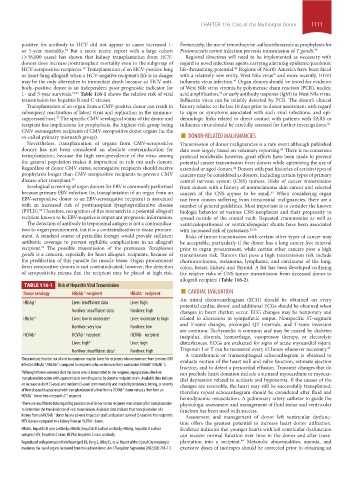
                                                                          allograft recipient (Table 116-2).
                      TABLE 116-1    Risk of Hepatitis Viral Transmission     ■
                                                             −
                                         +
                    Donor serology   HBsAb  recipient    HBsAb  recipient   CARDIAC EVALUATION
                                                                          An  initial  electrocardiogram  (ECG)  should  be  obtained  on  every
                    HBsAg +          Liver: insufficient data  Liver: high
                                                                          potential cardiac donor, and additional ECGs should be obtained when
                                     Nonliver: insufficient data  Nonliver: high  changes in heart rhythm occur. ECG changes may be temporary and
                    HBcAb +          Liver: low to moderate a  Liver: moderate to high  related to alterations in sympathetic output. Nonspecific ST-segment
                                                                          and  T-wave  changes,  prolonged  QT  intervals,  and  T-wave  inversion
                                     Nonliver: very low  Nonliver: low    are common. Tachycardia is common and may be caused by diabetes
                    HCVAb +          HCVAb  recipient    HCVAb  recipient  insipidus, diuresis, hemorrhage, vasopressor therapy, or electrolyte
                                         +
                                                            −
                                     Liver: high b       Liver: high      disturbances. ECGs are evaluated for signs of acute myocardial injury.
                                     Nonliver: insufficient data c  Nonliver: high  Troponin I or T can be measured every 12 hours whenever necessary. 47
                                                                           A transthoracic or transesophageal echocardiogram is obtained to
                    a Data indicate that the risk of viral transmission may be lower for recipients who are immune from previous HBV   evaluate motion of the heart wall and valve function, estimate ejection
                                                               +
                                                                   −
                    infection (HBsAb /HBcAb ) compared to recipients who are immune from vaccination (HBsAb /HBcAb ).
                                +
                           +
                                                                          fraction, and to detect a pericardial effusion. Transient changes that do
                    b Although there is evidence that the donor virus is transmitted to the recipient, repopulation after liver    not preclude heart donation include a stunned myocardium or myocar-
                    transplantation occurs with approximately even frequency by donor or recipient strain. Available data indicate   dial depression related to acidosis and hypoxemia. If the causes of the
                    no increase in short (1-year) and medium (5-year) term mortality and morbidity (incidence, timing, or severity     changes are reversible, the heart may still be successfully transplanted;
                    of liver disease) is associated with transplantation of a liver from a HCVAb  donor versus a liver from an   therefore repeat echocardiogram should be considered after fluid and
                                                      +
                    HCVAb  donor into a hepatitis C  recipient.
                       −
                                   +
                                                                          hemodynamic resuscitation. A pulmonary artery catheter to guide the
                    c There are insufficient data regarding persistence of donor versus recipient virus strains after transplantation    physiologic assessment and management of fluid status and ventricular
                    to determine the true incidence of viral transmission. Available data indicate that transplantation of a    function has been used with success.
                    kidney from an HCVAb  donor has no adverse impact on graft and patient survival (5 years) or the recipient’s   Assessment and management of donor left ventricular dysfunc-
                              +
                    HCV disease compared to a kidney from an HCVAb  donor.  tion offers the greatest potential to increase heart donor utilization.
                                           −
                    HBcAb, hepatitis B core antibody; HBsAb, hepatitis B surface antibody; HBsAg, hepatitis B surface   Evidence indicates that younger hearts with left ventricular dysfunction
                      antigen; HCV, hepatitis C virus; HCVAb, hepatitis C virus antibody.  can recover normal function over time in the donor and after trans-
                                                                                              48
                    Reproduced with permission from Rosengard BR, Feng S, Alfrey EJ, et al. Report of the Crystal City meeting to   plantation  into  a  recipient.   Metabolic  abnormalities,  anemia,  and
                    maximize the use of organs recovered from the cadaver donor. Am J Transplant. September 2002;2(8):701-711.  excessive doses of inotropes should be corrected prior to obtaining an
            section10.indd   1111                                                                                      1/20/2015   9:20:03 AM

