


Page 1594 - Hall et al (2015) Principles of Critical Care-McGraw-Hill
P. 1594
CHAPTER 116: Care of the Multiorgan Donor  1113


                    these previously considered marginal donors, or more appropriately   from cerebrovascular accident, and cold ischemic time.  To date, many
                                                                                                                 53
                    termed “extended” donors are now being used, any potential brain-dead   donor organs that were previously not considered suitable for trans-
                    patient without obvious contraindication to organ donation should be   plantation, “marginal” or extended grafts are now being used in selected
                    referred to appropriate local organ procurement agencies for final deter-  circumstances. The extended donors are identified based on demo-
                    mination of suitability.                              graphic, clinical, laboratory, and histologic data. This includes donor age
                        ■  RENAL EVALUATION                               >70 years or <3 months, donor body weight over 100 kg, moderate or
                                                                          severe macrovesicular fat infiltration of the liver, and abnormal liver func-
                    The discard rate of kidneys procured from cadaveric donors in the   tion  tests.  Serum  aspartate  aminotransferase  (AST)  >160 IU/L,  serum
                    United States has been increasing to an alarming level of more than 15%   sodium >160 mmol/L, donor stay in intensive care of more than 5 days,
                    of kidneys recovered for transplantation. Approximately 50% of kidneys   significant periods of hypotension (<60 mm Hg systolic BP for more than
                    from cadaveric donors over 60 years of age (older-age donors) are not   30 minutes associated with a rise in serum AST), and significant systemic
                    transplanted due to donor quality.                    infection are all parameters considered to define extended grafts.
                     The renal system in a cadaveric donor undergoes a number of physi-  Donor selection remains highly subjective, and in the absence of reliable
                    ologic changes that are influenced dramatically by both the medical   laboratory tests the decision whether to use an extended graft is left to the
                    therapies used to prevent brain death and by brain death itself. Timely   judgment of the transplant surgeon. The definition of what constitutes
                    hemodynamic management is important because the risk of acute tubular   an “extended” graft will continue to vary between centers until reliable
                    necrosis and allograft failure could increase if donor systolic blood pres-  parameters are available for prospectively predicting early graft function. 54
                    sure is consistently lower than 80 to 90 mm Hg.  The results of basic renal
                                                     51
                    function tests such as measurement of serum levels of creatinine and urea  DONOR MANAGEMENT
                    nitrogen and urinalysis should be reviewed to provide a profile of renal
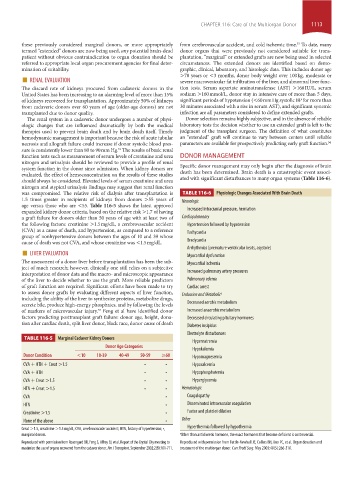
                    system function in the donor since admission. When kidney donors are   Specific donor management may only begin after the diagnosis of brain
                    evaluated, the effect of hemoconcentration on the results of these studies   death has been determined. Brain death is a catastrophic event associ-
                    should always be considered. Elevated levels of serum creatinine and urea   ated with significant disturbances to many organ systems (Table 116-6).
                    nitrogen and atypical urinalysis findings may suggest that renal function
                    was  compromised. The relative  risk  of dialysis  after  transplantation  is       TABLE 116-6    Physiologic Changes Associated With Brain Death
                    1.5  times greater  in  recipients  of kidneys  from  donors  >55  years  of   Neurologic
                    age versus those who are  <55.  Table 116-5 shows the latest approved
                    expanded kidney donor criteria, based on the relative risk >1.7 of having     Increased intracranial pressure, herniation
                    a graft failure for donors older than 50 years of age with at least two of   Cardiopulmonary
                    the following factors: creatinine >1.5 mg/dL, a cerebrovascular accident     Hypertension followed by hypotension
                    (CVA) as a cause of death, and hypertension, as compared to a reference     Tachycardia
                    group of nonhypertensive donors between the ages of 10 and 39 whose
                    cause of death was not CVA, and whose creatinine was <1.5 mg/dL.    Bradycardia
                        ■  LIVER EVALUATION                                 Arrhythmias (premature ventricular beats, asystole)
                                                                            Myocardial dysfunction
                    The assessment of a donor liver before transplantation has been the sub-    Myocardial ischemia
                    ject of much research; however, clinically one still relies on a subjective
                    interpretation of donor data and the macro- and microscopic appearance     Increased pulmonary artery pressures
                    of the liver to decide whether to use the graft. More reliable predictors     Pulmonary edema
                    of graft function are required. Significant efforts have been made to try     Cardiac arrest
                    to assess donor grafts by evaluating different aspects of liver function,   Endocrine and Metabolic a
                    including the ability of the liver to synthesize proteins, metabolize drugs,
                    secrete bile, produce high-energy phosphates, and by following the levels     Decreased aerobic metabolism
                    of markers of microvascular injury.  Feng et al have identified donor     Increased anaerobic metabolism
                                              52
                    factors predicting posttransplant graft failure: donor age, height, dona-    Decreased circulating pituitary hormones
                    tion after cardiac death, split liver donor, black race, donor cause of death     Diabetes insipidus
                                                                            Electrolyte disturbances
                      TABLE 116-5    Marginal Cadaver Kidney Donors
                                                                             Hypernatremia
                                                Donor Age Categories         Hypokalemia
                    Donor Condition   <10    10-39   40-49  50-59  ≥60       Hypomagnesemia
                    CVA + HTN + Creat >1.5                   •       •       Hypocalcemia
                    CVA + HTN                                •       •       Hypophosphatemia
                    CVA + Creat >1.5                         •       •       Hyperglycemia
                    HTN + Creat >1.5                         •       •    Hematologic
                    CVA                                              •      Coagulopathy
                    HTN                                              •      Disseminated intravascular coagulation
                    Creatinine >1.5                                  •      Factor and platelet dilution
                    None of the above                                •    Other
                    Creat >1.5, creatinine >1.5 mg/dL; CVA, cerebrovascular accident; HTN, history of hypertension; •,     Hyperthermia followed by hypothermia
                    marginal donors.                                      a Other than antidiuretic hormone, the exact hormones that become deficient is controversial.
                    Reproduced with permission from Rosengard BR, Feng S, Alfrey EJ, et al. Report of the Crystal City meeting to   Reproduced with permission from Tuttle-Newhall JE, Collins BH, Kuo PC, et al. Organ donation and
                    maximize the use of organs recovered from the cadaver donor. Am J Transplant. September 2002;2(8):701-711.    treatment of the multiorgan donor. Curr Probl Surg. May 2003;40(5):266-310.


            section10.indd   1113                                                                                      1/20/2015   9:20:04 AM

