


Page 1595 - Hall et al (2015) Principles of Critical Care-McGraw-Hill
P. 1595
1114     PART 10: The Surgical Patient


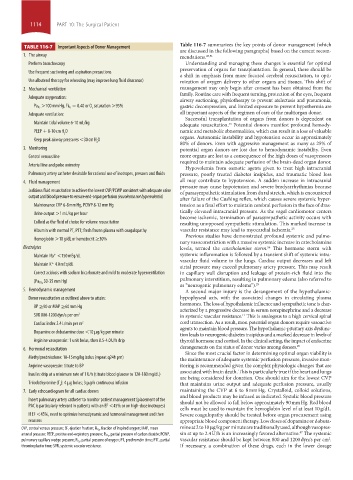
                                                                       Table 116-7 summarizes the key points of donor management (which
                   TABLE 116-7    important Aspects of Donor Management
                                                                       are discussed in the following paragraphs) based on the current recom-
                  1.  The airway                                       mendations. 47,51
                    Perform bronchoscopy                                 Understanding and managing these changes is essential for optimal
                                                                       preservation of organs for transplantation. In general, there should be
                    Use frequent suctioning and aspiration precautions
                                                                       a shift in emphasis from more focused cerebral resuscitation, to opti-
                    Use albuterol therapy for wheezing (may improve lung fluid clearance)  mization of oxygen delivery to other organs and tissues. This shift of
                  2.  Mechanical ventilation                             management may only begin after consent has been obtained from the
                                                                       family. Routine care with frequent turning, protection of the eyes, frequent
                    Adequate oxygenation:
                                                                       airway suctioning, physiotherapy to prevent atelectasis and pneumonia,
                                   = 0.40 or O  saturation >95%        gastric decompression, and limited exposure to prevent hypothermia are
                     Pa O 2  >100 mm Hg, Fi O 2
                                         2
                    Adequate ventilation:                              all important aspects of the regimen of care of the multiorgan donor.
                                                                         Successful  transplantation  of  organs  from  donors  is  dependent on
                      Maintain tidal volume 6-10 mL/kg                 adequate resuscitation.  Potential donors manifest profound hemody-
                                                                                        55
                     PEEP + 8-10 cm H O                                namic and metabolic abnormalities, which can result in a loss of valuable
                                2
                      Keep peak airway pressures <30 cm H O            organs. Autonomic instability and hypotension occur in approximately
                                           2                           80% of donors. Even with aggressive management as many as 25% of
                  3.  Monitoring                                       potential organ donors are lost due to hemodynamic instability. Even
                    Central venous line                                more organs are lost as a consequence of the high doses of vasopressors
                                                                       required to maintain adequate perfusion of the brain-dead organ donor.
                    Arterial line and pulse oximetry
                                                                         Hypovolemia from osmotic agents given to treat high intracranial
                    Pulmonary artery catheter desirable for rational use of inotropes, pressors and fluids  pressure,  poorly  treated  diabetes  insipidus,  and  traumatic  blood  loss
                  4.  Fluid management                                 all may contribute to hypotension. A sudden increase in intracranial
                                                                       pressure may cause hypotension and severe bradyarrhythmias because
                     Judicious fluid resuscitation to achieve the lowest CVP/PCWP consistent with adequate urine   of parasympathetic stimulation from dural stretch, which is encountered
                    output and blood pressure to ensure end-organ perfusion (euvolemia not hypervolemia)  after failure of the Cushing reflex, which causes severe systemic hyper-
                      Maintenance CVP 6-8 mm Hg, PCWP 8-12 mm Hg       tension as a final effort to maintain cerebral perfusion in the face of dras-
                                                                       tically elevated intracranial pressure. As the vagal cardiomotor centers
                     Urine output >1 mL/kg per hour
                                                                       become ischemic, termination of parasympathetic activity occurs with
                      Colloid as the fluid of choice for volume resuscitation  resulting unopposed sympathetic stimulation. This marked increase in
                      Albumin with normal PT, PTT; fresh frozen plasma with coagulopathy  vascular resistance may lead to myocardial ischemia. 25
                                                                         Previous studies have demonstrated profound systemic and pulmo-
                     Hemoglobin >10 g/dL or hematocrit ≥30%
                                                                       nary vasoconstriction with a massive systemic increase in catecholamine
                  Electrolytes                                         levels, termed the  catecholamine storm.  This hormone storm with
                                                                                                     56
                     Maintain Na  <150 mEq/dL                          systemic inflammation is followed by a transient shift of systemic intra-
                            +
                                                                       vascular fluid volume to the lungs. Cardiac output decreases and left
                           +
                     Maintain K  4.0 mEq/dL                            atrial pressure may exceed pulmonary artery pressure. This may result
                      Correct acidosis with sodium bicarbonate and mild to moderate hyperventilation  in capillary wall disruption and leakage of protein-rich fluid into the
                                                                       pulmonary interstitium, resulting in pulmonary edema (also referred to
                         30-35 mm Hg)
                     (Pa CO 2
                                                                       as “neurogenic pulmonary edema”). 25
                  5.  Hemodynamic management                             A second major injury is the derangement of the hypothalamic-
                    Donor resuscitation as outlined above to attain:   hypophyseal axis, with the associated changes in circulating plasma
                                                                       hormones. The loss of hypothalamic influence and sympathetic tone is char-
                     BP ≥90 or MAP ≥60 mm Hg
                                                                       acterized by a progressive decrease in serum norepinephrine and a decrease
                      SVR 800-1200 dyn/s per cm 2                      in systemic vascular resistance.  This is analogous to a high cervical spinal
                                                                                            11
                      Cardiac index 2.4 L/min per m 2                  cord transection. As a result, most potential organ donors require vasoactive
                                                                       agents to maintain blood pressure. The hypothalamic-pituitary axis dysfunc-
                      Dopamine or dobutamine dose <10 µg/kg per minute
                                                                       tion leads to neurogenic diabetes insipidus and a marked decrease in levels of
                      Arginine vasopressin: 1 unit bolus, then 0.5-4.0 U/h drip  thyroid hormone and cortisol. In the clinical setting, the impact of endocrine
                  6.  Hormonal resuscitation                           derangements on the status of donor varies among donors. 29
                                                                         Since the most crucial factor in determining optimal organ viability is
                    Methylprednisolone: 10-15 mg/kg bolus (repeat q24h prn)  the maintenance of adequate systemic perfusion pressure, invasive mon-
                    Arginine vasopressin: titrate to BP                itoring is recommended given the complex physiologic changes that are
                                                                       associated with brain death. This is particularly true if the heart and lungs
                    Insulin: drip at a minimum rate of 1 U/h (titrate blood glucose to 120-180 mg/dL)
                                                                       are being considered for donation. One should aim for the lowest CVP
                    Triiodothyronine (T ): 4 µg bolus; 3 µg/h continuous infusion  that maintains urine output and adequate perfusion pressure, usually
                              3
                  7.  Early echocardiogram for all cardiac donors      maintaining the CVP at 6 to 8 mm Hg. Crystalloid, colloid solutions,
                                                                       and blood products may be infused as indicated. Systolic blood pressure
                     Insert pulmonary artery catheter to monitor patient management (placement of the   should not be allowed to fall below approximately 90 mm Hg. Red blood
                    PAC is particularly relevant in patients with an EF <45% or on high-dose inotropes)
                                                                       cells must be used to maintain the hemoglobin level of at least 10 g/dL.
                     If EF <45%, need to optimize hemodynamic and hormonal management and then    Severe coagulopathy should be treated before organ procurement using
                    reassess                                           appropriate blood component therapy. Low doses of dopamine or dobuta-
                                            , fraction of inspired oxygen; MAP, mean    mine at 2 to 10 µg/kg per minute are traditionally used, although vasopres-
                 CVP, central venous pressure; EF, ejection fraction; FiO 2                                     47
                                               , partial pressure of carbon dioxide; PCWP,   sin at up to 2.4 U/h is an increasingly favored alternative.  The systemic
                 arterial pressure; PEEP, positive end-expiratory pressure; PCO 2                                         2
                                     , partial pressure of oxygen; PT, prothrombin time; PTT, partial   vascular resistance should be kept between 800 and 1200 dyn/s per cm .
                 pulmonary capillary wedge pressure; PO 2
                 thromboplastin time; SVR, systemic vascular resistance.  If necessary, a combination of these drugs, each in the lower dosage


            section10.indd   1114                                                                                      1/20/2015   9:20:04 AM

