


Page 1593 - Hall et al (2015) Principles of Critical Care-McGraw-Hill
P. 1593
1112     PART 10: The Surgical Patient


                   TABLE 116-2    Relative Risk of Central Nervous System Tumor Transmission    TABLE 116-3    Heart Donor Criteria
                  Lowest Risk                                           Criteria     Modification(s)
                    Benign meningiomas                                  Age          Donors >55 may be used selectively, though coexisting LVH and
                    Pituitary adenomas                                               longer ischemic times may increase recipient mortality risks
                    Acoustic schwannomas                                Size         Despite an increased risk associated with small donors, a normal-
                                                                                     sized adult male (>70 kg) donor is suitable for most recipients
                    Craniopharyngiomas
                                                                        LVH          Mild LVH (wall thickness <13 mm by echocardiography and no
                    Astrocytoma (grade I)
                                                                                     LVH by ECG criteria) does not preclude recovery, particularly with
                    Epidermoid cysts, colloid cysts                                  shorter ischemic times
                    Low-grade oligodendrogliomas                        Valvular lesions  Certain lesions, such as mild or moderate mitral or tricuspid
                    Gangliogliomas, gangliocytomas                                     regurgitation, or a normally functioning bicuspid aortic valve may
                                                                                     be amenable to repair prior to transplantation
                    Pineocytomas, ependymomas
                                                                        Congenital lesions  Certain lesions, such as a secundum type ASD, may be amenable
                    Well-differentiated teratomas                                    to repair
                    Papillomas                                          Coronary angiography a.  Male donor age 35-45 years and female donor age 35-50 years:
                    Hemangioblastomas                                                  perform angiography if there is a history of cocaine use or ≥3
                                                                                       risk factors for CAD
                  Moderate Risk
                                                                                     b.  Male donor age 46-55 years and female donor age 51-55 years:
                    Astrocytoma (grade II)                                             angiography recommended
                    Gliomatosis cerebri                                              c.  Age >55 years: angiography strongly recommended
                  Highest Risk                                          CAD          Donor hearts with mild coronary artery disease should be consid-
                                                                                     ered for recipients with relatively urgent need
                    Anaplastic astrocytoma (grade III)
                                                                       ASD, atrial septal defect; CAD, coronary artery disease; ECG, electrocardiographic; LVH, left
                    Glioblastoma multiforme
                                                                       ventricular hypertrophy.
                    Medulloblastoma                                    Reproduced with permission from Rosengard BR, Feng S, Alfrey EJ, et al. Report of the Crystal City meeting to
                    Anaplastic oligodendroglioma                       maximize the use of organs recovered from the cadaver donor. Am J Transplant. September 2002;2(8):701-711.
                    Pineoblastomas
                    Chordomas                                          Ganz catheter monitoring is important to keep the central venous pres-
                                                                       sure below 8 to 10 cm H O. Diuretics should be given when pulmonary
                                                                                         2
                    Malignant ependymomas                              edema is seen, but care should be taken to maintain stable hemodynam-
                    Primary cerebral lymphomas                         ics if diabetes insipidus also exists.
                                                                         Wider application of broader criteria for donor selection and procure-
                 Reproduced with permission from Rosengard BR, Feng S, Alfrey EJ, et al. Report of the Crystal City meeting to   ment is possible and can clearly increase the size of the donor pool, and
                 maximize the use of organs recovered from the cadaver donor. Am J Transplant. September 2002;2(8):701-711.
                                                                       therefore the intensivist plays an important role in identifying potential
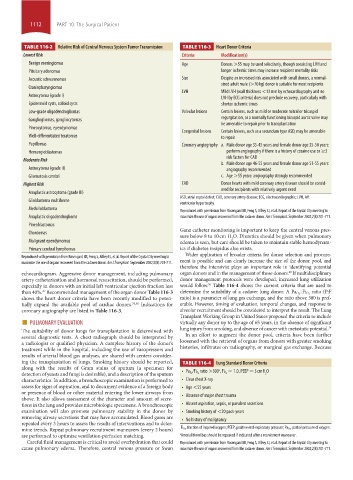
                 echocardiogram. Aggressive donor management, including pulmonary   organ donors and in the management of those donors.  If multidisciplinary
                                                                                                            49
                 artery catheterization and hormonal resuscitation, should be performed,   donor management protocols were developed, increased lung utilization
                 especially in donors with an initial left ventricular ejection fraction less   would  follow.   Table 116-4  shows  the  current  criteria  that  are used to
                                                                                 50
                        47
                 than 40%.  Recommended management of the organ donor Table 116-3    determine the suitability of a cadaver lung donor. A Pa O 2  : Fi O 2  ratio (P:F
                 shows the heart donor criteria have been recently modified to poten-  ratio) is a parameter of lung gas exchange, and the ratio above 300 is pref-
                 tially expand the available pool of cardiac donors. 34,48  Indications for   erable. However, timing of evaluation, temporal changes, and response to
                 coronary angiography are listed in Table 116-3.       alveolar recruitment should be considered to interpret the result. The Lung
                     ■  PULMONARY EVALUATION                           Transplant Working Group in United States proposed the criteria to include
                                                                       virtually any donor up to the age of 65 years, in the absence of significant
                 The suitability of donor lungs for transplantation is determined with   lung injury from smoking, and absence of cancer with metastatic potential. 34
                 several diagnostic tests.  A chest  radiograph  should be interpreted by   In an effort to augment the donor pool, criteria have been further
                 a radiologist or qualified physician. A complete history of the donor’s   loosened with the retrieval of organs from donors with greater smoking
                 treatment while in the hospital, including the use of vasopressors and   histories, infiltrates on radiography, or marginal gas exchange. Because
                 results of arterial blood gas analyses, are shared with centers consider-
                 ing the transplantation of lungs. Smoking history should be reported,     TABLE 116-4    Lung Standard Donor Criteria
                 along with the results of Gram stains of sputum (a specimen for    a
                 detection of yeasts and fungi is desirable), and a description of the sputum   •  Pa O 2 /Fi O 2  ratio >300 , Fi O 2  = 1.0, PEEP = 5 cm H O
                                                                                                    2
                 characteristics. In addition, a bronchoscopic examination is performed to   •  Clear chest X-ray
                 assess for signs of aspiration, and to document evidence of a foreign body   •  Age <55 years
                 or presence of blood or other material entering the lower airways from   •  Absence of major chest trauma
                 above. It also allows assessment of the character and amount of secre-
                 tions in the lung and provides microbiologic specimens. A bronchoscopic   •  Absent aspiration, sepsis, or purulent secretions
                 examination will also promote pulmonary stability in the donor by   •  Smoking history of <20 pack-years
                 removing airway secretions that may have accumulated. Blood gases are   •  No history of malignancy
                 repeated every 3 hours to assess the results of interventions and to deter-
                 mine trends. Repeat pulmonary recruitment maneuvers (every 2 hours)    FiO 2 , fraction of inspired oxygen; PEEP, positive end-expiratory pressure; PaO 2 , partial pressure of oxygen.
                 are performed to optimize ventilation-perfusion matching.  a Arterial blood bas should be repeated if indicated after a recruitment maneuver.
                   Careful fluid management is critical to avoid overhydration that could   Reproduced with permission from Rosengard BR, Feng S, Alfrey EJ, et al. Report of the Crystal City meeting to
                 cause pulmonary edema. Therefore, central venous pressure or Swan   maximize the use of organs recovered from the cadaver donor. Am J Transplant. September 2002;2(8):701-711.


            section10.indd   1112                                                                                      1/20/2015   9:20:03 AM

