


Page 1613 - Hall et al (2015) Principles of Critical Care-McGraw-Hill
P. 1613
1132     PART 10: The Surgical Patient


                 microelectrode within a semipermeable membrane at the bedside via   the oxygen treatment group.  Cerebral microdialysis studies also sug-
                                                                                            140
                 a cranial bolt or in the operating room, into the brain surface usually   gest that after severe TBI, the brain may show signs of ischemia if the
                 in an area expected to be the most prone to ischemia (Fig. 118-15).   CPP trends below 50 mm Hg; however, no significant benefits are appar-
                      is an alternative way to monitor the effects of ICP on brain tissue   ent from elevating the CPP above this threshold. 85,141
                 Pbt O 2
                 oxygenation.
                                             monitoring is that a very small
                   An important limitation of Pbt O 2                  TREATMENT OF INTRACRANIAL HYPERTENSION
                 volume of tissue surrounding the probe, about 1 mm , is sampled.
                                                           3
                 Changes that affect a clinically insignificant (ie, small) area at the elec-  Treatment of elevated ICP should take into account the risks of hernia-
                 trode site can lead to over interpretation of results and clinically signifi-  tion, which are determined by the location, asymmetry, and size of the
                 cant changes that are distant to the small sample area will be undetected.  mass lesion as well as the absolute ICP. Herniation can occur at ICP
                                                values (eg, <10-15 mm Hg) 134,135    <20 to 25 mm Hg and pupillary abnormalities have been reported with
                   In terms of outcome after TBI, low Pbt O 2
                                                                                               142
                 of longer duration (eg, >30 minutes)  are associated with higher mor-  ICP values as low as 18 mm Hg.  An individualized approach taking
                                            135
                 tality rates (56% vs 9%) and less favorable neurological outcomes (GOS   into account ICP in the context of the clinical exam and CT imaging
                     84                 levels <15 mm Hg lasting ≥4 hours may   over  time  is  necessary;  however,  current  Brain  Trauma  Foundation
                 4-5).  TBI patients with Pbt O 2
                                 136                           have also   (BTF)  guidelines  recommend  treatment  of  IH  after  TBI  at  an  upper
                 have a 50% mortality.  Greater than 5% reductions in Pbt O 2
                                                                                                                          86
                 been reported after TBI during patient transport between ICU and the   ICP threshold of 20 to 25 mm Hg and maintaining ICP <20 mm Hg.
                 radiology suite, and the effect appears to be associated with preexisting   A recent meta-analysis of trials and case series reported after 1970, in
                         and reduced lung function. 137                which patients were treated for severe closed TBI, found a consistent
                 low Pbt O 2
                                              may include high concentrations   12%  lower mortality  and 6%  higher  favorable outcomes among  the
                   Treatment aimed at improving Pbt O 2
                                                                                                          143
                 of inspired oxygen, ventilator manipulation, sedation, CPP augmenta-  aggressive ICP monitored and treated patients.  However, a recently
                 tion, or ICP reduction. 84,138  Although maintaining Pbt O 2  >25 mm Hg has   published multicenter, randomized controlled trial of ICP-directed
                 been reported to significantly decrease mortality (44% vs 25%) in TBI   monitoring in patients with severe TBI did not demonstrate any signifi-
                 patients treated with a high oxygen concentration protocol,  outcome   cant difference in outcome versus treatment based on serial neurological
                                                            139
                                                                                        103
                             -directed treatment are inconclusive due to nonrandom-  exam and CT imaging.  The role of ICP monitoring after severe TBI
                 studies on Pbt O 2
                 ized controlled design and lack of medium or longer-term outcome   needs reassessment and further study. 103
                        84                         , the goal is to maintain   In addition to general measures including head in midline posi-
                 measures.  However, when monitoring Pbt O 2
                      levels ≥15 mm Hg. 84                             tion and elevated to 30° to avoid compromising venous drainage, ICP
                 Pbt O 2                                               lowering treatments include sedation, muscle relaxants, CSF drainage,
                     ■  CEREBRAL MICRODIALYSIS                         hyperventilation, hyperosmolar therapy, neurosurgical decompression,
                 Cerebral microdialysis is primarily a research technique performed by   barbiturate coma, and hypo- or normothermia.
                 ing room or via burr hole near damaged or “at risk” cerebral cortex to   ■  SEDATION, ANALGESIA, AND PARALYTICS
                 inserting a tiny semipermeable intracranial catheter(s) in the operat-
                 extract and measure brain metabolites (via dialysis). One study in TBI   Although sedatives and sedating analgesics may be avoided in more
                 patients demonstrated that 100% inspired oxygen within 6 hours of   stable patients to allow close monitoring of the neurological examina-
                 admission was associated with an improvement in metabolic parameters   tion, critically ill patients with severe TBI will require sedation to control
                 including increased brain glucose and decreased glutamate, lactate, and   agitation (encephalopathy), reduce pain, improve oxygenation and ven-
                 lactate/pyruvate ratio but a nonsignificant improvement in outcome in   tilation via ventilator synchrony, reduce oxygen consumption, allow for
                                                                       procedures and imaging, and minimize ICP via sedative and analgesic
                                                                       effects, decreased cerebral metabolic rate, and decreased CBF. In cases of
                                                                       refractory intracranial hypertension, high-dose barbiturates (see below)
                                                                       may be used to reduce ICP by deep suppression of CMR. The effects of
                                                                       sedatives on blood pressure may be beneficial in controlling systemic
                                                                       hypertension or deleterious if they result in systemic hypotension with
                                                                       reduced CPP. After TBI the interrelationships between ICP, hetero-
                                                                       geneous  distribution  of autoregulation  dysfunction,  CBF, and CMR
                                                                       make the prediction of the effect of decreased CPP difficult. The ability
                                                                       to regionally monitor cerebral metabolism at the bedside is needed to
                                                                       assess what are likely individual responses to TBI. In the meantime,
                                                                       conservative control of parameters and maintenance of homeostasis
                                                                       are recommended. Critically ill patients, particularly those with SIRS or
                                                                       sepsis, have a tendency to become hypotensive with sedation and will
                                                                       need vasopressors along with sedation to maintain the desired MAP/
                                                                       CPP. Vasopressors should be prepared and ready to infuse just before
                                                                       sedation in patients with low normal BP or frank hypotension. Bolus
                                                                       doses of sedative analgesics should be avoided in patients with critical
                                                                       reductions in intracranial compliance since they have a greater tendency
                                                                       to decrease MAP and increase ICP. 144,145
                                                                         The commonly used sedatives are short-acting benzodiazepines such as
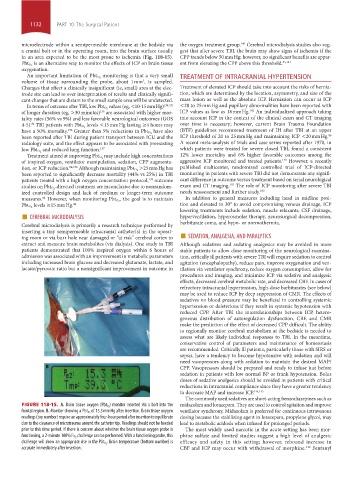
                                               ) monitor inserted via a bolt into the   midazolam and lorazepam. They are used to control agitation and improve
                 FIGURE 118-15.  A. Brain tissue oxygen (Pbt O 2
                                          of 15.3 mm Hg after insertion. Brain tissue oxygen   ventilator synchrony. Midazolam is preferred for continuous intravenous
                 frontal region. B. Monitor showing a Pbt O 2
                 readings (top number) require an approximately four-hour period after insertion to equilibrate   dosing because the stabilizing agent in lorazepam, propylene glycol, may
                 due to the clearance of microtrauma around the catheter tip. Readings should not be heeded   lead to metabolic acidosis when infused for prolonged periods.
                 prior to this time period. If there is concern about whether the brain tissue oxygen probe is   The most widely used narcotic in the acute setting has been mor-
                                     challenge can be performed. With a functioning probe, this   phine sulfate and limited studies suggest a high level of analgesic
                 functioning, a 2-minute 100% Fi O 2
                                              . Brain temperature (bottom number) is   efficacy and safety in this setting; however, rebound increase in
                 challenge will show an appropriate rise in the Pbt O 2
                 accurate immediately after insertion.                 CBF and ICP may occur with withdrawal of morphine.  Fentanyl
                                                                                                                  146


            section10.indd   1132                                                                                      1/20/2015   9:20:22 AM

