


Page 1611 - Hall et al (2015) Principles of Critical Care-McGraw-Hill
P. 1611
1130     PART 10: The Surgical Patient


                                                                       hypotension  and should not be used as a substitute for monitoring
                                                                                112
                                                                       MAP and ICP. 85
                                                                         The  state of autoregulation is  an  important  determinant  of the
                                                                       response to CPP manipulation. Patients with intact autoregulation will
                                                                       tolerate higher CPP, but after acute TBI, autoregulation may be region-
                   Intracranial pressure                               CBF is regulated by metabolism and does not show a linear relationship
                                                                       ally or globally impaired. The more viable the brain tissue, the greater the
                                                                       to CPP; the greater the brain injury, the more CBF appears to be influ-
                                                                       enced by CPP.  Maintaining CPP >70 mm Hg  may require fluid and
                                                                                 109
                                                                                                         113
                                                                       vasopressor therapy and has been associated with the development of
                                                                       acute respiratory distress syndrome (ARDS), cerebral edema, and myo-
                                                                       cardial complications that can compromise cerebral oxygen delivery. In
                                                           C   D       a randomized controlled trial of a cerebral blood flow-targeted protocol
                                                                       using CPP >70 mm Hg versus an ICP-targeted protocol with ICP main-
                                            A           B              tained at <20 mm Hg after TBI, there was no significant difference in
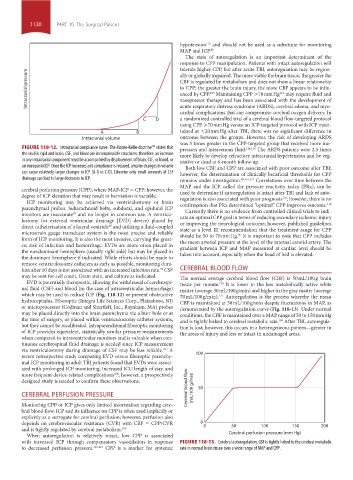
                                      Intracranial volume              outcome  between  the groups. However,  the risk of developing ARDS
                                                                       was 5 times greater in the CPP-targeted group that received more ino-
                 FIGURE 118-12.  Intracranial compliance curve. The Monro-Kellie doctrine  states that   pressors and intravenous fluid. 114,115  The ARDS patients were 2.5 times
                                                              243
                 the skull is rigid and brain, CSF, and blood are incompressible structures; therefore, an increase   more likely to develop refractory intracranial hypertension and be veg-
                 in any intracranial component must be accompanied by displacement of brain, CSF, or blood, or   etative or dead at 6-month follow-up.
                 an increase in ICP. Once the ICP increases and compliance is reduced, smaller changes in volume   Both low CBF and CPP are associated with poor outcome after TBI;
                 can cause relatively larger changes in ICP (A-B vs C-D). Likewise only small amounts of CSF   however, the determination of clinically beneficial thresholds for CPP
                 drainage can lead to large decreases in ICP.          remains under investigation. 85,116,117  Correlations over time between the
                                                                       MAP and the ICP, called the pressure reactivity index (PRx), can be
                 cerebral perfusion pressure (CPP), where MAP-ICP = CPP; however, the   used to determine if autoregulation is intact after TBI and lack of auto-
                 degree of ICP elevation that may result in herniation is variable.  regulation is also associated with poor prognosis ; however, there is no
                                                                                                          118
                   ICP monitoring may be achieved via ventriculostomy or brain   confirmation that PRx determined “optimal” CPP improves outcome. 119
                 parenchymal probes. Subarachnoid bolts, subdural, and epidural ICP   Currently there is no evidence from controlled clinical trials to indi-
                 monitors are inaccurate  and no longer in common use. A ventricu-  cate an optimal CPP goal in terms of reducing secondary ischemic injury
                                   87
                 lostomy (or external ventricular drainage [EVD] device) placed by   or improving the neurological outcome; however, published guidelines
                 direct catheterization of a lateral ventricle  and utilizing a fluid-coupled   state as a level III recommendation that the treatment range for CPP
                                               87
                 microstrain gauge transducer system is the most precise and reliable   should be 50 to 70 mm Hg.  It is important to note that CPP includes
                                                                                           85
                 form of ICP monitoring. It is also the most invasive, carrying the great-  the mean arterial pressure at the level of the internal carotid artery. The
                 est risk of infection and hemorrhage. EVDs are more often placed in   gradient between ICP and MAP measured at cardiac level should be
                 the nondominant hemisphere (usually right side) but may be placed in   taken into account, especially when the head of bed is elevated.
                 the dominant hemisphere if indicated. While efforts should be made to
                 remove ventriculostomy catheters as early as possible, monitoring dura-
                 tion after 10 days is not associated with an increased infection rate.  CSF   CEREBRAL BLOOD FLOW
                                                                26
                 may be sent for cell count, Gram stain, and culture as indicated.  The normal average cerebral blood flow (CBF) is 50 mL/100 g brain
                   EVD is potentially therapeutic, allowing the withdrawal of cerebrospi-  tissue per minute.  It is lower in the less metabolically active white
                                                                                     120
                 nal fluid (CSF) and blood (in the case of intraventricular hemorrhage)   matter (average 30 mL/100 g/min) and higher in the gray matter (average
                 which may be used to reduce ICP (Fig. 118-12) or prevent obstructive   70 mL/100 g/min).  Autoregulation is the process whereby the mean
                                                                                    121
                 hydrocephalus. Fiberoptic (Integra Life Sciences Corp., Plainsboro, NJ)   CBF is maintained at 50 mL/100 g/min despite fluctuations in MAP, as
                 or microprocessor (Codman and Shurtleff, Inc., Raynham, MA) probes   demonstrated by the autoregulation curve (Fig. 118-13). Under normal
                 may be placed directly into the brain parenchyma via a burr hole or at   conditions, the CBF is maintained over a MAP range of 50 to 150 mm Hg
                 the time of surgery, or placed within ventriculostomy catheter systems,   and is tightly linked to cerebral metabolic rate.  After TBI, autoregula-
                                                                                                         109
                 but they cannot be recalibrated. Intraparenchymal fiberoptic monitoring   tion is lost; however, this occurs in a heterogeneous pattern—greater in
                 of ICP provides equivalent, statistically similar pressure measurements   the areas of injury and less or intact in undamaged areas.
                 when compared to intraventricular monitors and is valuable when con-
                 tinuous cerebrospinal fluid drainage is needed since ICP measurement
                 via ventriculostomy during drainage of CSF may be less reliable.  A
                                                                 107
                 recent retrospective study comparing EVD versus fiberoptic parenchy-  100
                 mal ICP monitoring in adult TBI patients found that EVDs were associ-
                 ated with prolonged ICP monitoring, increased ICU length of stay, and
                 more frequent device-related complications ; however, a prospectively
                                                 108
                 designed study is needed to confirm these observations.
                 CEREBRAL PERFUSION PRESSURE                              Cerebral blood flow  (mL/100 g/min)  50
                 Monitoring CPP or ICP gives only limited information regarding cere-
                 bral blood flow. ICP and its influence on CPP is often used implicitly or
                 explicitly as a surrogate for cerebral perfusion; however, perfusion also
                 depends on cerebrovascular resistance (CVR) with CBF = CPP/CVR   0
                 and is tightly regulated by cerebral metabolism. 109          0         50        100       150       200
                   When autoregulation is relatively intact, low CPP is associated      Cerebral perfusion pressure (mm Hg)
                 with increased ICP through compensatory vasodilation in response   FIGURE 118-13.  Cerebral autoregulation. CBF is tightly linked to the cerebral metabolic
                 to decreased perfusion pressure. 110,111  CPP is a marker for systemic   rate in normal brain tissue over a wide range of MAP and CPP.


            section10.indd   1130                                                                                      1/20/2015   9:20:19 AM

