


Page 1612 - Hall et al (2015) Principles of Critical Care-McGraw-Hill
P. 1612
CHAPTER 118: Head Injury  1131

                                                                              ■
                     The methods devised to quantitatively measure CBF were developed                   )
                                                                            JUGULAR VENOUS BULB OXIMETRY (Sj O2
                    over 65 years ago ; however, none are in common use at the bedside   Retrograde placement of a catheter into the internal jugular vein cepha-
                                120
                    today. Measurement of CBF has contributed greatly to elucidating the   lad toward the jugular venous bulb can be used to sample the jugular
                    pathophysiology of TBI, but bedside monitoring of CBF for clinical    venous blood via intermittent blood gas sampling or continuously via
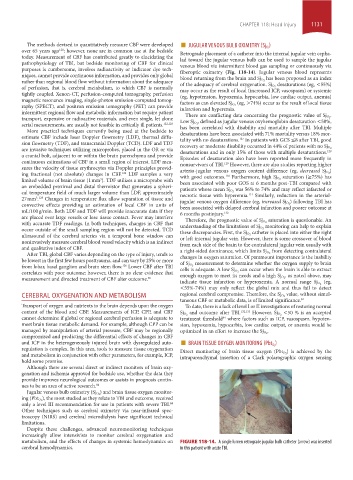
                    purposes is cumbersome, involves radioactivity or indicator dye tech-  fiberoptic oximetry (Fig. 118-14). Jugular venous blood represents
                    niques, cannot provide continuous information, and provides only global            has been proposed as an index
                    rather than regional blood flow without information about the adequacy   blood returning from the brain and Sj O 2   desaturations (eg, <55%)
                    of perfusion, that is, cerebral metabolism, to which CBF is normally   of the adequacy of cerebral oxygenation. Sj O 2
                                                                          may occur as the result of local (increased ICP, vasospasm) or systemic
                    tightly coupled. Xenon-CT, perfusion-computed tomography, perfusion   (eg, hypotension, hypoxemia, hypocarbia, low cardiac output, anemia)
                    magnetic resonance imaging, single-photon emission-computed tomog-        (eg, >74%) occur as the result of local tissue
                    raphy (SPECT), and positron emission tomography (PET) can provide   factors as can elevated Sj O 2
                                                                          infarction and hyperemia.
                    intermittent regional flow and metabolic information but require patient                                 .
                    transport, expensive or radioactive materials, and even single, let alone   There are conflicting data concerning the prognostic value of Sj O 2
                                                                                , defined as jugular venous oxyhemoglobin desaturation <50%,
                    serial measurements, are usually not feasible in critically ill patients. 122,123  Low Sj O 2
                                                                          has been correlated with disability and mortality after TBI. Multiple
                     More practical techniques currently being used at the bedside to   desaturations have been associated with 71% mortality versus 18% mor-
                    estimate CBF include laser Doppler flowmetry (LDF), thermal diffu-  tality with no desaturations.  In patients with GCS ≤8 after TBI, good
                                                                                              127
                    sion flowmetry (TDF), and transcranial Doppler (TCD). LDF and TDF
                    are invasive techniques utilizing microprobes, placed in the OR or via   recovery or moderate disability occurred in 44% of patients with no Sj O 2
                                                                                                                            128
                                                                          desaturations and in only 15% of those with multiple desaturations.
                    a cranial bolt, adjacent to or within the brain parenchyma and provide   Episodes of desaturation also have been reported more frequently in
                    continuous estimations of CBF in a small region of interest. LDF mea-  nonsurvivors of TBI.  However, there are also studies reporting higher
                                                                                         129
                    sures the velocity of tissue erythrocytes via Doppler principles provid-                                 )
                    ing fractional (not absolute) changes in CBF.  LDF samples a very   arterio-jugular venous oxygen content difference (eg,  decreased Sj O 2
                                                      124
                                                                                                             saturation (≥75%) has
                                                                                         130
                    limited volume of brain tissue (1 mm ). TDF utilizes a microprobe with   with good outcomes.  Furthermore, high Sj O 2
                                              3
                                                                          been associated with poor GOS at 6 months post-TBI compared with
                    an embedded proximal and distal thermistor that generates a spheri-      was 56% to 74% and may reflect infarcted or
                    cal temperature field of much larger volume than LDF, approximately   patients whose mean Sj O 2  131
                                                                          necrotic  tissue  with  hyperemia.   Similarly,  reduction  in  the  arterial-
                    27 mm .  Changes in temperature flux allow separation of tissue and                        ) following TBI has
                         3 125
                    convective effects providing an estimation of local CBF in units of   jugular venous oxygen difference (eg, increased Sj O 2
                                                                          been associated with delayed cerebral infarction and poorer outcome at
                    mL/100 g/min. Both LDF and TDF will provide inaccurate data if they   6 months postinjury. 132
                    are placed over large vessels or lose tissue contact. Fever may interfere           saturation is questionable. An
                    with accurate TDF readings. In both techniques, changes in CBF that   Therefore, the prognostic value of Sj O 2
                                                                                                       monitoring can help to explain
                    occur outside of the small sampling region will not be detected. TCD   understanding of the limitations of Sj O 2
                                                                                                   catheter is placed into either the right
                    ultrasound of the cerebral arteries via a temporal bone window can   these discrepancies. First, the Sj O 2
                                                                          or left internal jugular vein. However, there is some crossover of blood
                    noninvasively measure cerebral blood vessel velocity which is an indirect   from each side of the brain to the contralateral jugular vein usually with
                    and qualitative index of CBF.                                                        from detecting contralateral
                     After TBI, global CBF varies depending on the type of injury, tends to   a right-sided dominance, which limits Sj O 2
                                                                          changes in oxygen saturation. Of paramount importance is the inability
                    be lowest in the first few hours posttrauma, and can vary by 25% or more    measurement to determine whether the oxygen supply to brain
                    from lobar, basal ganglion and brain stem flow.  Lower CBF after TBI   of Sj O 2   can occur when the brain is able to extract
                                                      126
                    correlates with poor outcome; however, there is no clear evidence that   cells is adequate. A low Sj O 2  , as noted above, may
                    measurement and directed treatment of CBF alter outcome. 85  enough oxygen to meet its needs and a high Sj O 2
                                                                          indicate  tissue  infarction  or hyperoxemia.  A  normal  range  Sj O 2   (eg,
                                                                          <55%-74%)  may  only  reflect  the  global  mix  and  thus  fail  to  detect
                    CEREBRAL OXYGENATION AND METABOLISM                   regional cerebral compromise. Therefore, the Sj O 2  value, without simul-
                                                                          taneous CBF or metabolic data, is of limited significance. 84
                    Transport of oxygen and nutrients to the brain depends upon the oxygen    To date, there is a lack of level I or II investigations of restoring normal
                    content of the blood and CBF. Measurements of ICP, CPP, and CBF   Sj O 2  and outcome after TBI. 132,133  However, Sj O 2  <50 % is an accepted
                    cannot determine if global or regional cerebral perfusion is adequate to   treatment threshold  where factors such as ICP, vasospasm, hypoten-
                                                                                        84
                    meet brain tissue metabolic demand. For example, although CPP can be   sion, hypoxemia, hypocarbia, low cardiac output, or anemia would be
                    managed by manipulation of arterial pressure, CBF may be regionally   optimized in an effort to increase the Sj O 2 .
                    compromised and predicting the differential effects of changes in CBF
                    and ICP in the heterogeneously injured brain with dysregulated auto-    ■  BRAIN TISSUE OXYGEN MONITORING (Pbt O2 )
                    regulation is complex. In this area, tools to measure tissue oxygenation                  ) is achieved by the
                    and metabolism in conjunction with other parameters, for example, ICP,   Direct monitoring of brain tissue oxygen (Pbt O 2
                                                                          intraparenchymal insertion of a Clark polarographic oxygen sensing
                    hold some promise.
                     Although there are several direct or indirect monitors of brain oxy-
                    genation and ischemia approved for bedside use, whether the data they
                    provide improves neurological outcomes or assists in prognosis contin-
                    ues to be an area of active research. 84
                                              ) and brain tissue oxygen monitor-
                     Jugular venous bulb oximetry (Sj O 2
                           ), the most studied as they relate to TBI and outcome, received
                    ing (Pbt O 2
                    only a level III recommendation for use in patients with severe TBI.
                                                                      84
                    Other  techniques  such  as  cerebral oximetry  via near-infrared  spec-
                    troscopy  (NIRS)  and  cerebral  microdialysis  have  significant  technical
                    limitations.
                     Despite these challenges, advanced neuromonitoring techniques
                    increasingly allow intensivists to monitor cerebral oxygenation and
                    metabolism, and the effects of changes in systemic hemodynamics on   FIGURE 118-14.  A single lumen retrograde jugular bulb catheter (arrow) was inserted
                    cerebral hemodynamics.                                in this patient with acute TBI.
            section10.indd   1131                                                                                      1/20/2015   9:20:20 AM

