


Page 1608 - Hall et al (2015) Principles of Critical Care-McGraw-Hill
P. 1608
CHAPTER 118: Head Injury  1127


                                          Levels of evidence                 Definition
                                         I                At least one good quality randomized controlled trial (RCT).
                                         II               Moderate quality RCT; lacks ≥1 criteria for a good quality RCT, e.g.,
                                                          controlled trials without randomization. Good quality cohort or case-
                                                          control studies.
                                         III              Poor quality RCT; major violations of criteria for a good or moderate
                                                          quality RCT, cohort or case control study; Case series, databases, or
                                                          registries, expert opinion

                                                                       35
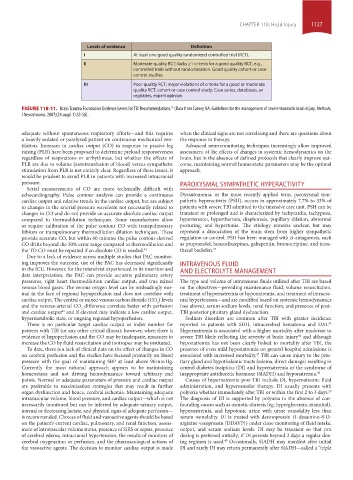
                    FIGURE 118-11.  Brain Trauma Foundation Evidence Levels for TBI Recommendations.  (Data from Carney NA. Guidelines for the management of severe traumatic brain injury. Methods,
                    J Neurotrauma. 2007;(24 suppl 1):S3-S6).

                    adequate without spontaneous respiratory efforts—and this requires   when the clinical signs are not correlating and there are questions about
                    a heavily sedated or paralyzed patient on continuous mechanical ven-  the response to therapy.
                    tilation. Increases in cardiac output (CO) in response to passive leg   Advanced neuromonitoring techniques increasingly allow improved
                    raising (PLR) have been proposed to determine preload responsiveness   assessment of the effects of changes in systemic hemodynamics on the
                    regardless of respirations or arrhythmias, but whether the effects of   brain, but in the absence of defined protocols that clearly improve out-
                    PLR are due to volume (autotransfusion of blood) versus sympathetic   come, maintaining normal homeostatic parameters may be the optimal
                    stimulation from PLR is not entirely clear. Regardless of these issues, it   approach.
                    would be prudent to avoid PLR in patients with increased intracranial
                    pressure.                                             PAROXYSMAL SYMPATHETIC HYPERACTIVITY
                     Serial  measurements of CO  are more  technically difficult with
                    echocardiography. Pulse contour analysis can provide a continuous   Dysautonomia, or the more recently applied term, paroxysmal sym-
                    cardiac output and relative trends in the cardiac output, but are subject   pathetic hyperactivity (PSH), occurs in approximately 7.7% to 33% of
                    to changes in the arterial pressure waveform not necessarily related to   patients with severe TBI admitted to the intensive care unit. PSH can be
                    changes in CO and do not provide an accurate absolute cardiac output   transient or prolonged and is characterized by tachycardia, tachypnea,
                    compared to thermodilution techniques. Some manufactures allow   hypertension, hyperthermia, diaphoresis, pupillary dilation, abnormal
                    or require calibration of the pulse contour CO with transpulmonary   posturing,  and  hypertonia.  The  etiology  remains  unclear,  but  may
                    lithium or transpulmonary thermodilution dilution techniques. These   represent  a  dissociation  of  the  brain  stem  from  higher  sympathetic
                    provide accurate CO, but within 60 minutes the pulse contour-derived   regulation or control. PSH has been managed with β-antagonists, such
                    CO drifts beyond the 30% error range compared to thermodilution and   as propranolol, benzodiazepines, gabapentin, bromocriptine, and intra-
                    the TD CO must be repeated if an absolute CO is needed. 42  thecal baclofen. 44
                     Due to a lack of evidence across multiple studies that PAC monitor-
                    ing improves the outcome, use of the PAC has decreased significantly   INTRAVENOUS FLUID
                    in the ICU. However, for the intensivist experienced in its insertion and   AND ELECTROLYTE MANAGEMENT
                    data interpretation, the PAC can provide accurate pulmonary artery
                    pressures, right heart thermodilution cardiac output, and true mixed   The type and volume of intravenous fluids utilized after TBI are based
                    venous blood gases. The venous oxygen level can be misleadingly nor-  on the objectives—providing maintenance fluid, volume resuscitation,
                    mal in the face of regional hypoperfusion and does not correlate with   treatment of hypernatremia or hyponatremia, and treatment of intracra-
                    cardiac output. The central or mixed venous carbon dioxide (CO ) levels   nial hypertension—and are modified based on systemic hemodynamics
                                                                  2
                    and the venous-arterial CO  difference correlate better with perfusion   (see above), serum sodium levels, renal function, and presence of post-
                                        2
                    and cardiac output  and if elevated may indicate a low cardiac output,   TBI posterior pituitary gland dysfunction.
                                 43
                    hypermetabolic state, or ongoing regional hypoperfusion.  Sodium disorders are common after TBI with greater incidence
                     There  is  no particular  target  cardiac  output  or  index  number  for   reported in patients with SDH, intracerebral hematoma and DAI.
                                                                                                                            45
                    patients with TBI (or any other critical illness); however, when there is   Hypernatremia is associated with a higher mortality after moderate to
                                                                                                                  46
                    evidence of hypoperfusion and the CO may be inadequate, measures to   severe TBI likely reflecting the severity of brain injury  and although
                    increase the CO by fluid resuscitation and inotropes may be instituted.  hyponatremia has not been clearly linked to mortality after TBI, the
                     To date, there is a lack of clinical data on the effect of changes in CO   presence of even mild hyponatremia on general hospital admissions is
                    on cerebral perfusion and the studies have focused primarily on blood   associated with increased mortality.  TBI can cause injury to the pitu-
                                                                                                    47
                    pressure with the goal of maintaining SBP at least above 90 mm Hg.   itary gland and hypothalamic tracts (edema, direct damage) resulting in
                    Currently the most rational approach appears to be maintaining   central diabetes insipidus (DI) and hypernatremia or the syndrome of
                    homeostasis and not driving hemodynamics toward arbitrary end   inappropriate antidiuretic hormone (SIADH) and hyponatremia. 48
                    points. Normal or adequate parameters of pressure and cardiac output   Causes of hypernatremia post-TBI include DI, hypernatremic fluid
                    are preferable to maximization strategies that may result in further   administration, and hyperosmolar therapy. DI usually presents  with
                    organ dysfunction and hence, cerebral ischemia. Maintaining adequate   polyuria whether immediately after TBI or within the first 2 to 3 days.
                                                                                                                            49
                    intravascular volume, blood pressure, and cardiac output—which is not   The diagnosis of DI is supported by polyuria in the absence of con-
                    necessarily monitored but can be inferred by adequate urinary output,   founding causes such as osmotic diuresis (eg, hyperglycemia, mannitol),
                    normal or decreasing lactate, and physical signs of adequate perfusion—  hypernatremia, and hypotonic urine with urine osmolality less than
                    is recommended. Choices of fluid and vasoactive agents should be based   serum  osmolality.  DI  is  treated  with  desmopressin  (1-desamino-8-D-
                    on the patient’s current cardiac, pulmonary, and renal function, assess-  arginine vasopressin [DDAVP]) under close monitoring of fluid intake,
                    ment of intravascular volume status, presence of SIRS or sepsis, presence   output,  and  serum  sodium  levels.  DI  may  be  transient  so  that  prn
                    of cerebral edema, intracranial hypertension, the results of monitors of   dosing is preferred initially; if DI persists beyond 2 days a regular dos-
                    cerebral oxygenation or perfusion, and the pharmacological actions of   ing regimen is used.  Occasionally, SIADH may manifest after initial
                                                                                         49
                    the vasoactive agents. The decision to monitor cardiac output is made   DI and rarely DI may return permanently after SIADH—called a “triple


            section10.indd   1127                                                                                      1/20/2015   9:20:17 AM

