


Page 1634 - Hall et al (2015) Principles of Critical Care-McGraw-Hill
P. 1634
CHAPTER 120: Torso Trauma  1153


                                                                          resuscitative phase, particularly if the source of instability is major hem-
                        • In general,  indications  for surgical  intervention in  abdominal   orrhage in the thoracic or abdominal cavity. Although it may be possible
                      trauma are perforation, penetration, and hemorrhage.  to identify a specific source in the thorax or abdomen for the abnormal
                        • An organ-specific diagnosis is not necessary to establish the need   hemodynamics in the trauma patient, it is frequently impossible to be
                      for laparotomy in trauma.                           absolutely certain of such a source. Therefore, a decision has to be made
                        • Ultrasound, peritoneal lavage, and computed tomographic (CT)   to  approach  the  hemodynamically  abnormal  patient  through  either  a
                                                                          laparotomy or a thoracotomy if a source outside the thorax or abdomen
                      scan are important tools in assessing the traumatized abdomen   has been ruled out. With this approach, one must be prepared to stop
                      when physical examination alone is unreliable.      exploration of one cavity when it becomes obvious that the source of the
                        • Most thoracic injuries can be managed appropriately by simple   hemodynamic abnormality is in the other.
                      measures aimed at correcting thoracic sources of hypoperfusion
                      and hypoxemia.                                      CLASSIFICATION OF TORSO TRAUMA
                        • Emergency thoracotomy should be considered in the unstable or
                      unresponsive patient when this technique could potentially reverse   Generally, torso trauma may be classified into two broad groups: pen-
                      the source of instability.                          etrating and blunt. As indicated earlier, any penetrating missile entering
                                                                          inferior to the nipple line can produce diaphragmatic, intrathoracic, or
                                                                          abdominal injuries. Similarly, blunt injuries may disrupt intrathoracic
                    Injuries involving the chest and abdomen may be considered as a single   contents as well as intra-abdominal contents either directly or indi-
                    complex—torso trauma. This strategy is based on several factors. The   rectly through fractures of the lower ribs, which then puncture intra-
                    configuration of the diaphragm and its attachment to the rib cage result   abdominal organs such as the spleen, liver, and stomach.
                    in marked variability in its position with respiration and thus in demar-  A more clinically applicable method of classifying torso trauma involves
                    cation of the thoracic and abdominal cavities. It is not unusual for the   two categories. The first category consists of injuries that are immediately
                    diaphragm to traverse distances of over 15 cm between the inspiratory   life threatening and thus require immediate intervention because of car-
                    and expiratory phases of respiration. The diaphragm may be at the level   diorespiratory or hemodynamic compromise. The other category includes
                    of the nipple line during full expiration and well below the costal margin   injuries in a relatively hemodynamically normal patient. These latter
                    during full inspiration, with corresponding shifts of the abdominal and   injuries are considered to be potentially life threatening because, if left
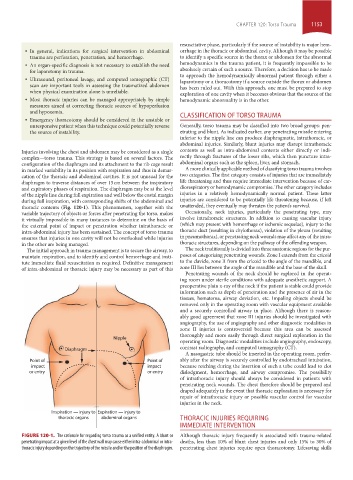
                    thoracic contents (Fig. 120-1). This phenomenon, together with the   unattended, they eventually may threaten the patient’s survival.
                    variable trajectory of objects or forces after penetrating the torso, makes   Occasionally, neck injuries, particularly the penetrating type, may
                    it virtually impossible in many instances to determine on the basis of   involve intrathoracic structures. In addition to causing vascular injury
                    the external point of impact or penetration whether intrathoracic or   (which may present with hemorrhage or ischemic sequelae), injury to the
                    intra-abdominal injury has been sustained. The concept of torso trauma   thoracic duct (resulting in chylothorax), violation of the pleura (resulting
                    ensures that injuries in one cavity will not be overlooked while injuries   in pneumothorax), or penetrating neck wounds may affect any of the intra-
                    in the other are being managed.                       thoracic structures, depending on the pathway of the offending weapon.
                     The initial approach in trauma management is to secure the airway, to   The neck traditionally is divided into three anatomic regions for the pur-
                    maintain respiration, and to identify and control hemorrhage and insti-  poses of categorizing penetrating wounds. Zone I extends from the cricoid
                    tute immediate fluid resuscitation as required. Definitive management   to the clavicle, zone II from the cricoid to the angle of the mandible, and
                    of intra-abdominal or thoracic injury may be necessary as part of this   zone III lies between the angle of the mandible and the base of the skull.
                                                                           Penetrating wounds of the neck should be explored in the operat-
                                                                          ing room under sterile conditions with adequate anesthetic support. A
                                                                          preoperative plain x-ray of the neck if the patient is stable could provide
                                                                          information such as depth of penetration and the presence of air in the
                                                                          tissues, hematoma, airway deviation, etc. Impaling objects should be
                                                                          removed only in the operating room with vascular equipment available
                                                                          and a securely controlled airway in place. Although there is reason-
                                                                          ably good agreement that zone III injuries should be investigated with
                                                                          angiography, the use of angiography and other diagnostic modalities in
                                                                          zone II injuries is controversial because this area can be assessed
                                                                          thoroughly and more easily through direct surgical exploration in the
                                                   Nipple
                                                                          operating room. Diagnostic modalities include angiography, endoscopy,
                                                                          contrast radiography, and computed tomography (CT).
                                  Diaphragm
                                                                           A nasogastric tube should be inserted in the operating room, prefer-
                      Point of                                Point of    ably after the airway is securely controlled by endotracheal intubation,
                       impact                                 impact      because retching during the insertion of such a tube could lead to clot
                      or entry                                or entry    dislodgment, hemorrhage, and airway compromise. The possibility
                                                                          of intrathoracic injury should always be considered in patients with
                                                                          penetrating neck wounds. The chest therefore should be prepared and
                                                                          draped adequately in the event that thoracic exploration is necessary for
                                                                          repair of intrathoracic injury or possible vascular control for vascular
                                                                          injuries in the neck.
                              Inspiration — injury to  Expiration — injury to
                                thoracic organs  abdominal organs         THORACIC INJURIES REQUIRING
                                                                          IMMEDIATE INTERVENTION

                    FIGURE 120-1.  The rationale for regarding torso trauma as a unified entity. A blunt or   Although thoracic injury frequently is associated with trauma-related
                    penetrating impact at a given level of the chest wall may cause either intra-abdominal or intra-  deaths, less than 10% of blunt chest injuries and only 15% to 30% of
                    thoracic injury depending on the trajectory of the missile and/or the position of the diaphragm.  penetrating chest injuries  require open  thoracotomy. Lifesaving skills


            section10.indd   1153                                                                                      1/20/2015   9:20:58 AM

