


Page 1630 - Hall et al (2015) Principles of Critical Care-McGraw-Hill
P. 1630
CHAPTER 119: Spinal Injuries  1149


                       1                                  2                                         3

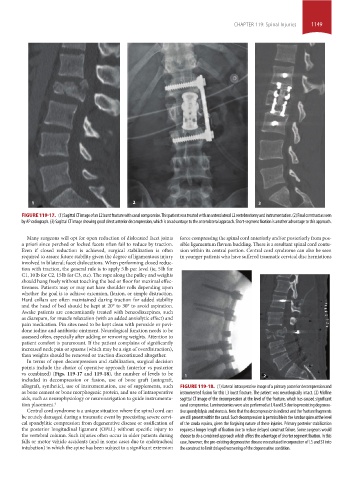
                    FIGURE 119-17.  (1) Sagittal CT image of an L2 burst fracture with canal compromise. This patient was treated with an anterolateral L2 vertebrectomy and instrumentation. (2) Final construct as seen
                    by AP radiograph. (3) Sagittal CT image showing good direct anterior decompression, which is an advantage to the anterolateral approach. Short-segment fixation is another advantage to this approach.

                     Many surgeons will opt for open reduction of dislocated facet joints   force compressing the spinal cord anteriorly and/or posteriorly from pos-
                    a priori since perched or locked facets often fail to reduce by traction.   sible ligamentum flavum buckling. There is a resultant spinal cord contu-
                    Even if closed reduction is achieved, surgical stabilization is often   sion within its central portion. Central cord syndrome can also be seen
                    required to assure future stability given the degree of ligamentous injury   in younger patients who have suffered traumatic cervical disc herniations
                    involved in bilateral; facet dislocations. When performing closed reduc-
                    tion with traction, the general rule is to apply 5 lb per level (ie, 5 lb for
                    C1, 10 lb for C2, 15 lb for C3, etc). The rope along the pulley and weights
                    should hang freely without touching the bed or floor for maximal effec-
                    tiveness. Patients may or may not have shoulder rolls depending upon
                    whether the goal is to achieve extension, flexion, or simple distraction.
                    Hard  collars  are  often  maintained  during  traction  for  added  stability
                    and the head of bed should be kept at 20° to 30° to avoid aspiration.
                    Awake patients are concomitantly treated with benzodiazepines, such
                    as diazepam, for muscle relaxation (with an added anxiolytic effect) and
                    pain medication. Pin sites need to be kept clean with peroxide or povi-
                    done iodine and antibiotic ointment. Neurological function needs to be
                    assessed often, especially after adding or removing weights. Attention to
                    patient comfort is paramount. If the patient complains of significantly
                    increased neck pain or spasms (which may be a sign of overdistraction),
                    then weights should be removed or traction discontinued altogether.
                     In terms of open decompression and stabilization, surgical decision
                    points include the choice of operative approach (anterior vs posterior
                    vs combined) (Figs. 119-17  and 119-18), the number of levels to be   1           2
                    included in decompression or fusion, use of bone graft (autograft,
                    allograft, synthetic), use of instrumentation, use of supplements, such   FIGURE 119-18.  (1) Lateral intraoperative image of a primary posterior decompression and
                    as bone cement or bone morphogenic protein, and use of intraoperative   instrumented fusion for this L3 burst fracture. The patient was neurologically intact. (2) Midline
                    aids, such as neurophysiology or neuronavigation to guide instrumenta-  sagittal CT image of the decompression at the level of the fracture, which has caused significant
                    tion placement. 4                                     canal compromise. Laminectomies were also performed at L4 and L5 due to preexisting degenera-
                     Central cord syndrome is a unique situation where the spinal cord can   tive spondylolysis and stenosis. Note that the decompression is indirect and the fracture fragments
                    be acutely damaged during a traumatic event by preexisting severe cervi-  are still present within the canal. Such decompression is permissible in the lumbar spine at the level
                    cal spondylitic compression from degenerative disease or ossification of   of the cauda equina, given the forgiving nature of these injuries. Primary posterior stabilization
                    the posterior longitudinal ligament (OPLL) without specific injury to   requires a longer length of fixation due to reduce delayed construct failure. Some surgeons would
                    the vertebral column. Such injuries often occur in older patients during   choose to do a combined approach which offers the advantage of shorter segment fixation. In this
                    falls or motor vehicle accidents (and in some cases due to endotracheal   case, however, the pre-existing degenerative disease necessitated incorporation of L5 and S1 into
                    intubation) in which the spine has been subject to a significant extension   the construct to limit delayed worsening of the degenerative condition.


            section10.indd   1149                                                                                      1/20/2015   9:20:55 AM

