


Page 1636 - Hall et al (2015) Principles of Critical Care-McGraw-Hill
P. 1636
CHAPTER 120: Torso Trauma  1155


                                                                          paradoxus accurately. The physician should note the difference between
                                                                          systolic blood pressure during inspiration and expiration. The pressure
                                                                          waveform will exhibit a lower peak level in inspiration, with higher peak
                                                                          levels in expiration. The difference between the two peaks is the mea-
                                                                          sure of the degree of pulsus paradoxus. The degree of pulsus paradoxus
                                                                          may be determined at the bedside by listening for the first set of sounds
                                                                          with the sphygmomanometer slowly deflating. The first set of sounds
                                                                          represents the systolic blood pressure on expiration. As the pressure in
                                                                          the cuff is slowly released, the gaps in systolic blood pressure sounds
                                                                          between inspiration and expiration disappear, and there is an increased
                                                                          frequency of sounds heard with the stethoscope. The difference between
                                  https://kat.cr/user/tahir99/
                                                                          the initial pressure and the pressure when the gaps in sounds have disap-
                                 Opening in                               peared is the degree of pulsus paradoxus. Since distended neck veins and
                                 chest wall
                              (but not gauze pad)                         hypotension are present in both tension pneumothorax and cardiac tam-
                                                                          ponade, differentiation between these two conditions is important but at
                                                                          times difficult. The physician must rely on evidence of hyperresonance
                                                                          and decreased breath sounds that will suggest tension pneumothorax. If
                                                                          a search for these signs still leaves doubt, the patient should be treated
                                             Occlusive dressing
                                            (taped on three sides)        first for possible tension pneumothorax by insertion of a needle in the
                                                                          pleural space. This step can be performed quickly and will give the diag-
                                                                          nosis as well as be therapeutic for a tension pneumothorax. Once tension
                              Free edge
                                                                          pneumothorax is ruled out, one should proceed to treatment for cardiac
                                                                          tamponade  if  signs  of  circulatory compromise  persist.  If  immediately
                                                                          available in the emergency setting, epigastric placement of an ultrasound
                                                                          probe is also helpful in diagnosing hemopericardium. In many trauma
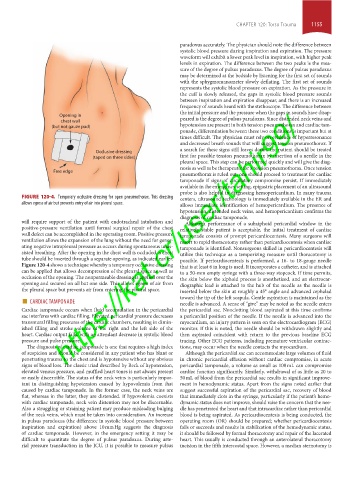
                    FIGURE 120-4.  Temporary occlusive dressing for open pneumothorax. This dressing   centers, ultrasound technology is immediately available in the ER and
                    allows egress of air but prevents entry of air into pleural space.  allows immediate identification of hemopericardium. The presence of
                                                                          hypotension, distended neck veins, and hemopericardium confirms the
                                                                          diagnosis of cardiac tamponade.
                    will require support of the patient with endotracheal intubation and   Although performance of a subxiphoid pericardial window in the
                    positive-pressure ventilation until formal surgical repair of the chest   relatively stable patient is acceptable, the initial treatment of cardiac
                    wall defect can be accomplished in the operating room. Positive pressure   tamponade consists of prompt pericardiocentesis. Many surgeons will
                    ventilation allows the expansion of the lung without the need for gener-  resort to rapid thoracotomy rather than pericardiocentesis when cardiac
                    ating negative intrapleural pressure as occurs during spontaneous unas-  tamponade is identified. Nonsurgeons skilled in pericardiocentesis will
                    sisted breathing. After the opening in the chest wall is occluded, a chest   utilize this technique as a temporizing measure until thoracotomy is
                    tube should be inserted through a separate opening, as indicated earlier.   possible. If pericardiocentesis is performed, a 16- to 18-gauge needle
                    Figure 120-4 shows a technique whereby a temporary occlusive dressing   that is at least 6 in long is used. It incorporates a catheter, and is attached
                    can be applied that allows decompression of the pleural space as well as   to a 50-mm empty syringe with a three-way stopcock. If time permits,
                    occlusion of the opening. The nonpermeable dressing is applied over the   the skin below the xiphoid process is anesthetized, and an electrocar-
                    opening and secured on all but one side. This allows egress of air from   diographic lead is attached to the hub of the needle as the needle is
                    the pleural space but prevents air from entering the pleural space.  inserted below the skin at roughly a 45° angle and advanced cephalad
                        ■  CARDIAC TAMPONADE                              toward the tip of the left scapula. Gentle aspiration is maintained as the
                                                                          needle is advanced. A sense of “give” may be noted as the needle enters
                    Cardiac tamponade occurs when fluid accumulation in the pericardial   the pericardial sac. Nonclotting blood aspirated at this time confirms
                    sac interferes with cardiac filling. Elevated pericardial pressure decreases   a pericardial position of the needle. If the needle is advanced into the
                    transmural filling pressures of the cardiac chambers, resulting in dimin-  myocardium, an injury pattern is seen on the electrocardiogram (ECG)
                    ished  filling  and  stroke  volume  of  the  right  and  the  left  side  of  the   monitor. If this is noted, the needle should be withdrawn slightly and
                    heart. Cardiac output falls, with an attendant decrease in systolic blood     then aspirated coincident with return to the previous baseline ECG
                    pressure and pulse pressure.                          tracing. Other ECG patterns, including premature ventricular contrac-
                     The diagnosis of cardiac tamponade is one that requires a high index   tions, may occur when the needle contacts the myocardium.
                    of suspicion and should be considered in any patient who has blunt or   Although the pericardial sac can accommodate large volumes of fluid
                    penetrating trauma to the chest and is hypotensive without any obvious   in  chronic  pericardial  effusion  without  cardiac  compromise,  in  acute
                    signs of blood loss. The classic triad described by Beck of hypotension,   pericardial tamponade, a volume as small as 100 mL can compromise
                    elevated venous pressure, and muffled heart tones is not always present   cardiac function significantly. Similarly, withdrawal of as little as 20 to
                    or easily discernible. The status of the neck veins is particularly impor-  50 mL of blood from the pericardial sac results in significant improve-
                    tant in distinguishing hypotension caused by hypovolemia from that   ment in hemodynamic status. Apart from the signs noted earlier that
                    caused by cardiac tamponade. In the former case, the neck veins are   suggest successful aspiration of the pericardial sac, recovery of blood
                    flat, whereas in the latter, they are distended. If hypovolemia coexists   that immediately clots in the syringe, particularly if the patient’s hemo-
                    with cardiac tamponade, neck vein distention may not be discernable.   dynamic status does not improve, should raise the concern that the nee-
                    Also a struggling or straining patient may produce misleading bulging   dle has penetrated the heart and that intracardiac rather than pericardial
                    of the neck veins, which must be taken into consideration. An increase   blood is being aspirated. As pericardiocentesis is being conducted, the
                    in pulsus paradoxus (the difference in systolic blood pressure between   operating room (OR) should be prepared; whether pericardiocentesis
                    inspiration and expiration) above  10 mm Hg suggests the  diagnosis   fails or succeeds and results in stabilization of the hemodynamic status,
                    of cardiac tamponade. However, in the emergency setting it may be   it should be followed by formal thoracotomy and repair of the lacerated
                    difficult to quantitate the degree of pulsus paradoxus. During arte-  heart. This usually is conducted through an anterolateral thoracotomy
                    rial pressure transduction in the ICU, it is possible to measure pulsus   incision in the fifth intercostal space. However, a median sternotomy is


            section10.indd   1155                                                                                      1/20/2015   9:21:07 AM

