


Page 444 - Clinical Hematology_ Theory _ Procedures ( PDFDrive )
P. 444
428            PART 6  ■  Neoplastic Disorders


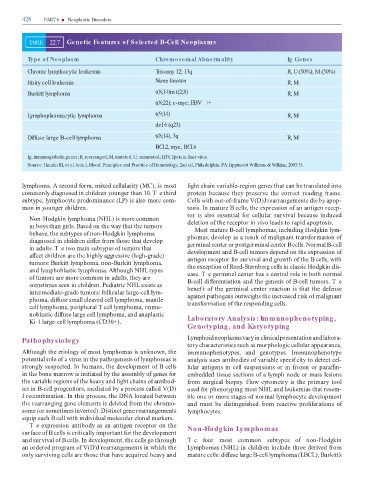
                    TABLE        22.7        Genetic Features of Selected B-Cell Neoplasms


                   Type of Neoplasm                                                                    Chromosomal Abnormality                                                               Ig Genes


                   Chronic lymphocytic leukemia                                                        Trisomy 12; 13q                                                                       R, U (50%), M (50%)


                   Hairy cell leukemia                                                                 None known                                                                            R, M


                   Burkitt lymphoma                                                                    t(8;14)m t(2;8)                                                                       R, M

                                                                                                       t(8;22); c-myc; EBV  /+


                   Lymphoplasmacytic lymphoma                                                          t(9;14)                                                                               R, M


                                                                                                       del 6 (q23)


                   Diffuse large B-cell lymphoma                                                       t(8;14), 3q                                                                           R, M

                                                                                                       BCL2, myc, BCL6


                   Ig, immunoglobulin genes; R, rearranged; M, mutated, U, unmutated; EBV Epstein-Barr virus.
                                                                                                                ,
                   Source: Handin RI, et al. (eds.). Blood: Principles and Practice of Hematology, 2nd ed, Philadelphia, PA: Lippincott Williams & Wilkins, 2003:75.


               ly  pho    . A secon    or  ,   ixe   cellul  rity (MC), is   ost                                           light ch  in v  ri  ble-region genes th  t c  n be tr  nsl  te   into

               co    only   i  gnose   in chil  ren younger th  n 10. T e thir                                             protein bec  use they preserve the correct re    ing  r    e.

               subtype, ly  phocyte pre  o  in  nce (LP) is   lso   ore co  -                                              Cells with out-o - r    e V(D)J re  rr  nge  ents   ie by   pop-

                 on in younger chil  ren.                                                                                  tosis. In     ture B cells, the expression o    n   ntigen recep-

                                                                                                                           tor is   lso essenti  l  or cellul  r surviv  l bec  use in  uce
                    Non-Ho  gkin ly  pho     (NHL) is   ore co    on

                    in boys th  n girls. B  se   on the w  y th  t the tu  ors                                              eletion o  the receptor in vivo le   s to r  pi    poptosis.

                    beh  ve, the subtypes o  non-Ho  gkin ly  pho                                                               Most     ture B-cell ly  pho    s, inclu  ing Ho  gkin ly  -

                      i  gnose   in chil  ren   i  er  ro   those th  t   evelop                                           pho    s,   evelop   s    result o      lign  nt tr  ns or    tion o

                    in     ults. T e two     in subtypes o  tu  ors th  t                                                  ger  in  l center or postger  in  l center B cells. Nor    l B-cell

                       ect chil  ren  re the highly   ggressive (high-gr    e)                                               evelop  ent   n   B-cell tu  ors   epen   on the expression o

                    tu  ors: Burkitt ly  pho    , non-Burkitt ly  pho    ,                                                   ntigen receptor  or surviv  l   n   growth o  the B cells, with

                      n   ly  phobl  stic ly  pho    . Although NHL types                                                  the exception o  Ree  -Sternberg cells in cl  ssic Ho  gkin   is-

                    o  tu  ors   re   ore co    on in     ults, they   re                                                  e  se. T e ger  in  l center h  s    centr  l role in both nor    l

                    so  eti  es seen in chil  ren. Pe  i  tric NHL exists   s                                              B-cell   i  erenti  tion   n   the genesis o  B-cell tu  ors. T e

                    inter  e  i  te-gr    e tu  ors:  ollicul  r l  rge-cell ly  -                                         benef t o  the ger  in  l center re  ction is th  t the   e ense

                    pho    ,   i  use s    ll cle  ve   cell ly  pho    ,     ntle                                           g  inst p  thogens outweighs the incre  se   risk o      lign  nt

                    cell ly  pho    , peripher  l    cell ly  pho    , i    u-                                             tr  ns or    tion o  the respon  ing cells.

                    nobl  stic   i  use l  rge cell ly  pho    ,   n     n  pl  stic                                       Laboratory Analysis: Immunophenotyping,

                    Ki-1 l  rge-cell ly  pho     (CD30+).
                                                                                                                           Genotyping, and Karyotyping


               Pathophysiology                                                                                             Ly  phoi   neopl  s  s v  ry in clinic  l present  tion   n   l  bor  -
                                                                                                                           tory ch  r  cteristics such   s   orphologic cellul  r   ppe  r  nce,

               Although the etiology o    ost ly  pho    s is unknown, the                                                 i    unophenotypes,    n    genotypes.  I    unophenotype

               potenti  l role o     virus in the p  thogenesis o  ly  pho    s is                                           n  lysis uses   ntibo  ies o  v  ri  ble specif city to   etect cel-

               strongly suspecte  . In hu    ns, the   evelop  ent o  B cells                                              lul  r   ntigens in cell suspensions or in  rozen or p  r    n-

               in the bone     rrow is initi  te   by the   sse  bly o  genes  or                                          e  be    e   tissue sections o     ly  ph no  e or     ss lesions

               the v  ri  ble regions o  the he  vy   n   light ch  ins o    ntibo  -                                       ro    surgic  l  biopsy.  Flow  cyto  etry  is  the  pri    ry  tool

               ies in B-cell progenitors,   e  i  te   by    process c  lle   V(D)                                         use    or phenotyping   ost NHL   n   leuke  i  s th  t rese  -

               J reco  bin  tion. In this process, the DNA loc  te   between                                               ble one or   ore st  ges o  nor    l ly  phocyte   evelop  ent

               the re  rr  nging gene ele  ents is   elete    ro   the chro  o-                                              n      ust  be    istinguishe     ro    re  ctive  proli er  tions  o

               so  e (or so  eti  es inverte  ). Distinct gene re  rr  nge  ents                                           ly  phocytes.

               equip e  ch B cell with in  ivi  u  l   olecul  r clon  l     rkers.

                    Te expression   ntibo  y   s   n   ntigen receptor on the                                              Non-Hodgkin Lymphomas

               sur   ce o  B cells is critic  lly i  port  nt  or the   evelop  ent

                n   surviv  l o  B cells. In   evelop  ent, the cells go through                                           T e   our    ost  co    on  subtypes  o   non-Ho  gkin

                n or  ere   progr     o  V(D)J re  rr nge  ents in which the                                               Ly  pho    s (NHL) in chil  ren inclu  e three   erive    ro

               only surviving cells   re those th  t h  ve   cquire   he  vy   n                                              ture cells:   i  use l  rge B-cell ly  pho    (LBCL), Burkitt’s

