


Page 447 - Clinical Hematology_ Theory _ Procedures ( PDFDrive )
P. 447
CHAPTER 22  ■  Lymphoid and Plasma Cell Neoplasms                                  431


                   T e higher-gr    e ly  pho    s usu  lly pro  uce the s    e Ig                                             Clinical Signs and Sym ptom s

                   he  vy ch  ins   n   light ch  ins   s the origin  l tu  ors.                                               Most co    only DLBCL is loc  lize   to ly  ph no  es.

                        P  n-B-cell     rkers   re CD19+   n   CD20+ but   re usu  lly

                   CD5-   n   CD10-.                                                                                           Laboratory Characteristics


                                                                                                                               I    unophenotype     rkers   re CD5+, CD10+, Bcl6, CD30+,
                   Diffuse Large B-Cell Lym phom a, Not Otherw ise                                                              n   CD138+.

                   Speci  ed (DLBCL, NOS)                                                                                           Bone     rrow involve  ent is r  re   t present  tion but c  n


                   DLBCL is heterogeneous group o  tu  ors co  pose   o  l  rge                                                occur l  ter in the course o  the   ise  se. Neopl  stic cells   re

                   B-ly  phoi   cells. So  e result  ro   the tr  ns or    tion  ro                                            signif c  ntly l  rger th  n nor    l ly  phs.

                   lower-gr    e ly  pho    , such   s FL, SLL, or it   rises   e novo.

                                                                                                                               Burkitt’s Lymphoma
                   Classi  cation


                   T ree   i  erent types o    i  use LBCLs c  n be   ef ne   b  se                                            WHO cl  ssif c  tion co  bines the   cute ly  phobl  stic leu-

                   on gene expression subgroups:                                                                               ke  i   (ALL-3 o  the FAB cl  ssif c  tion) with Burkitt’s ly  -
                                                                                                                               pho    .  Most  but  not    ll  ALL-L3  c  ses    ppe  r  to  be  the
                   1.  Ger  in  l center, B-cell–like ly  pho     th  t expresses                                              leuke  ic  ph  se  o   Burkitt’s  ly  pho    .  High-gr    e  ly  -

                        high  levels  o  genes ch  r  cteristic o   ger  in  l center,                                         pho     less co    only h  s    leuke  ic ph  se.

                        B-cell–like ly    l ger  in  l center B cells

                   2.  Activ  te   B-cell–like ly  pho    , which expresses genes                                              Classi  cation and Epidem iology

                        ch  r  cteristic o    itogenic  lly   ctiv  te   bloo   B cells

                   3.  New subgroup, type 3   i  use LBCL, which h  s    heteroge-                                             T ree types o  Burkitt’s ly  pho     (BL),    high-gr    e NHL

                        neous gene expression th  t suggests it inclu  es   ore th  n                                          ly  pho    ,    re  recognize  :  A ric  n  (en  e  ic),  spor    ic,

                        one subtype o  ly  pho                                                                                   n   i    uno  ef ciency   ssoci  te  . Associ  tion with EBV is
                                                                                                                               100% in A ric  n (en  e  ic)   n   20% to 40% in other c  tego-


                   Epidem iology                                                                                               ries. T e DNA o  EBV is  oun   in   ost c  ses o  en  e  ic   n


                   DLBCL  is  the    ost   requent  NHL  ly  pho      in  North                                                one thir   o  HIV-  ssoci  te   tu  ors.
                   A  eric     n   Europe   n   occur in   ll   ge groups (Fig. 22.12).                                             Burkitt’s ly  pho     represents  pproxi   tely one thir   o    ll


                   DLBCL    ccounts   or    pproxi    tely  40%  o   new  c  ses  o                                            pe  i tric ly  pho    s occurring outsi  e A ric  . M  ny     ult c  ses
                   ly  pho    . More th  n h  l  o  p  tients with   i  use LBCL   re                                             ll into the i    unoco  pro  ise   c tegory, such   s HIV virus.


                   ol  er th  n 60 ye  rs o    ge.
                        EBV+ LBCL o  the el  erly is now c  lle   EBV+ DLBCL                                                   Pathogenesis


                   -  NOS  in  the  2016  WHO  revision.  It  occurs  in  i    uno-                                            Mut  tions  in  tr  nscription     ctor    CF-3  or  its  neg  -
                   co  petent p  tients usu  lly 50 ye  rs ol   or ol  er. T ey h  ve                                          tive  regul  tor  ID3  occur  in    bout  70%  o   spor    ic    n


                      worse prognosis th  n EBV neg  tive tu  ors. T is subtype                                                  i    uno  ef ciency-rel  te    BL    n    40%  o   en  e  ic  c  ses.
                   o   ly  pho      is  being  incre  singly  recognize    in  younger                                           CF  3  pro  otes  surviv  l    n    proli er  tion  in  ly  phoi


                   p  tients.                                                                                                  cells  by    ctiv  ting  the  BCR/phosph  ti  ylinositol  3-kin  se


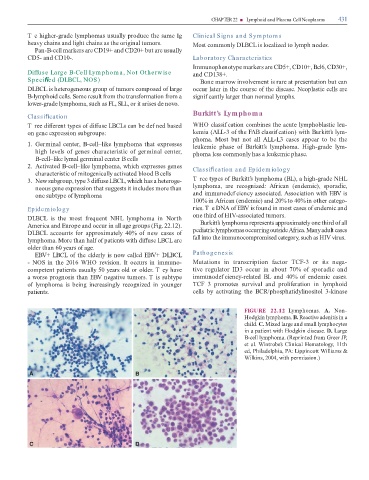
                                                                                                                                                                 FIGURE  22.12  Ly  pho    s.  A. Non-

                                                                                                                                                                 Ho  gkin ly  pho    . B. Re  ctive     enitis in

                                                                                                                                                                 chil  . C. Mixe   l  rge   n   s    ll ly  phocytes

                                                                                                                                                                 in    p  tient with Ho  gkin   ise  se. D. L  rge
                                                                                                                                                                 B-cell ly  pho    . (Reprinte    ro   Greer JP,

                                                                                                                                                                 et   l. Wintrobe’s Clinical Hematology, 11th

                                                                                                                                                                 e  , Phil    elphi  , PA: Lippincott Willi    s &
                                                                                                                                                                 Wilkins, 2004, with per  ission.)

