


Page 525 - Clinical Hematology_ Theory _ Procedures ( PDFDrive )
P. 525
CHAPTER 26 ■ Disorders of Primary Hemostasis and Thrombosis Vasculature and Platelets 509
be ow 100 × 10 /L, c inica sy to s usua y inc u e signs
9
QUAN I A IVE PLA ELE DISORDERS
o ro onge c ot retraction such as the resence o etechiae
T e nor a range o circu ating ate ets is 150 × 10 /L to or ur ura.
9
400 × 10 /L. When the quantity o ate ets ecreases to ev- T ro bocyto enia can be c assi e base on atho hysi-
9
e s be ow this range, a con ition o thrombocytopenia exists. o ogy into our i erent categories (Box 26.1). Various con-
I the quantity o ate ets increases, thro bocytosis is the itions, such as a er the use o extracor orea circu ation in
resu t. Disor ers o ate ets can be c assi e as o ows: car iac by ass surgery or in a coho ic iver isease, can ro-
uce thro bocyto enia.
■ Quantitative (thro bocyto enia or thro bocytosis) T ro bocyto enia in itse rare y oses a threat to a ecte
■ Qua itative (thro bocythe ia or thro bocyto athy) atients, but isor ers associate with it—which inc u e
ee venous thro bosis, DIC, u onary e bo is , cere-
bra thro bosis, yocar ia in arction, an ische ic injury
Thrombocytopenia to the egs or ar s—can ro uce severe orbi ity an or-
ta ity Most thro bocyto enic con itions can be c assi e
I a esion occurs so ewhere in a atient’s bo y, a corre ation
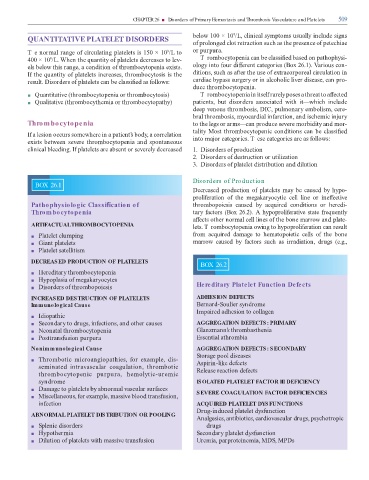
exists between severe thro bocyto enia an s ontaneous into ajor categories. T ese categories are as o ows:
c inica b ee ing. I ate ets are absent or severe y ecrease 1. Disor ers o ro uction
2. Disor ers o estruction or uti ization
3. Disor ers o ate et istribution an i ution
Disorders of Production
BOX 26.1
Decrease ro uction o ate ets ay be cause by hy o-
ro i eration o the egakaryocytic ce ine or ine ective
Pathophysiologic Classi cation of thro bo oiesis cause by acquire con itions or here i-
Thrombocytopenia tary actors (Box 26.2). A hy o ro i erative state requent y
a ects other nor a ce ines o the bone arrow an ate-
ARTIFACTUAL THROMBOCYTOPENIA ets. T ro bocyto enia owing to hy o ro i eration can resu t
■ P ate et c u ing ro acquire a age to he ato oietic ce s o the bone
■ Giant ate ets arrow cause by actors such as irra iation, rugs (e.g.,
■ P ate et sate itis
DECREASED PRODUCTION OF PLATELETS
BOX 26.2
■ Here itary thro bocyto enia
■ Hy o asia o egakaryocytes
■ Disor ers o thro bo oiesis Hereditary Platelet Function Defects
INCREASED DESTRUCTION OF PLATELETS ADHESION DEFECTS
Immunological Cause Bernar -Sou ier syn ro e
I aire a hesion to co agen
■ I io athic
■ Secon ary to rugs, in ections, an other causes AGGREGATION DEFECTS: PRIMARY
■ Neonata thro bocyto enia G anz ann’s thro basthenia
■ Posttrans usion ur ura Essentia athro bia
Nonimmunological Cause AGGREGATION DEFECTS: SECONDARY
Storage oo iseases
■ hro botic icroangio athies, or exa e, is- As irin- ike e ects
se inate intravascu ar coagu ation, thro botic Re ease reaction e ects
thro bocyto enic ur ura, he o ytic-ure ic
syn ro e ISOLATED PLATELET FACTOR III DEFICIENCY
■ Da age to ate ets by abnor a vascu ar sur aces SEVERE COAGULATION FACTOR DEFICIENCIES
■ Misce aneous, or exa e, assive b oo trans usion,
in ection ACQUIRED PLATELET DYSFUNCTIONS
Drug-in uce ate et ys unction
ABNORMAL PLATELET DISTRIBUTION OR POOLING
Ana gesics, antibiotics, car iovascu ar rugs, sychotro ic
■ S enic isor ers rugs
■ Hy other ia Secon ary ate et ys unction
■ Di ution o ate ets with assive trans usion Ure ia, ar roteine ia, MDS, MPDs

