


Page 528 - Clinical Hematology_ Theory _ Procedures ( PDFDrive )
P. 528
512            PART 7  ■  Principles and Disorders of Hemostasis and Thrombosis


               Pathophysiology                                                                                                                           Characteristics of Immune


               I    une HI   is cause   by an antibo  y that recognizes he  -                                                   TABLE        26.2        Thrombocytopenia

               arin boun   to PF4 on the    ate et sur ace (Fig. 26.7). T e

               antibo  y  bin  s  to  the  he  arin-PF4  co     ex,  which  then                                                                                            New ly

               a  ows the antibo  y to bin   the Fc rece  tor on the    ate et.                                                Characteristic                               Diagnosed                  Chronic

               Interaction with the Fc rece  tor activates the    ate et that

               resu ts in the  oss o     ate ets, thro  bocyto  enia, an      ate et                                           Peak age                                     2–5 years                  Adulthood

               aggregation (thro  bosis). A s  a   nu  ber o  cases o  HI                                                                                                                              (30–60 years)

                 ay invo ve an antigen other than the PF4 co     ex.                                                           History of infection                         Common                     Uncommon

                                                                                                                               Spontaneous remission                        Common                     Rare

               Laboratory Data


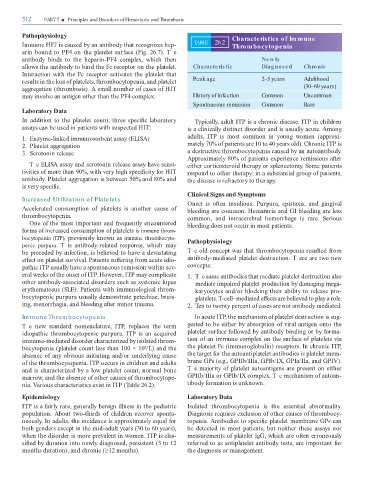
               In a    ition to the    ate et count, three s  eci  c  aboratory                                                  y  ica  y, a  u t I  P is a chronic   isease. I  P in chi   ren
               assays can be use   in   atients with sus  ecte   HI  :                                                     is a c inica  y   istinct   isor  er an   is usua  y acute. A  ong


               1.  Enzy  e- inke   i    unosorbent assay (ELISA)                                                           a  u ts,  I  P  is    ost  co    on  in  young  wo  en  (a    roxi-

               2.  P ate et aggregation                                                                                      ate y 70% o    atients are 10 to 40 years o   ). Chronic I  P is

               3.  Serotonin re ease                                                                                       a   estructive thro  bocyto  enia cause   by an autoantibo  y.
                                                                                                                           A    roxi  ate y 80% o    atients ex  erience re  issions a  er

                    T e ELISA assay an   serotonin re ease assay have sensi-                                               either corticosteroi   thera  y or s   enecto  y. So  e   atients
               tivities o    ore than 90%, with very high s  eci  city  or HI                                              res  on   to other thera  y; in a substantia  grou   o    atients,


               antibo  y. P ate et aggregation is between 50% an   80% an                                                  the   isease is re ractory to thera  y.
               is very s  eci  c.


                                                                                                                           Clinical Signs and Symptoms
               Increased Utilization of Platelets
                                                                                                                           Onset  is  o  en  insi  ious.  Pur  ura,  e  istaxis,  an    gingiva
               Acce erate    consu    tion  o      ate ets  is  another  cause  o                                          b ee  ing are co    on. He  aturia an   GI b ee  ing are  ess
               thro  bocyto  enia.                                                                                         co    on,  an    intracerebra   he  orrhage  is  rare.  Serious


                    One o  the   ost i    ortant an    requent y encountere                                                b ee  ing   oes not occur in   ost   atients.

                or  s o  increase   consu    tion o     ate ets is immune throm-

               bocytopenia (ITP),   revious y known as immune thrombocyto-                                                 Pathophysiology
               penic  purpura.  T is  antibo  y-re ate    res  onse,  which    ay


               be   rece  e   by in ection, is be ieve   to have a   evastating                                            T e o    conce  t was that thro  bocyto  enia resu te    ro
               e  ect on    ate et surviva . Patients su  ering  ro   acute i  io-                                         antibo  y-  e  iate      ate et   estruction. T ere are two new


                 athic I  P usua  y have a s  ontaneous re  ission within sev-                                             conce  ts:
               era  weeks o  the onset o  I  P. However, I  P   ay co     icate                                            1.  T e sa  e antibo  ies that   e  iate    ate et   estruction a so


               other antibo  y-associate     isor  ers such as syste  ic  u  us                                                   e  iate i    aire      ate et   ro  uction by   a aging  ega-
               erythe  atosus (SLE). Patients with i    uno ogica  thro  -                                                       karyocytes an  /or b ocking their abi ity to re ease   ro-


               bocyto  enic   ur  ura usua  y   e  onstrate   etechiae, bruis-                                                      ate ets.   -ce  –  e  iate   e  ects are be ieve   to    ay a ro e.
               ing,   enorrhagia, an   b ee  ing a  er   inor trau  a.                                                     2.    en to twenty   ercent o  cases are not antibo  y   e  iate  .


               Im m une Throm bocytopenia                                                                                       In acute I  P, the   echanis   o     ate et   estruction is sug-


               T e  new  stan  ar    no  enc ature,  I  P,  re   aces  the  ter                                            geste   to be either by absor  tion o  vira  antigen onto the
               i  io  athic  thro  bocyto  enic   ur  ura.  I  P  is  an acquire                                              ate et sur ace  o  owe   by antibo  y bin  ing or by  or  a-


               i    une-  e  iate     isor  er characterize   by iso ate   thro  -                                         tion o  an i    une co     ex on the sur ace o     ate ets via
               bocyto  enia (   ate et count  ess than 100 × 10 /L) an   the                                               the    ate et Fc (i    unog obu in) rece  tors. In chronic I  P,
                                                                                               9

               absence o  any obvious initiating an  /or un  er ying cause                                                 the target  or the autoanti   ate et antibo  ies is    ate et   e  -
               o  the thro  bocyto  enia. I  P occurs in chi   ren an   a  u ts                                            brane GPs (e.g., GPIIb/IIIa, GPIb/IX, GPIa/IIa, an   GPIV).


               an   is characterize   by a  ow    ate et count, nor  a  bone                                               T e   ajority o     ate et autoantigens are   resent on either
                 arrow, an   the absence o  other causes o  thro  bocyto  e-                                               GPIIb/IIIa or GPIb/IX co     ex. T e   echanis   o  autoan-


               nia. Various characteristics exist in I  P (  ab e 26.2).                                                   tibo  y  or  ation is unknown.


               Epidemiology                                                                                                Laboratory Data


               I  P is a  air y rare, genera  y benign i  ness in the   e  iatric                                          Iso ate    thro  bocyto  enia  is  the  essentia   abnor  a ity.

                 o  u ation.  About  two-thir  s  o   chi   ren  recover  s  onta-                                         Diagnosis requires exc usion o  other causes o  thro  bocy-

               neous y. In a  u ts, the inci  ence is a    roxi  ate y equa   or                                           to  enia. Antibo  ies to s  eci  c    ate et   e  brane GPs can

               both gen  ers exce  t in the   i  -a  u t years (30 to 60 years),                                           be   etecte   in   ost   atients, but neither these assays nor

               when the   isor  er is   ore   reva ent in wo  en. I  P is c as-                                              easure  ents o     ate et IgG, which are o  en erroneous y

               si  e   by   uration into new y   iagnose  ,   ersistent (3 to 12                                           re erre   to as anti   ate et antibo  y tests, are i    ortant  or

                 onths   uration), an   chronic (≥12   onths).                                                             the   iagnosis or   anage  ent.

