


Page 530 - Clinical Hematology_ Theory _ Procedures ( PDFDrive )
P. 530
514            PART 7  ■  Principles and Disorders of Hemostasis and Thrombosis


                aintain the nor  a  quantity o  circu ating    ate ets. Disor  ers                                         sur ace o  b oo   ce  s to the actin cytoske eton, the network o

               that   ay   ro  uce s   eno  ega y with resu tant s   enic   oo ing                                          bers that   ake u   a ce  u ar structura   ra  ework. Actin is

               or   e aye   intras   enic transit inc u  e a coho ic or   osthe  atic                                      an u trastructura  co    onent o  the ce  u ar architecture that

               cirrhosis with   orta  hy  ertension,  y    ho  as an    euke  ias,                                         is invo ve   in intrace  u ar an   ce   substrate interactions an

               an    i  i     isor  ers such as Gaucher’s   isease.                                                        signa ing via its ro e in ce     or  ho ogy an     ove  ent. T e

                                                                                                                           actin cytoske eton is res  onsib e  or ce  u ar  unctions such as
               Posttransfusion Throm bocytopenia                                                                           growth, en  ocytosis, exocytosis, an   cytokinesis.


               Massive  b oo    trans usion  is  co     ete  re   ace  ent  o                                                   A  ack o   unctiona  WAS   in    ate ets i    airs their   eve -

                 atient’s b oo   vo u  e with 24 hours. When units o    acke                                               o    ent,  ea  ing  to re  uce   size,   icrothro  bocyto  enia,

               RBCs an      as  a ex  an  ers trans use  , there is a re  uc-                                              an     ys unctiona     ate ets with an intrinsic   e ect.

               tion  in  the     ate et  count,    i utiona   thro  bocyto  enia.

               Signi  cant changes to a    ate et count o  50.0 to 100 × 10 /L                                             Signs and Sym ptom s
                                                                                                               9
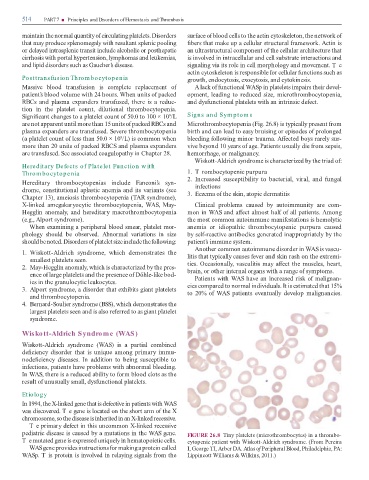
               are not a    arent unti    ore than 15 units o    acke   RBCs an                                            Microthro  bocyto  enia (Fig. 26.8) is ty  ica  y   resent  ro

                  as  a ex  an  ers are trans use  . Severe thro  bocyto  enia                                             birth an   can  ea   to easy bruising or e  iso  es o    ro onge

               (a    ate et count o   ess than 50.0 × 10 /L) is co    on when                                              b ee  ing  o  owing   inor trau  a. A  ecte   boys rare y sur-
                                                                                9
                 ore than 20 units o    acke   RBCS an      as  a ex  an  ers                                              vive beyon   10 years o  age. Patients usua  y   ie  ro   se  sis,

               are trans use  . See associate   coagu o  athy in Cha  ter 28.                                              he  orrhage, or   a ignancy.

                                                                                                                                Wiskott-A   rich syn  ro  e is characterize   by the tria   o :
               Hereditary Defects of Platelet Function w ith

               Throm bocytopenia                                                                                           1.  T ro  bocyto  enic   ur  ura

                                                                                                                           2.  Increase    susce  tibi ity  to  bacteria ,  vira ,  an     unga
               Here  itary  thro  bocyto  enias  inc u  e  Fanconi’s  syn-                                                       in ections

                 ro  e, constitutiona  a   astic ane  ia an   its variants (see                                            3.  Ecze  a o  the skin, ato  ic   er  atitis

               Cha  ter 13), a  eiosis thro  bocyto  enia (  AR syn  ro  e),

               X- inke    a  egakaryocytic  thro  bocyto  enia,  WAS,  May-                                                     C inica     rob e  s  cause    by  autoi    unity  are  co  -

               Hegg in ano  a y,  an   here  itary   acrothro  bocyto  enia                                                  on in WAS an   a  ect a   ost ha   o  a     atients. A  ong

               (e.g., A   ort syn  ro  e).                                                                                 the   ost co    on autoi    une   ani estations is he  o ytic

                    When exa  ining a   eri  hera  b oo   s  ear,    ate et   or-                                          ane  ia  or  i  io  athic  thro  bocyto  enic    ur  ura  cause

                ho ogy shou    be observe  . Abnor  a  variations in size                                                  by se  -reactive antibo  ies generate   ina    ro  riate y by the

               shou    be note  . Disor  ers o     ate et size inc u  e the  o  owing:                                      atient’s i    une syste  .

                                                                                                                                Another co    on autoi    une   isor  er in WAS is vascu-
               1.  Wiskott-A   rich  syn  ro  e,  which    e  onstrates  the                                                itis that ty  ica  y causes  ever an   skin rash on the extre  i-
                     s  a  est    ate ets seen.


               2.  May-Hegg in ano  a y, which is characterize   by the   res-                                             ties. Occasiona  y, vascu itis   ay a  ect the   usc es, heart,
                                                                                                                           brain, or other interna  organs with a range o  sy    to  s.
                     ence o   arge    ate ets an   the   resence o  Döh e- ike bo  -                                            Patients with WAS have an increase   risk o    a ignan-


                     ies in the granu ocytic  eukocytes.
               3.  A   ort syn  ro  e, a   isor  er that exhibits giant    ate ets                                         cies co    are   to nor  a  in  ivi  ua s. It is esti  ate   that 15%
                                                                                                                           to  20%  o   WAS    atients  eventua  y    eve o      a ignancies.
                     an   thro  bocyto  enia.
               4.  Bernar  -Sou ier syn  ro  e (BSS), which   e  onstrates the


                      argest    ate ets seen an   is a so re erre   to as giant    ate et
                     syn  ro  e.


               Wiskott-Aldrich Syndrome (WAS)


               Wiskott-A   rich  syn  ro  e  (WAS)  is  a    artia   co  bine

                 e  ciency    isor  er that  is  unique  a  ong    ri  ary  i    u-

               no  e  ciency    iseases.  In  a    ition  to  being  susce  tib e  to

               in ections,   atients have   rob e  s with abnor  a  b ee  ing.

               In WAS, there is a re  uce   abi ity to  or   b oo   c ots as the

               resu t o  unusua  y s  a  ,   ys unctiona     ate ets.


               Etiology


               In 1994, the X- inke   gene that is   e ective in   atients with WAS

               was   iscovere  . T e gene is  ocate   on the short ar   o  the X

               chro  oso  e, so the   isease is inherite   in an X- inke   recessive.

                    Te   ri  ary   e ect in this unco    on X- inke   recessive

                e  iatric   isease is cause   by a   utations in the WAS gene.                                             FIGURE 26.8    iny    ate ets (  icrothro  bocytes) in a thro  bo-

               Te   utate   gene is ex  resse   unique y in he  ato  oietic ce  s.                                         cyto  enic   atient with Wiskott-A   rich syn  ro  e. (Fro   Pereira

                    WAS gene   rovi  es instructions  or   aking a   rotein ca  e                                          I, George   I, Arber DA. Atlas o  Peripheral Blood, Phi a  e   hia, PA:

               WAS  . T is   rotein is invo ve   in re aying signa s  ro   the                                             Li    incott Wi  ia  s & Wi kins, 2011.)

