


Page 736 - Clinical Hematology_ Theory _ Procedures ( PDFDrive )
P. 736
720            APPENDIX F  ■  Interleukins


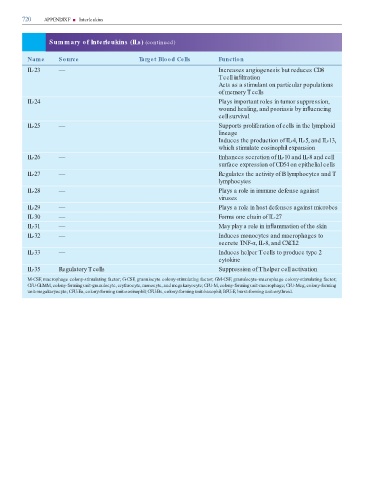
                                 Summary of Interleukins (ILs) (continued)


                   Name                Source                                               Target Blood Cells                                  Function


                   IL-23               —                                                                                                        Increases angiogenesis but reduces CD8

                                                                                                                                                T cell in  ltration

                                                                                                                                                Acts as a stimulant on particular populations

                                                                                                                                                of memory T cells


                   IL-24               —                                                                                                        Plays important roles in tumor suppression,

                                                                                                                                                wound healing, and psoriasis by in  uencing

                                                                                                                                                cell survival


                   IL-25               —                                                                                                        Supports proliferation of cells in the lymphoid

                                                                                                                                                lineage

                                                                                                                                                Induces the production of IL-4, IL-5, and IL-13,

                                                                                                                                                which stimulate eosinophil expansion

                   IL-26               —                                                                                                        Enhances secretion of IL-10 and IL-8 and cell


                                                                                                                                                surface expression of CD54 on epithelial cells

                   IL-27               —                                                                                                        Regulates the activity of B lymphocytes and T

                                                                                                                                                lymphocytes


                   IL-28               —                                                                                                        Plays a role in immune defense against

                                                                                                                                                  viruses


                   IL-29               —                                                                                                        Plays a role in host defenses against microbes


                   IL-30                —                                                                                                       Forms one chain of IL-27


                   IL-31               —                                                                                                        May play a role in in  ammation of the skin


                   IL-32               —                                                                                                        Induces monocytes and macrophages to

                                                                                                                                                 secrete TNF-α, IL-8, and CXCL2

                   IL-33                —                                                                                                       Induces helper T cells to produce type 2

                                                                                                                                                  cytokine


                   IL-35                Regulatory T cells                                                                                      Suppression of T helper cell activation


                   M-CSF, macrophage colony-stimulating factor; G-CSF, granulocyte colony-stimulating factor; GM-CSF, granulocyte-macrophage colony-stimulating factor;
                     CFU-GEMM, colony-forming unit-granulocyte, erythrocyte, monocyte, and megakaryocyte; CFU-M, colony-forming unit-macrophage; CFU-Meg, colony-forming

                   unit-megakaryocyte; CFU-Eo, colony-forming unit-eosinophil; CFU-Bs, colony-forming unit-basophil; BFU-E, burst-forming unit-erythroid.

