


Page 12 - Review of Medical Microbiology and Immunology ( PDFDrive )
P. 12
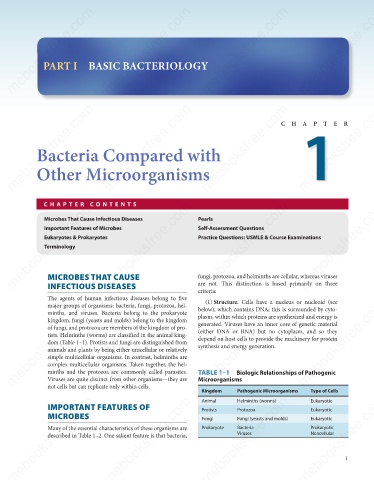
mebooksfree.com


                                            mebooksfree.com
                                                                            mebooksfree.com
                                                                                                            mebooksfree.com
            mebooksfree.com
 mebooksfree.com  mebooksfree.com           mebooksfree.com                 mebooksfree.com                 mebooksfree.com                mebooksfree.com
                                                                                                                                           mebooksfree.com


                      PART I  BASIC BACTERIOLOGY


                                                                                                            mebooksfree.com
 mebooksfree.com  mebooksfree.com           mebooksfree.com                 mebooksfree.com         C   H  1             R                 mebooksfree.com

                                                                                                               P
                                                                                                           A
                                                                                                                     E
                                                                                                                  T
                    Bacteria Compared with


                    Other Microorganisms


 mebooksfree.com  mebooksfree.com           mebooksfree.com              Pearls                             mebooksfree.com                mebooksfree.com
                                                                            mebooksfree.com
                       CHAPTER  C ONTENT S
                       Microbes That Cause Infectious Diseases
                                                                         Self-Assessment Questions
                       Important Features of Microbes
                                                                         Practice Questions: USMLE & Course Examinations
                       Eukaryotes & Prokaryotes
                       Terminology


                        MICROBES THAT CAUSE
                                                                         fungi, protozoa, and helminths are cellular, whereas viruses
                                                                         are not. This distinction is based primarily on three
                        INFECTIOUS DISEASES
                                                                         criteria:
                        The agents of human infectious diseases belong to five
                                                                                                            mebooksfree.com
                                                                            mebooksfree.com
 mebooksfree.com  mebooksfree.com           mebooksfree.com              below), which contains DNA; this is surrounded by cyto-           mebooksfree.com
                                                                           (1) Structure. Cells have a nucleus or nucleoid (see
                        major groups of organisms: bacteria, fungi, protozoa, hel-
                        minths, and viruses. Bacteria belong to the prokaryote
                                                                         plasm, within which proteins are synthesized and energy is
                        kingdom, fungi (yeasts and molds) belong to the kingdom
                                                                         generated. Viruses have an inner core of genetic material
                        of fungi, and protozoa are members of the kingdom of pro-
                                                                         (either  DNA  or  RNA)  but  no  cytoplasm,  and  so  they
                        tists. Helminths (worms) are classified in the animal king-
                                                                         depend on host cells to provide the machinery for protein
                        dom (Table 1–1). Protists and fungi are distinguished from
                                                                         synthesis and energy generation.
                        animals and plants by being either unicellular or relatively
                        simple multicellular organisms. In contrast, helminths are
                        complex multicellular organisms. Taken together, the hel-
                        minths  and the  protozoa  are  commonly  called  parasites.
                                                                         TABLE 1–1  Biologic Relationships of Pathogenic
                                                                         Microorganisms
                        Viruses are quite distinct from other organisms—they are
                        not cells but can replicate only within cells.
                                                                          Kingdom     Pathogenic Microorganisms  Type of Cells
                                                                            mebooksfree.com
 mebooksfree.com  mebooksfree.com           mebooksfree.com               Fungi       Fungi (yeasts and molds) mebooksfree.com             mebooksfree.com
                                                                          Animal
                                                                                                              Eukaryotic
                                                                                      Helminths (worms)
                        IMPORTANT FEATURES OF
                                                                          Protists
                                                                                      Protozoa
                                                                                                              Eukaryotic
                        MICROBES
                                                                                                              Eukaryotic
                                                                                                              Prokaryotic
                                                                                      Bacteria
                                                                          Prokaryote
                        Many of the essential characteristics of these organisms are
                                                                                      Viruses
                                                                                                              Noncellular
                        described in Table 1–2. One salient feature is that bacteria,
                                                                                                                         1
 mebooksfree.com  mebooksfree.com           mebooksfree.com                 mebooksfree.com                 mebooksfree.com                mebooksfree.com

