Page 17 - Review of Medical Microbiology and Immunology ( PDFDrive )
P. 17
mebooksfree.com
                                                                            mebooksfree.com
 mebooksfree.com

                                                                            mebooksfree.com
            mebooksfree.com
                                            mebooksfree.com
 mebooksfree.com  mebooksfree.com         Chemical Composition         Function                             mebooksfree.com                mebooksfree.com
                                                                                                            mebooksfree.com
                                                                                                                                           mebooksfree.com
                     PART I  Basic Bacteriology
                 6
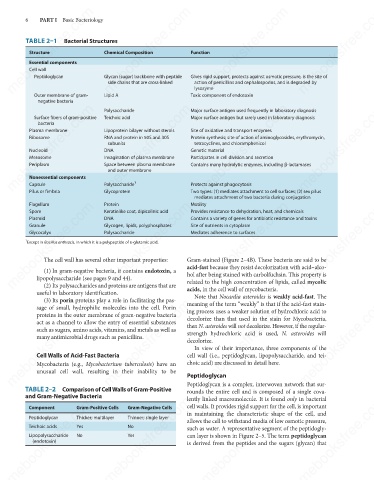
                 TABLE 2–1  Bacterial Structures
                  Structure
                  Essential components
                  Cell wall
                   Peptidoglycan
                                                                        action of penicillins and cephalosporins, and is degraded by
                                           side chains that are cross-linked
                                                                        lysozyme
                   Outer membrane of gram-
                                          Lipid A
                                                                       Toxic component of endotoxin
                     negative bacteria    Glycan (sugar) backbone with peptide   Gives rigid support, protects against osmotic pressure, is the site of
                                            mebooksfree.com
 mebooksfree.com  mebooksfree.com         Lipoprotein bilayer without sterols  Site of oxidative and transport enzymes  mebooksfree.com    mebooksfree.com
                                                                            mebooksfree.com
                                                                       Major surface antigen used frequently in laboratory diagnosis
                                          Polysaccharide
                                          Teichoic acid
                   Surface fibers of gram-positive
                                                                       Major surface antigen but rarely used in laboratory diagnosis
                     bacteria
                  Plasma membrane
                  Ribosome
                                          RNA and protein in 50S and 30S
                                                                       Protein synthesis; site of action of aminoglycosides, erythromycin,
                                           subunits
                                                                        tetracyclines, and chloramphenicol
                                          DNA
                  Nucleoid
                                                                       Genetic material
                                          Invagination of plasma membrane
                  Mesosome
                                                                       Participates in cell division and secretion
                  Periplasm
                                                                       Contains many hydrolytic enzymes, including β-lactamases
                                          Space between plasma membrane
                                           and outer membrane
                  Nonessential components
                                                    1
                                                                       Protects against phagocytosis
                                          Polysaccharide
                  Capsule
                                                                       Two types: (1) mediates attachment to cell surfaces; (2) sex pilus
                                          Glycoprotein
                  Pilus or fimbria
                                                                        mediates attachment of two bacteria during conjugation
                                            mebooksfree.com
                                                                            mebooksfree.com
 mebooksfree.com  mebooksfree.com         Glycogen, lipids, polyphosphates  Gram-stained (Figure 2–4B). These bacteria are said to be      mebooksfree.com
                                                                                                            mebooksfree.com
                                          Protein
                                                                       Motility
                  Flagellum
                  Spore
                                                                       Provides resistance to dehydration, heat, and chemicals
                                          Keratinlike coat, dipicolinic acid
                                          DNA
                                                                       Contains a variety of genes for antibiotic resistance and toxins
                  Plasmid
                  Granule
                                                                       Site of nutrients in cytoplasm
                  Glycocalyx
                                                                       Mediates adherence to surfaces
                                          Polysaccharide
                 1
                 Except in Bacillus anthracis, in which it is a polypeptide of d-glutamic acid.
                       The cell wall has several other important properties:
                                                                     acid-fast because they resist decolorization with acid–alco-
                       (1) In gram-negative bacteria, it contains endotoxin, a
                    lipopolysaccharide (see pages 9 and 44).
                                                                     related to the high concentration of lipids, called mycolic
                       (2) Its polysaccharides and proteins are antigens that are
                                                                     acids, in the cell wall of mycobacteria.
                    useful in laboratory identification.             hol after being stained with carbolfuchsin. This property is
                                                                        Note that Nocardia asteroides is weakly acid-fast. The
                       (3) Its porin proteins play a role in facilitating the pas-
                                                                            mebooksfree.com
                                                                                                            mebooksfree.com
 mebooksfree.com  mebooksfree.com           mebooksfree.com          decolorize than that used in the stain for Mycobacteria,              mebooksfree.com
                                                                     meaning of the term “weakly” is that if the acid-fast stain-
                    sage  of  small,  hydrophilic  molecules  into  the  cell.  Porin
                                                                     ing process uses a weaker solution of hydrochloric acid to
                    proteins in the outer membrane of gram-negative bacteria
                    act as a channel to allow the entry of essential substances
                                                                     then N. asteroides will not decolorize. However, if the regular-
                    such as sugars, amino acids, vitamins, and metals as well as
                                                                     strength hydrochloric acid is used,  N. asteroides will
                    many antimicrobial drugs such as penicillins.
                                                                     decolorize.
                                                                        In view of their importance, three components of the
                                                                     cell wall (i.e., peptidoglycan, lipopolysaccharide, and tei-
                    Cell Walls of Acid-Fast Bacteria
                                                                     choic acid) are discussed in detail here.
                    Mycobacteria (e.g.,  Mycobacterium tuberculosis) have an
                    unusual cell wall, resulting in their inability to be
                                                                     Peptidoglycan is a complex, interwoven network that sur-
                 TABLE 2–2  Comparison of Cell Walls of Gram-Positive   Peptidoglycan
                                                                     rounds the entire cell and is composed of a single cova-
                and Gram-Negative Bacteria
                                                                            mebooksfree.com
 mebooksfree.com  mebooksfree.com           mebooksfree.com          allows the cell to withstand media of low osmotic pressure,           mebooksfree.com
                                                                                                            mebooksfree.com
                                                                     lently linked macromolecule. It is found only in bacterial
                                                                     cell walls. It provides rigid support for the cell, is important
                                                  Gram-Negative Cells
                  Component
                                 Gram-Positive Cells
                                                                     in maintaining the characteristic shape of the cell, and
                  Peptidoglycan
                                                  Thinner; single layer
                                 Thicker; multilayer
                                 Yes
                                                  No
                  Teichoic acids
                                                                     such as water. A representative segment of the peptidogly-
                                                                     can layer is shown in Figure 2–5. The term peptidoglycan
                  Lipopolysaccharide
                                 No
                                                  Yes
                   (endotoxin)
                                                                     is derived from the peptides and the sugars (glycan) that
 mebooksfree.com  mebooksfree.com           mebooksfree.com                 mebooksfree.com                 mebooksfree.com                mebooksfree.com
   12   13   14   15   16   17   18   19   20   21   22