Page 16 - Review of Medical Microbiology and Immunology ( PDFDrive )
P. 16
mebooksfree.com


                                            mebooksfree.com
                                                                            mebooksfree.com
            mebooksfree.com
                                                                                                                                           mebooksfree.com
 mebooksfree.com  mebooksfree.com   electron mebooksfree.com                mebooksfree.com          of     mebooksfree.com                mebooksfree.com
                                                                                                            mebooksfree.com
                                                                                       CHAPTER 2  Structure of Bacterial Cells     5
                                                                                 Red
                                    Range of
                                                                                       Range of
                                                                                                  Lower limit
                                                                                        optical
                                                                                blood
                                                                                      microscope
                                   microscope
                                                                                                 human vision
                                                                                 cell
                                                                Escherichia coli
                                                     Mycoplasma
                                                                        Bacillus
                                                                        anthracis
                                                           Haemophilus
                                           Hepatitis
                                                            influenzae
                                            B virus
                                                                            Candida   Protozoa
                                                          Poxvirus
 mebooksfree.com  mebooksfree.com          0.03 0.05  0.1   0.3 0.5 Scale (µm) mebooksfree.com      100    300                             mebooksfree.com
                                                    HIV
                                                                                                            mebooksfree.com
                                                                            albicans
                                            mebooksfree.com
                                       Poliovirus
                                                                                    10
                                                                                5
                                                                                            30
                                                                            3
                                                                     1
                              0.005 0.01
                                                                                                50
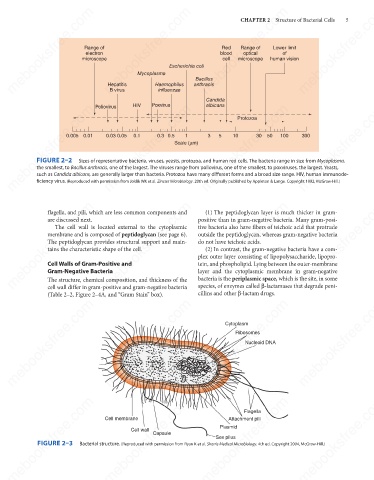
                    FIGURE 2–2
                                  Sizes of representative bacteria, viruses, yeasts, protozoa, and human red cells. The bacteria range in size from Mycoplasma,
                    the smallest, to Bacillus anthracis, one of the largest. The viruses range from poliovirus, one of the smallest, to poxviruses, the largest. Yeasts,
                    such as Candida albicans, are generally larger than bacteria. Protozoa have many different forms and a broad size range. HIV, human immunode-
                    ficiency virus. (Reproduced with permission from Joklik WK et al. Zinsser Microbiology. 20th ed. Originally published by Appleton & Lange. Copyright 1992, McGraw-Hill.)
 mebooksfree.com  mebooksfree.com           mebooksfree.com              positive than in gram-negative bacteria. Many gram-posi-          mebooksfree.com
                                                                            mebooksfree.com
                                                                                                            mebooksfree.com
                        flagella, and pili, which are less common components and
                                                                           (1) The peptidoglycan layer is much thicker in gram-
                        are discussed next.
                                                                         tive bacteria also have fibers of teichoic acid that protrude
                          The cell wall is located external to the cytoplasmic
                                                                         outside the peptidoglycan, whereas gram-negative bacteria
                        membrane and is composed of peptidoglycan (see page 6).
                        The peptidoglycan provides structural support and main-
                                                                         do not have teichoic acids.
                        tains the characteristic shape of the cell.
                                                                           (2) In contrast, the gram-negative bacteria have a com-
                                                                         plex outer layer consisting of lipopolysaccharide, lipopro-
                        Cell Walls of Gram-Positive and
                                                                         tein, and phospholipid. Lying between the outer-membrane
                        Gram-Negative Bacteria
                                                                         bacteria is the periplasmic space, which is the site, in some
                        The structure, chemical composition, and thickness of the
                                                                         species, of enzymes called β-lactamases that degrade peni-
                        cell wall differ in gram-positive and gram-negative bacteria
                                                                         cillins and other β-lactam drugs.
                        (Table 2–2, Figure 2–4A, and “Gram Stain” box).  layer  and the cytoplasmic membrane in gram-negative
 mebooksfree.com  mebooksfree.com           mebooksfree.com                 mebooksfree.com                 mebooksfree.com                mebooksfree.com
                                                                                  Cytoplasm
                                                                                     Ribosomes
                                                                                        Nucleoid DNA


                                            mebooksfree.com
 mebooksfree.com  mebooksfree.com          Cell membrane  Capsule           mebooksfree.com                 mebooksfree.com                mebooksfree.com
                                                                                        Flagella
                                                                                   Attachment pili
                                                                                Plasmid
                                                   Cell wall
                                                                               Sex pilus
                    FIGURE 2–3
                                  Bacterial structure. (Reproduced with permission from Ryan K et al. Sherris Medical Microbiology. 4th ed. Copyright 2004, McGraw-Hill.)


 mebooksfree.com  mebooksfree.com           mebooksfree.com                 mebooksfree.com                 mebooksfree.com                mebooksfree.com
   11   12   13   14   15   16   17   18   19   20   21