Page 167 - Review of Medical Microbiology and Immunology ( PDFDrive )
P. 167
mebooksfree.com


                                            mebooksfree.com
            mebooksfree.com
                                                                            mebooksfree.com
                                                                                                                                           mebooksfree.com
 mebooksfree.com  mebooksfree.com           mebooksfree.com                 mebooksfree.com                 mebooksfree.com                mebooksfree.com
                                                                                                            mebooksfree.com
                       PART II  Clinical Bacteriology
                 156
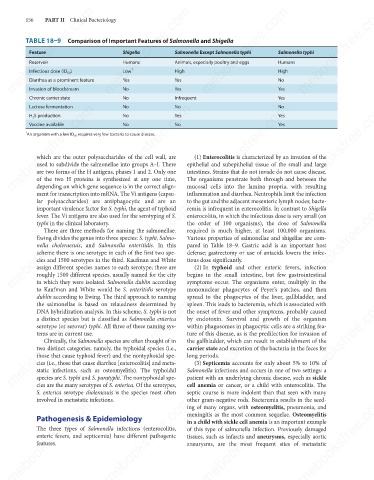
                 TABLE 18–9  Comparison of Important Features of Salmonella and Shigella
                                                Shigella
                                                                 Salmonella Except Salmonella typhi
                  Feature
                                                                                                   Salmonella typhi
                                                                                                   Humans
                                                                 Animals, especially poultry and eggs
                                                Humans
                  Reservoir
                                                   1
                  Infectious dose (ID 50 )
                                                                                                   High
                                                Low
                                                                 High
                  Diarrhea as a prominent feature
                                                                                                   Yes
                  Invasion of bloodstream
                                                                 Yes
                                                No
                                                                                                   Yes
                                                No
                                                                 Infrequent
                  Chronic carrier state         Yes              Yes                               No
                                                                            mebooksfree.com
 mebooksfree.com  mebooksfree.com           mebooksfree.com          epithelial and subepithelial tissue of the small and large            mebooksfree.com
                                                                                                            mebooksfree.com
                                                                 No
                  Lactose fermentation
                                                No
                                                                                                   No
                  H 2 S production
                                                                                                   Yes
                                                No
                                                                 Yes
                                                No
                  Vaccine available
                                                                                                   Yes
                                                                 No
                 1
                 An organism with a low ID 50  requires very few bacteria to cause disease.
                    which are the outer polysaccharides of the cell wall, are
                                                                        (1) Enterocolitis is characterized by an invasion of the
                    used to subdivide the salmonellae into groups A–I. There
                                                                     intestines. Strains that do not invade do not cause disease.
                    are two forms of the H antigens, phases 1 and 2. Only one
                    of  the  two H  proteins  is  synthesized at any  one time,
                                                                     The organisms penetrate both through and between the
                    depending on which gene sequence is in the correct align-
                                                                     mucosal cells into the lamina propria, with resulting
                                                                     inflammation and diarrhea. Neutrophils limit the infection
                    ment for transcription into mRNA. The Vi antigens (capsu-
                    lar polysaccharides) are antiphagocytic and are an
                                                                            mebooksfree.com
 mebooksfree.com  mebooksfree.com           mebooksfree.com          to the gut and the adjacent mesenteric lymph nodes; bacte-            mebooksfree.com
                                                                                                            mebooksfree.com
                                                                     remia is infrequent in enterocolitis. In contrast to Shigella
                    important virulence factor for S. typhi, the agent of typhoid
                                                                     enterocolitis, in which the infectious dose is very small (on
                    fever. The Vi antigens are also used for the serotyping of S.
                    typhi in the clinical laboratory.
                                                                     the order of 100 organisms), the dose of  Salmonella
                                                                     required is much higher, at least 100,000 organisms.
                       There are three methods for naming the salmonellae.
                                                                     Various properties of salmonellae and shigellae are com-
                    Ewing divides the genus into three species: S. typhi, Salmo-
                    nella choleraesuis, and  Salmonella enteritidis. In this
                                                                     pared in Table 18–9. Gastric acid is an important host
                    scheme there is one serotype in each of the first two spe-
                                                                     defense; gastrectomy or use of antacids lowers the infec-
                                                                     tious dose significantly.
                    cies and 1500 serotypes in the third. Kaufman and White
                    assign different species names to each serotype; there are
                                                                        (2) In  typhoid and other enteric fevers, infection
                    roughly 1500 different species, usually named for the city
                    in which they were isolated. Salmonella dublin according
                                                                     symptoms occur. The organisms enter, multiply in the
                                                                     mononuclear phagocytes of Peyer’s patches,  and then
                    to Kaufman and White would be  S.  enteritidis serotype
                                                                     spread to the phagocytes of the liver, gallbladder, and
                    dublin according to Ewing. The third approach to naming   begins in the small intestine, but few gastrointestinal
 mebooksfree.com  mebooksfree.com           mebooksfree.com          within phagosomes in phagocytic cells are a striking fea-             mebooksfree.com
                                                                                                            mebooksfree.com
                                                                            mebooksfree.com
                                                                     spleen. This leads to bacteremia, which is associated with
                    the  salmonellae  is  based  on relatedness  determined  by
                                                                     the onset of fever and other symptoms, probably caused
                    DNA hybridization analysis. In this scheme, S. typhi is not
                    a distinct species but is classified as  Salmonella enterica
                                                                     by endotoxin. Survival and growth of the organism
                    serotype (or serovar) typhi. All three of these naming sys-
                    tems are in current use.
                                                                     ture of this disease, as is the predilection for invasion of
                                                                     the gallbladder, which can result in establishment of the
                       Clinically, the Salmonella species are often thought of in
                                                                     carrier state and excretion of the bacteria in the feces for
                    two distinct categories, namely, the typhoidal species (i.e.,
                    those that cause typhoid fever) and the nontyphoidal spe-
                                                                     long periods.
                                                                        (3) Septicemia accounts for only about 5% to 10% of
                    cies (i.e., those that cause diarrhea [enterocolitis] and meta-
                    static infections, such as osteomyelitis). The typhoidal
                                                                     patient with an underlying chronic disease, such as sickle
                    species are S. typhi and S. paratyphi. The nontyphoidal spe-
                    cies are the many serotypes of S. enterica. Of the serotypes,
                                                                     cell anemia or cancer, or a child with enterocolitis. The
                    S.  enterica serotype  choleraesuis is the species most often   Salmonella infections and occurs in one of two settings: a
                                                                     septic course is more indolent than that seen with many
 mebooksfree.com  mebooksfree.com           mebooksfree.com          in a child with sickle cell anemia is an important example            mebooksfree.com
                                                                                                            mebooksfree.com
                                                                            mebooksfree.com
                                                                     other gram-negative rods. Bacteremia results in the seed-
                    involved in metastatic infections.
                                                                     ing of many organs, with osteomyelitis, pneumonia, and
                                                                     meningitis as the most common sequelae. Osteomyelitis
                    Pathogenesis & Epidemiology
                    The three types of  Salmonella infections (enterocolitis,
                                                                     of this type of salmonella infection. Previously damaged
                    enteric fevers, and septicemia) have different pathogenic
                                                                     tissues, such as infarcts and aneurysms, especially aortic
                    features.
                                                                     aneurysms, are the most frequent sites of metastatic
 mebooksfree.com  mebooksfree.com           mebooksfree.com                 mebooksfree.com                 mebooksfree.com                mebooksfree.com
   162   163   164   165   166   167   168   169   170   171   172