


Page 192 - Review of Medical Microbiology and Immunology ( PDFDrive )
P. 192
mebooksfree.com


                                                                                                            mebooksfree.com
            mebooksfree.com
                                            mebooksfree.com
                                                                            mebooksfree.com
                                                                                                                                           mebooksfree.com
 mebooksfree.com  mebooksfree.com           mebooksfree.com                 mebooksfree.com                 mebooksfree.com                mebooksfree.com
                                                                                                                        181
                                                    CHAPTER 20  Gram-Negative Rods  Related to Animal Sources (Zoonotic Organisms)
                          The pathogenesis of angiomas that occur in Bartonella
                        infections in immunocompromised individuals is uncer-
                        tain. One current explanation is that infection of endothe-
                        lial cells by Bartonella induces the synthesis of angiogenesis
                        factor that causes endothelial cells to proliferate.

                        Clinical Findings
                        In immunocompetent people,  B. henselae causes  cat-
                        scratch disease (CSD). This disease is characterized by
 mebooksfree.com  mebooksfree.com           mebooksfree.com                 mebooksfree.com                 mebooksfree.com                mebooksfree.com
                        fever and tender, enlarged lymph nodes, typically on the
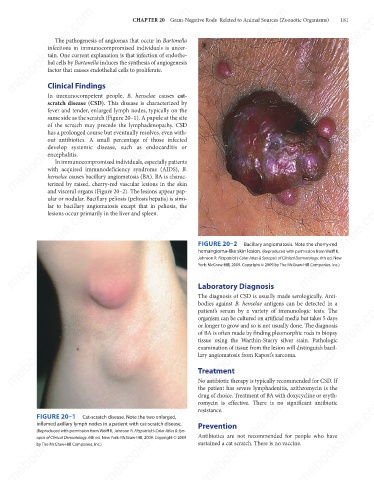
                        same side as the scratch (Figure 20–1). A papule at the site
                        of the scratch may precede the lymphadenopathy. CSD
                        has a prolonged course but eventually resolves, even with-
                        out antibiotics. A small percentage of those infected
                        develop systemic disease, such as endocarditis or
                        encephalitis.
                          In immunocompromised individuals, especially patients
                        with  acquired  immunodeficiency syndrome  (AIDS),  B.
                        henselae causes bacillary angiomatosis (BA). BA is charac-
                        terized by raised, cherry-red vascular lesions in the skin
                        and visceral organs (Figure 20–2). The lesions appear pap-
                        ular or nodular. Bacillary peliosis (peliosis hepatis) is simi-
 mebooksfree.com  mebooksfree.com           mebooksfree.com              FIGURE 20–2    Bacillary angiomatosis. Note the cherry-red        mebooksfree.com
                                                                            mebooksfree.com
                                                                                                            mebooksfree.com
                        lar to bacillary angiomatosis except that in peliosis, the
                        lesions occur primarily in the liver and spleen.


                                                                         hemangioma-like skin lesion. (Reproduced with permission from Wolff K,
                                                                         Johnson R. Fitzpatrick’s Color Atlas & Synopsis of Clinical Dermatology. 6th ed. New
                                                                         York: McGraw-Hill, 2009. Copyright © 2009 by The McGraw-Hill Companies, Inc.)


                                                                         Laboratory Diagnosis
                                                                         The diagnosis of CSD is usually made serologically. Anti-
 mebooksfree.com  mebooksfree.com           mebooksfree.com              or longer to grow and so is not usually done. The diagnosis       mebooksfree.com
                                                                            mebooksfree.com
                                                                                                            mebooksfree.com
                                                                         bodies against  B. henselae antigens can be detected in a
                                                                         patient’s serum by a variety of immunologic tests. The
                                                                         organism can be cultured on artificial media but takes 5 days
                                                                         of BA is often made by finding pleomorphic rods in biopsy
                                                                         tissue using the Warthin-Starry silver stain. Pathologic
                                                                         examination of tissue from the lesion will distinguish bacil-
                                                                         lary angiomatosis from Kaposi’s sarcoma.

                                                                         Treatment
                                                                         No antibiotic therapy is typically recommended for CSD. If
                                                                         the patient has severe lymphadenitis, azithromycin is the
                                                                         drug of choice. Treatment of BA with doxycycline or eryth-
 mebooksfree.com  mebooksfree.com           mebooksfree.com              Prevention                         mebooksfree.com                mebooksfree.com
                                                                            mebooksfree.com
                                                                         romycin is effective. There is no significant antibiotic
                                                                         resistance.
                    FIGURE 20–1
                                   Cat-scratch disease. Note the two enlarged,
                    inflamed axillary lymph nodes in a patient with cat-scratch disease.
                    (Reproduced with permission from Wolff K, Johnson R. Fitzpatrick’s Color Atlas & Syn-
                                                                         Antibiotics are not recommended for people who have
                    opsis of Clinical Dermatology. 6th ed. New York: McGraw-Hill, 2009. Copyright © 2009
                                                                         sustained a cat scratch. There is no vaccine.
                    by The McGraw-Hill Companies, Inc.)


 mebooksfree.com  mebooksfree.com           mebooksfree.com                 mebooksfree.com                 mebooksfree.com                mebooksfree.com

